
Look at the rigging on the warship. A thin line runs from a mast to the hull. The next line begins somewhere else. Between them, the pen had to leave the paper, move to the new starting point and land again. How did a machine built around 1800 know where to put it down?
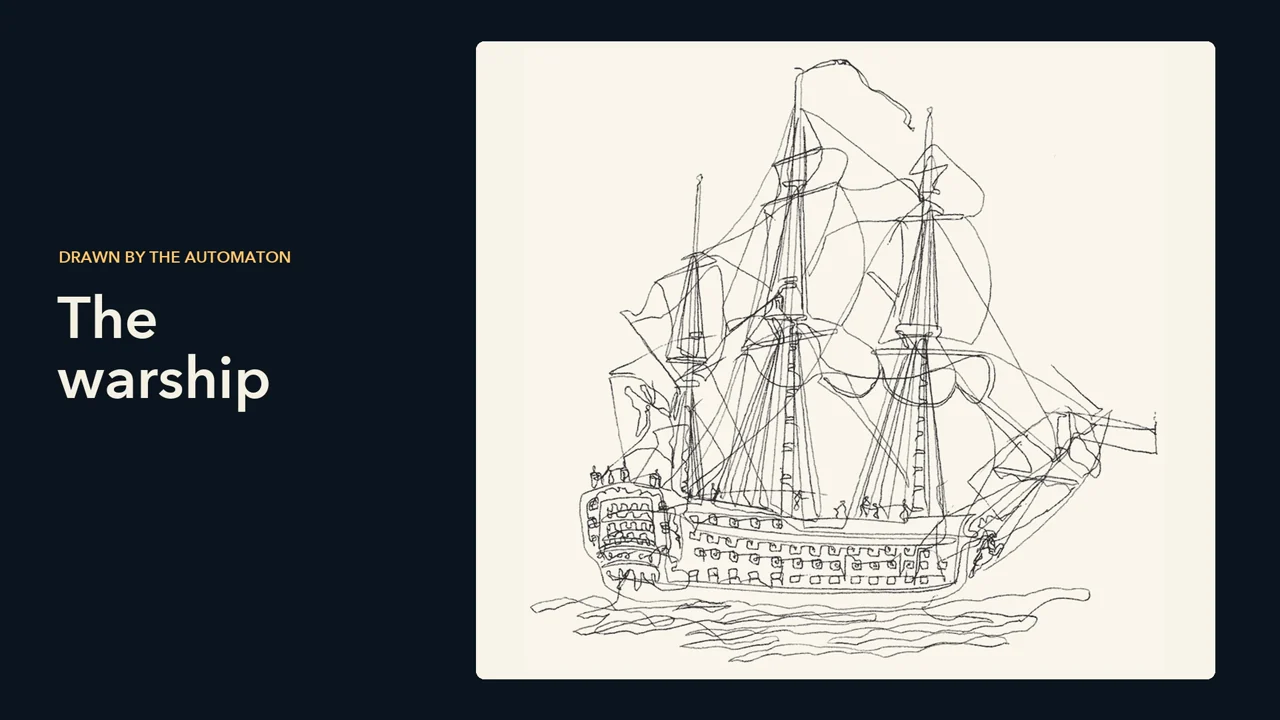
The warship drawn by Maillardet’s automaton. The fine lines of the rigging make the starting and stopping points easy to see.
The ship is one of four pictures made by Maillardet’s automaton, now at The Franklin Institute in Philadelphia. Its instructions are in the uneven edges of brass discs. As the discs turn, levers follow those edges and carry their movement up to the hand.
Even the gap in an equals sign needs instructions
The episode starts with two short strokes. The green linkage moves the pen sideways to draw the first. At the end of the line, the amber linkage lifts the pen and the blue linkage moves it toward the second line. The pen comes down at the new starting point, and the green linkage brings it back across. A little ink in the gap would give away a mistimed lift.
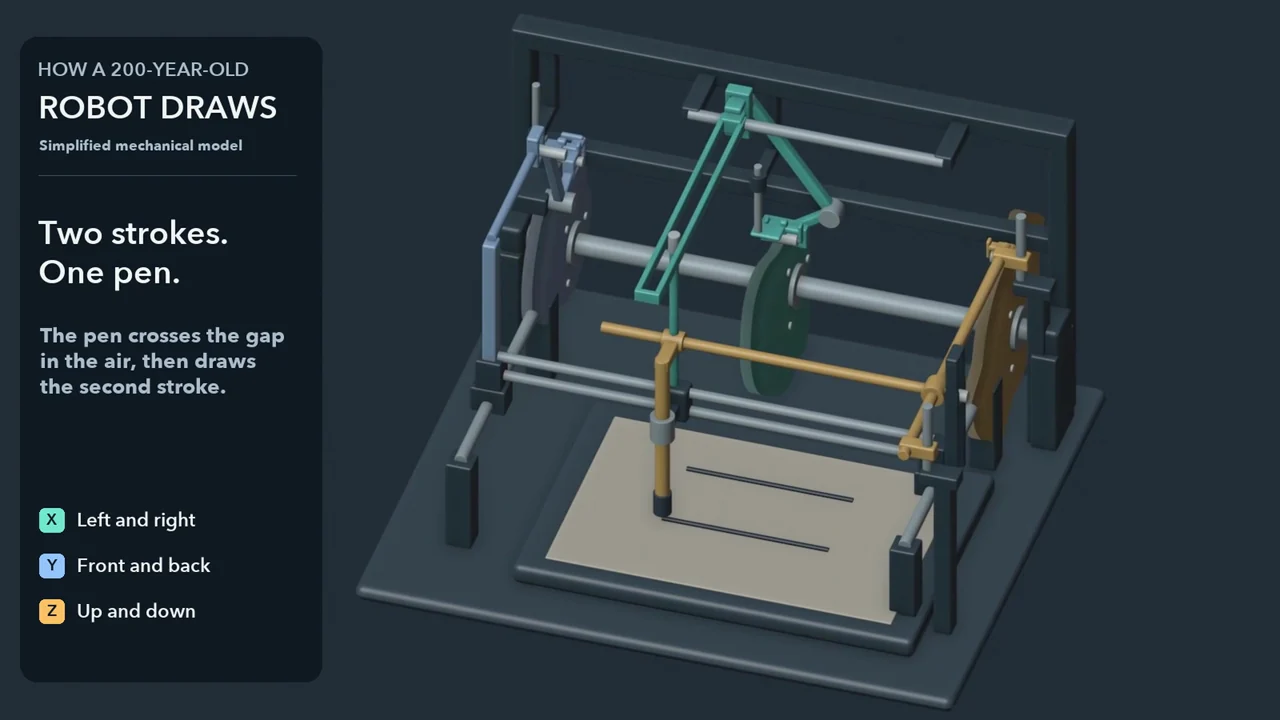
The episode’s teaching model. Green moves the pen sideways, blue moves it front to back, and amber lifts it off the paper.
Look at what supplies each motion. A lever called a follower rides against the edge of a turning cam. The distance from the shaft to the edge changes as the cam turns. The follower moves in response, and a linkage carries that motion to the pen. Three cams share a shaft, so every angle of rotation gives the pen a sideways position, a front-to-back position and a height. The three profiles have to agree at the instant the tip touches down.
One turn draws a sailboat
On the sailboat, follow the curved bottom of the hull. The pen travels sideways and front to back at the same time. The two movements change together to trace the curve. Then the pen lifts and travels to the foot of the mast. Each journey through the air ends exactly where the next ink line begins.
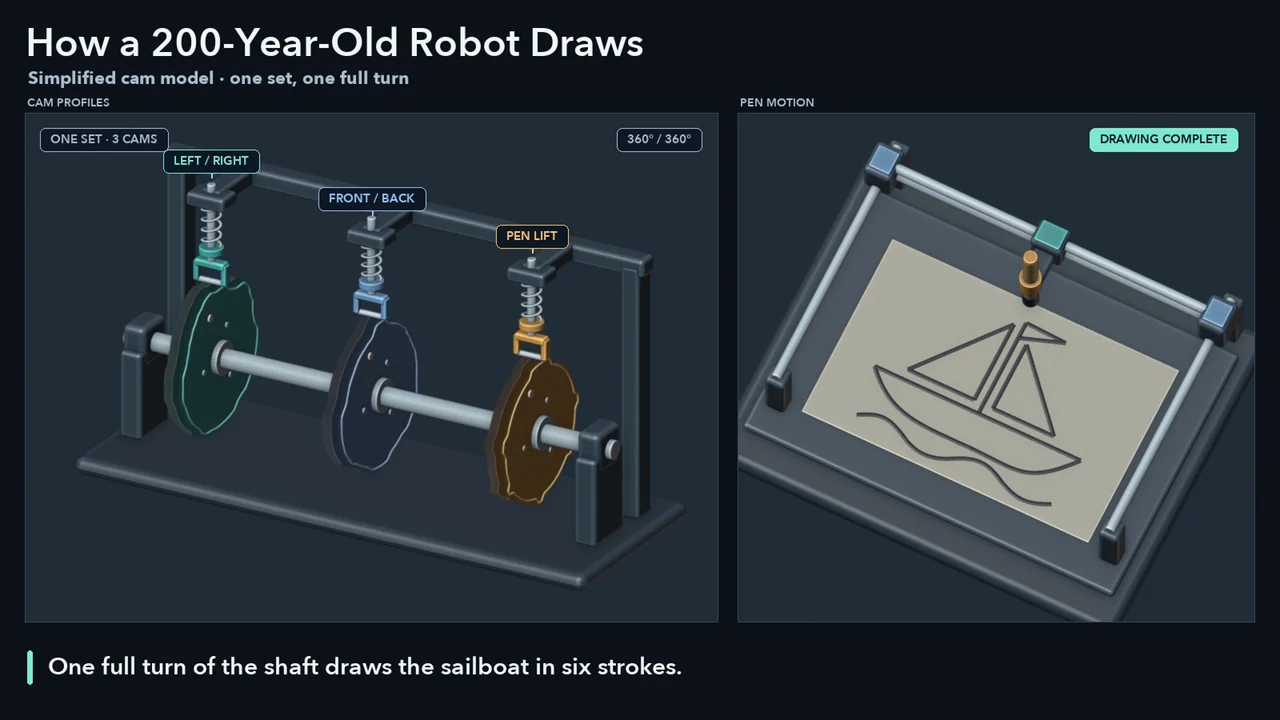
One turn of the shaft completes this six-stroke sailboat in the model.
A full turn of the shaft takes the model through the hull, mast, sails, pennant and waterline. That one turn includes every mark and every trip across blank paper.
How a drawing becomes a cam
To see where a cam profile can come from, run the idea in reverse. The demonstration moves the pen by hand. The same linkages now move three scribes while three blank brass discs turn at a steady speed. Each scribe records one part of the movement. If it stays the same distance from the centre, its mark follows a circular arc. When it moves inward or outward, the radius of the mark changes.
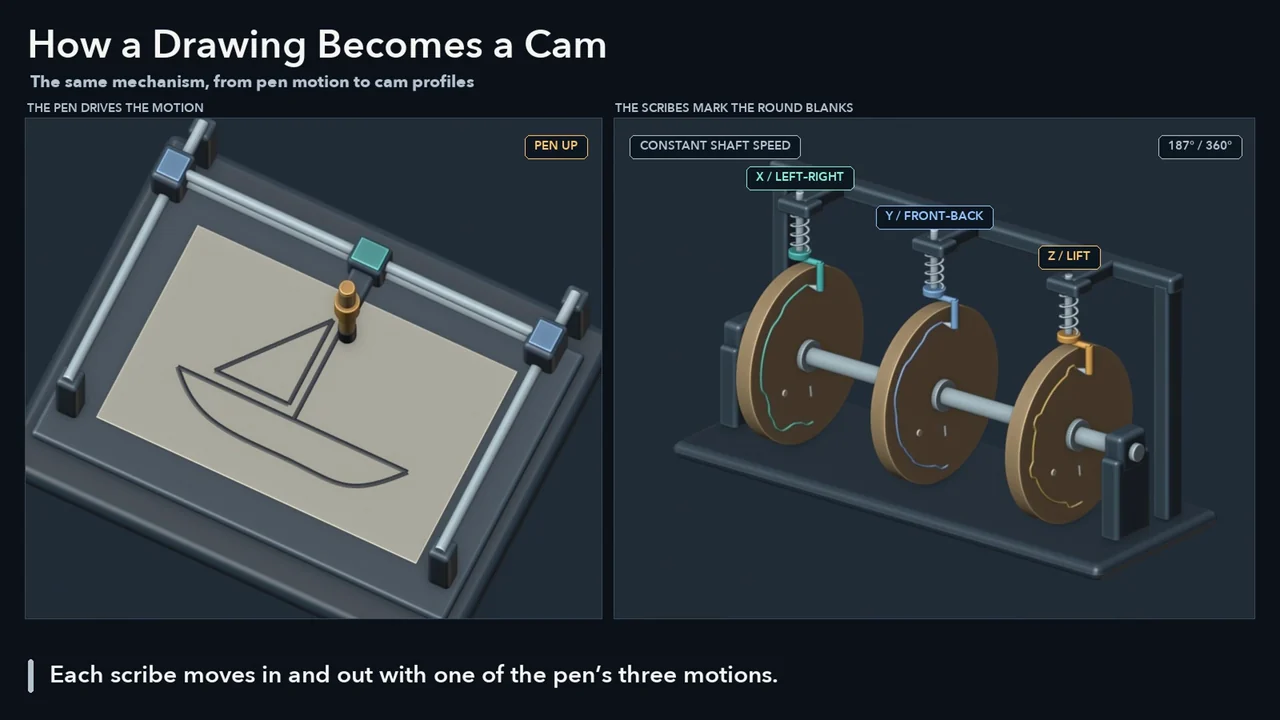
In the demonstration, the pen drives the scribes. A fixed distance from the centre traces a circular arc on a turning blank.
After one revolution, each disc has an outline. In the model, the maker saws on the waste side of the line and files the brass back to the working edge. Reinstall the three discs in step and their profiles can drive the pen through the recorded moves. The tracing and cutting sequence is a reconstruction for this episode.
How the real machine changes cam sets
The warship takes four rotations, each with a different trio of cams. At the end of a rotation the real machine pauses. The three followers rise clear of the brass edges. The cam bank slides sideways until the next three discs line up under them. The followers settle onto the new set and the hand continues the picture.
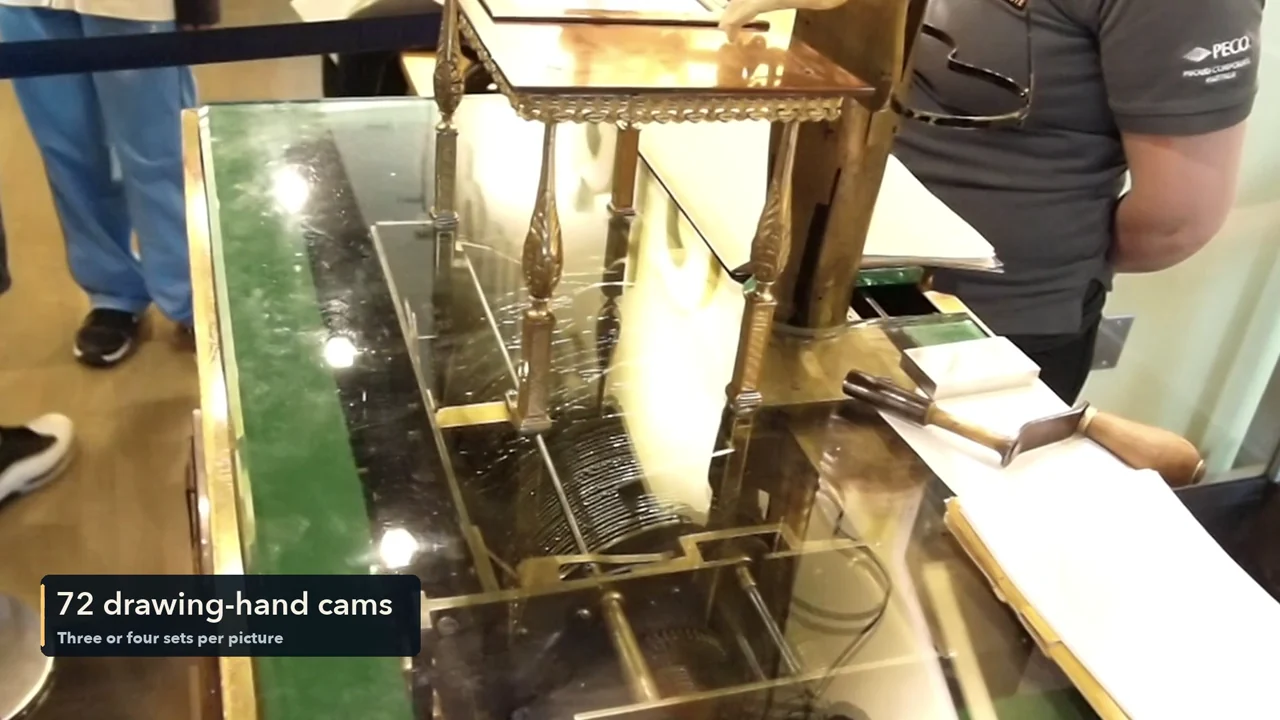
The drawing mechanism occupies the cabinet beneath the figure. Frame from footage by Z22, CC BY-SA 4.0, cropped and colour-adjusted in the episode.
The cabinet holds 72 cams for the drawing and writing hand, enough for four pictures and three poems. A spring drive rotates the discs and a separate spring drive shifts the bank. Each drawing uses three or four trios. The little sailboat fits on one because it makes do with six strokes.
The machine signs its work
When the damaged automaton reached The Franklin Institute in 1928, its maker was uncertain. After repairs, it worked through its repertoire. Along the lower border of the final poem it wrote Écrit par l’Automate de Maillardet, or “Written by the Automaton of Maillardet.” The words gave the museum a clue to the identity of the machine that had just written them.
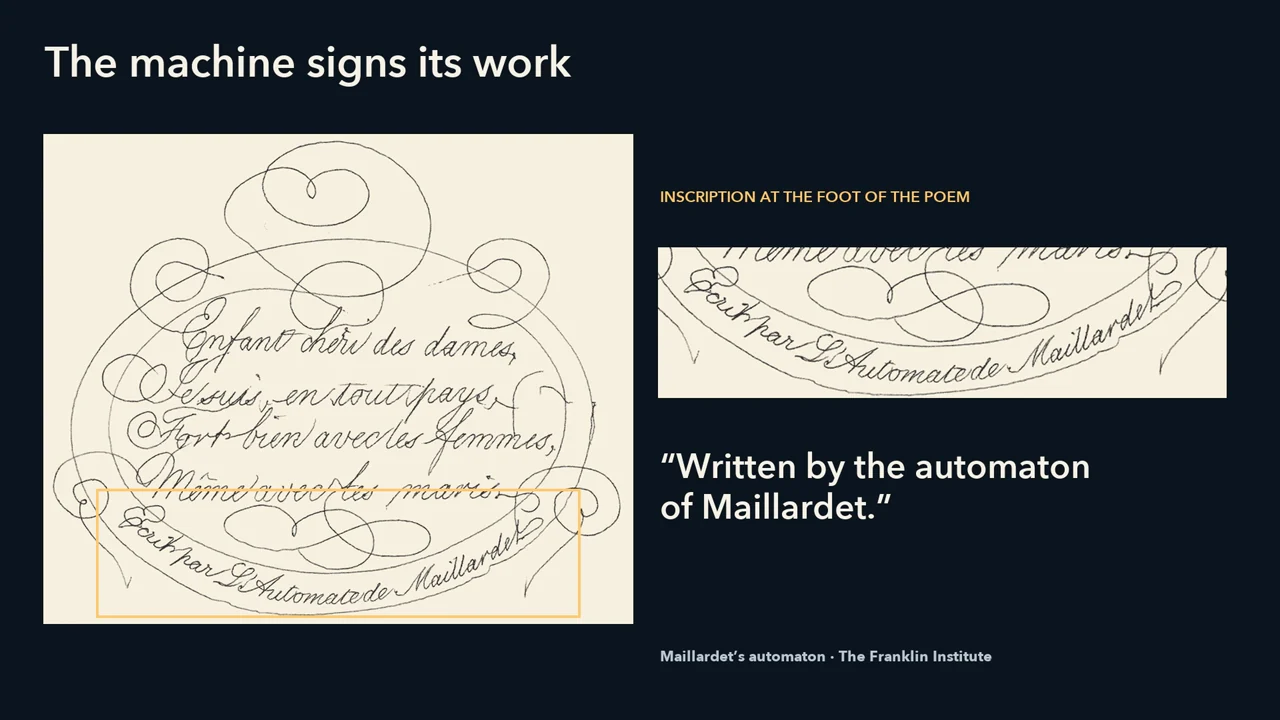
The final French poem and a detail of the inscription along its lower border. The Franklin Institute reproduction.
The Jacquard loom advances a card for each pass of weft. A key duplicator follows one continuous edge as it copies a shape. Maillardet’s automaton reads three edges in step. The same turning shaft tells the pen both where to go and when to leave the paper.
Watch the cams move the pen
01:17 · Three cams and one pen · 01:39 · One turn draws a sailboat · 03:15 · How the real machine changes cam sets.
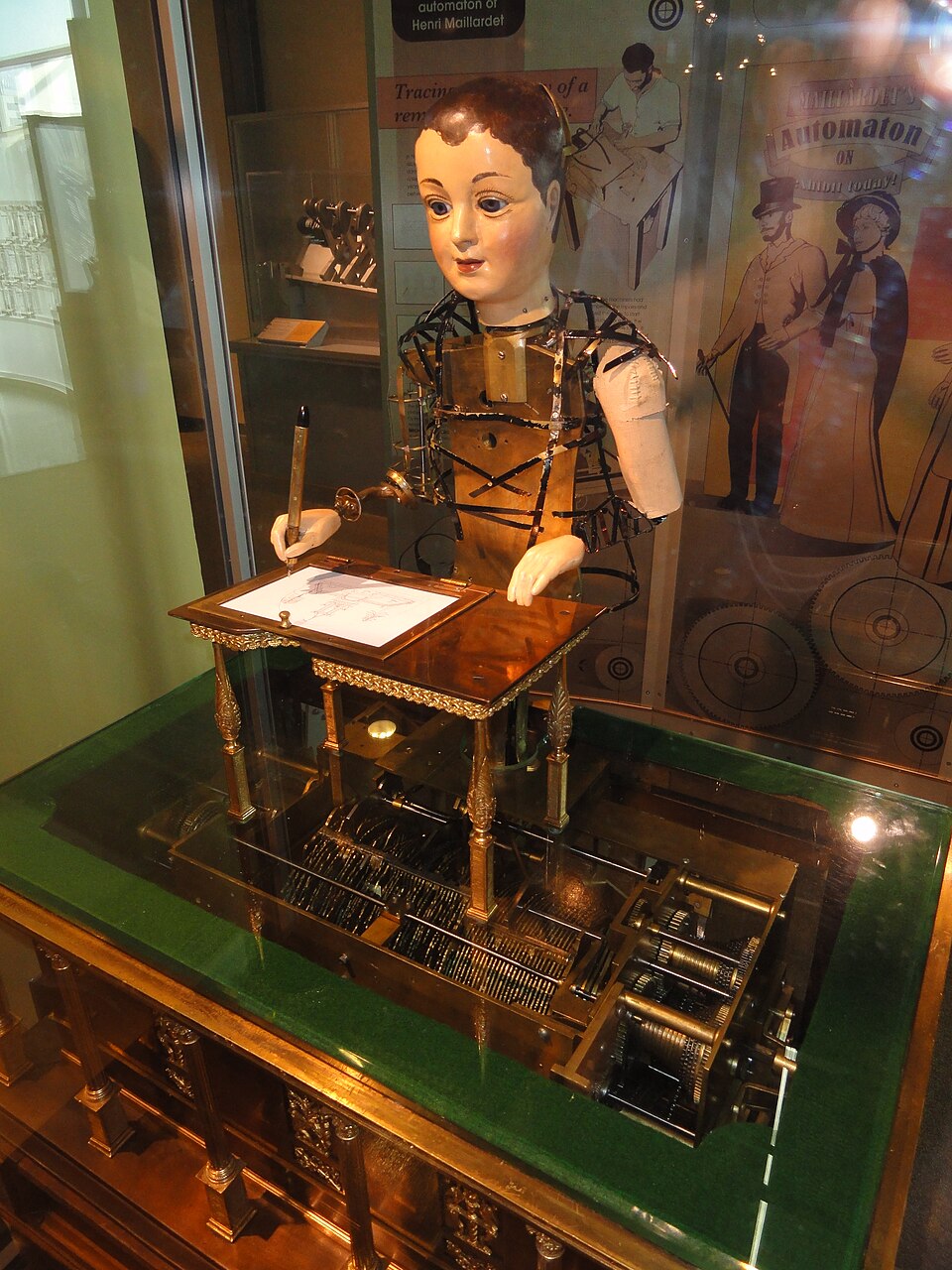 Maillardet's automaton
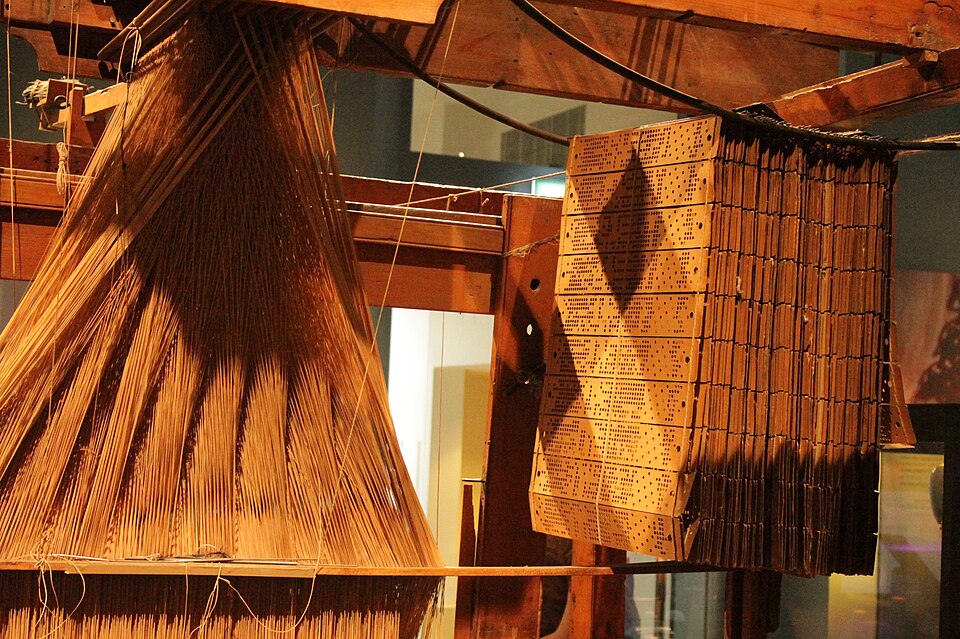 Jacquard Mechanism
COMMENTS (0)
Please Login to join the discussion.