
Falcon’s Loom
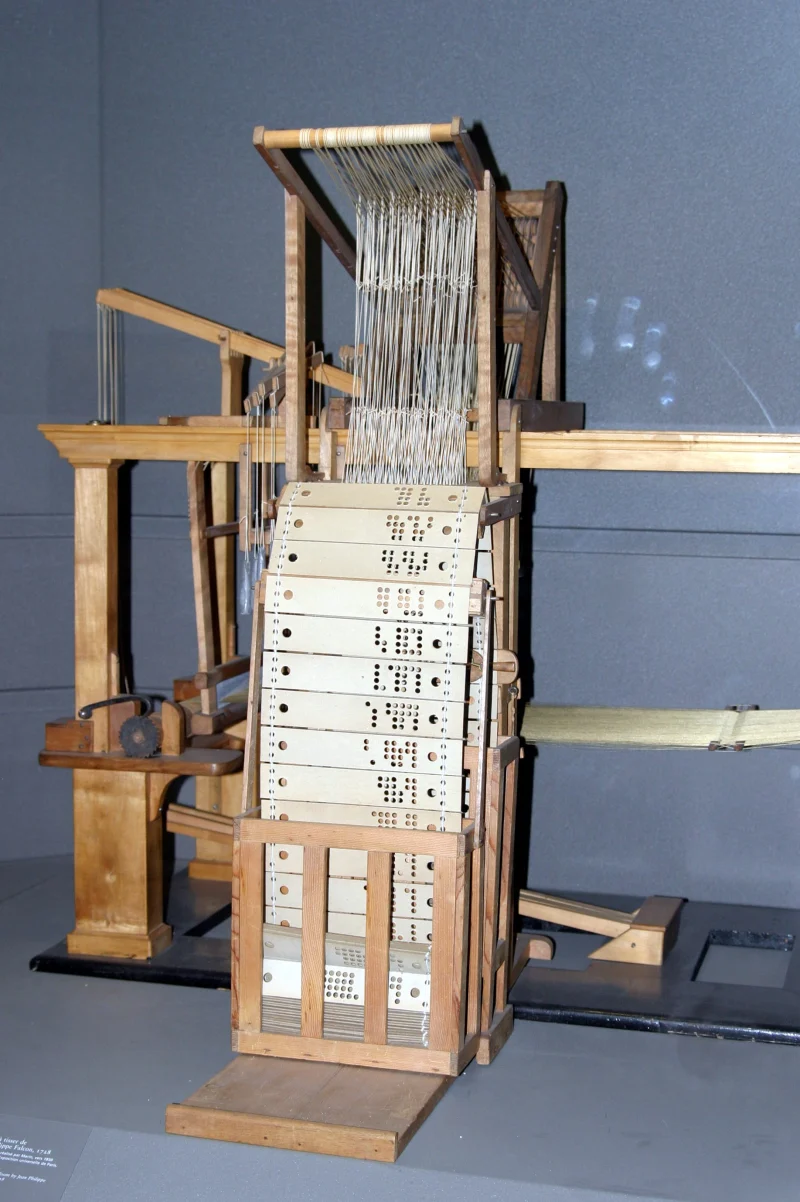
In 1728, Jean-Baptiste Falcon used a loop of laced, perforated cards to control the patterned harness of a loom. The cards held the sequence of warp selections. An assistant still presented them to the reader, one at a time. What...
About this artifact
In 1728, Jean-Baptiste Falcon used a loop of laced, perforated cards to control the patterned harness of a loom. The cards held the sequence of warp selections. An assistant still presented them to the reader, one at a time.
What the operator did on a drawloom
In a European drawloom workshop, a helper pulled selected cords in the pattern harness at each pick. Those cords raised the required warp ends. The weaver passed the shuttle through the opening and beat the new weft into place. A long repeat required the correct cords to be selected at every step, in time with the weaver.
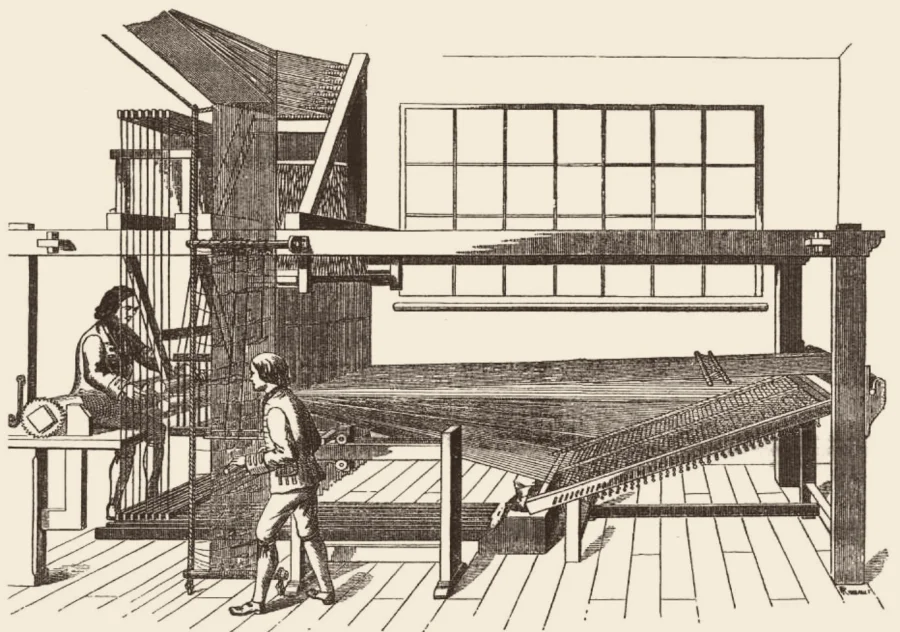
A French drawloom in Alfred Barlow’s The History and Principles of Weaving by Hand and by Power (1878). The helper works above the woven cloth.
How the cards took over the selection
Basile Bouchon had used a perforated paper strip in 1725. Falcon used individual punched cards laced into an endless chain. At each step, a card was presented to a bank of horizontal wires. Open and solid positions produced different responses, selecting the links that controlled the rear pattern harness. The weaver then passed the shuttle and the helper advanced the chain.
The card chain gave the instructions a form the workshop could handle separately from the loom’s cords. With a compatible harness setup, the workshop could exchange the chain for another design. As long as the cards stayed correctly laced and in register, the same sequence of selections would return when the loop came around.
What survives
Look at the museum model’s broad strip of card stock descending beneath the wires. Each horizontal edge is a joint between two cards. The loop follows the loom frame, closely spaced holes occupy the sensing field, and the links above it carry the selection into the harness. The photograph shows the model made by Marin for the 1855 Paris exhibition, now in the Musée des Arts et Métiers in Paris, inventory 6234-1. The Science Museum Group holds a separate model, object 1963-379.
Falcon’s design shows a stage between manual cord selection and the Jacquard head. The assistant still kept the machine in step by presenting each card. Later Jacquard mechanisms incorporated the advancement and presentation of the chain into the loom’s operating cycle, allowing one weaver to run a figured handloom.
Drawing credit
The drawloom engraving is from Alfred Barlow’s 1878 weaving manual, public domain. The cropped reproduction comes from the Landmark Trust’s Princelet Street History Album.
Sources & image credits
Conservatoire national des arts et métiers · Textile catalogue, figure 34 and inventory no. 6234 ↗
Musée des Arts et Métiers · Falcon’s loom and automatic weaving ↗
Musée d’Histoire de Lyon · The development of the Jacquard mechanism ↗
Marin’s model of Falcon’s loom, 1855, Musée des Arts et Métiers, inventory 6234-1. Resized for the web.
Image: Métier Falcon CNAM-IMG 0526.jpg
Creator: Rama
License: CC BY-SA 2.0 France
Read the story behind this mechanism
- Programmed Before Computers
- Page 1 · How the Jacquard Loom Works →
See how a laced chain moved warp selections onto cards in 1728.
- Page 1 · How the Jacquard Loom Works →
COMMENTS (0)
Please Login to join the discussion.