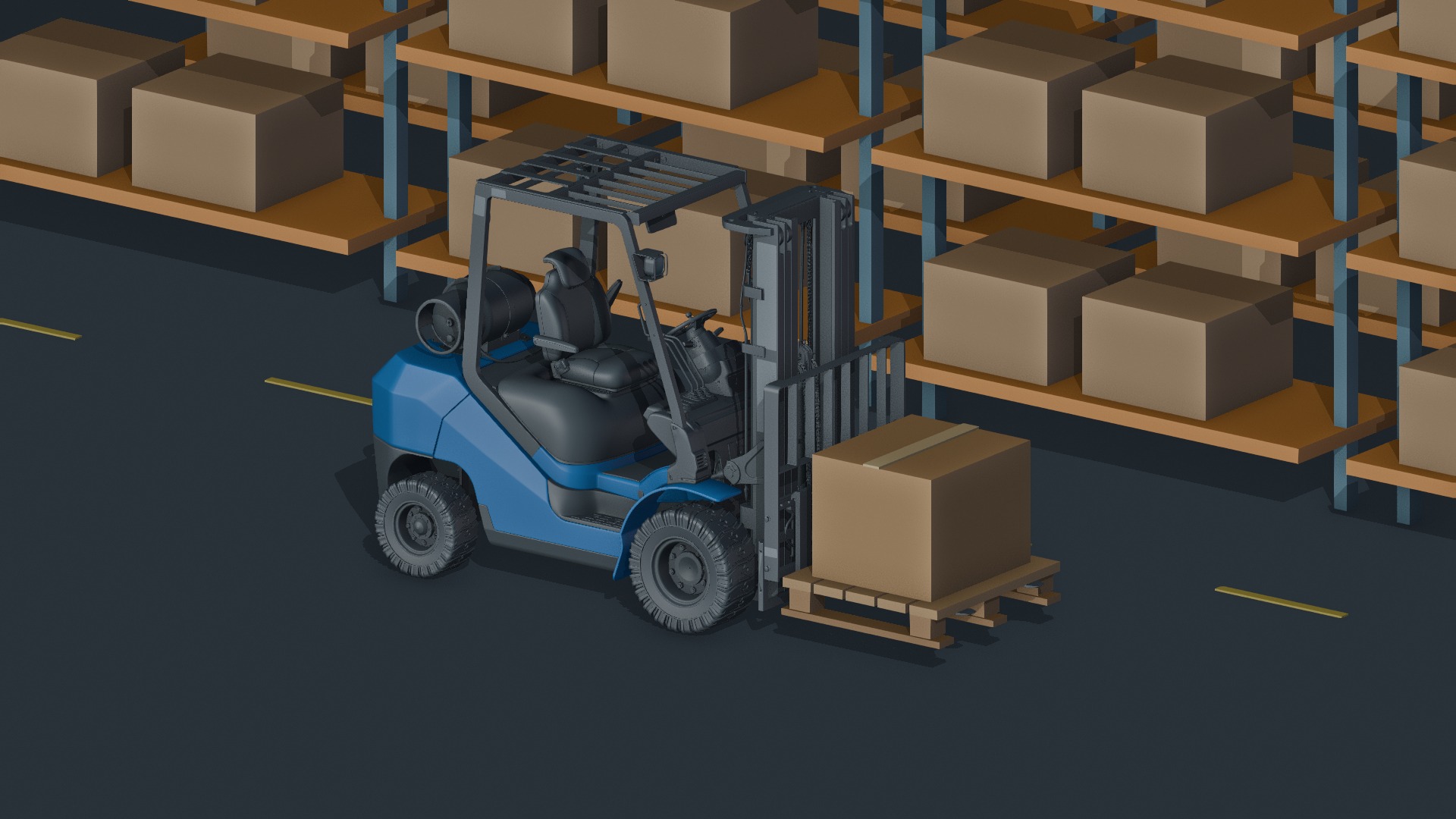
A compact vehicle built around a load
A forklift combines two jobs that are easy to underestimate: travelling through a workplace and positioning a heavy load accurately. Unlike a truck carrying goods on a platform between its axles, a common counterbalanced forklift supports its load ahead of the front wheels. That arrangement gives excellent access to pallets and racks, but it makes the relationship between load position and vehicle balance central to the design. The forks are only the visible contact point. Behind them lies an integrated system of structure, hydraulic power, guidance, traction, steering, and control.
Forklifts appear in factories, warehouses, ports, building supply yards, and many other settings because standardised unit loads allow one movement to replace repeated individual handling. A pallet connects the vehicle to this wider system. Its openings must accept the forks, its structure must support the goods, and its dimensions must suit storage and transport equipment. The forklift's influence therefore extends beyond the vehicle itself. It helps determine aisle layouts, rack arrangements, loading interfaces, packaging methods, and the sequence in which goods pass through a facility.
Balance is a matter of moments
In the familiar counterbalanced layout, the front axle provides an important reference for understanding forward tipping. The load creates a turning effect related to its weight and its horizontal distance from that reference. The mass of the truck behind it provides an opposing effect. A heavier load is not the only way to increase the demand: moving an unchanged load farther forward also increases its moment. This is why the position of the load's centre of gravity matters, and why the same truck cannot be described adequately by one weight number alone.
The real vehicle also has to remain stable sideways and during movement. Its effective support geometry, tyre behaviour, axle arrangement, and combined centre of gravity interact. A raised load changes the position of the combined centre of gravity, while acceleration, braking, turning, and floor irregularities introduce dynamic effects. These are physical explanations of the design problem, not a substitute for the particular machine's operating limits. Manufacturers describe capacity for specified configurations because mast height, attachments, load geometry, and other details change the relationship between a nominal load and the complete vehicle.
The mast guides rather than merely lifts
The mast is a guided structure that keeps the fork carriage moving along a controlled path. Nested sections allow a useful lift height without requiring the whole assembly to remain equally tall when lowered. Rollers or comparable guiding elements transfer loads between carriage and rails while permitting movement. The structure must resist bending and twisting as well as vertical force. Clearance is necessary for motion, but excessive movement would reduce precision and increase wear. Mast design consequently balances strength, compactness, visibility, and the smoothness of repeated loaded cycles.
Hydraulic cylinders and chains coordinate the movement of the mast and carriage in many designs. Pressurised oil acts on a piston, producing force that moves a cylinder element. Depending on the arrangement, chains passing over sheaves relate that movement to the travel of the carriage or another mast section. The chain is not simply a substitute for a crane cable; it belongs to a guided geometry. Toyota's explanation of mast chains identifies their role alongside the hydraulic lift cylinders. Particular reeving arrangements vary, so the visible movement should be understood through the specific mechanism rather than one universal diagram.
Hydraulic power turns a command into force
A hydraulic system transmits energy through fluid flow and pressure. The pump supplies flow, while pressure develops in response to resistance and the circuit's controls. A valve directs flow to the required function, and the cylinder converts fluid power into mechanical force. Lift, tilt, and attachment functions may use related parts of the system. Returning fluid completes the circuit through passages, a reservoir, and filtration. The operator's command therefore changes a controlled flow path rather than directly supplying the force needed to raise the load.
Cylinder size, flow rate, and load interact to determine behaviour. A larger effective piston area can produce more force at a given pressure, but requires more fluid for a given travel distance. Hydraulic power is not free leverage: producing more force while maintaining speed requires sufficient input power. Heat, leakage, friction, and flow restriction create losses. Controls must also manage lowering, where the load supplies gravitational energy. This makes smooth descent a distinct engineering problem from powered ascent. The circuit has to control movement predictably through the range of conditions for which it was designed.
Driving and steering in restricted spaces
Traction systems may use electric motors or combustion engines, with transmissions and controls suited to repeated short movements. An electric truck draws energy from a battery and uses power electronics to regulate its motors. A combustion truck may supply both travel and hydraulic functions through its engine and associated transmission. Neither layout can be judged by peak power alone. Frequent starts, low-speed positioning, standing time, charging or refuelling arrangements, and the working environment all affect whether a design suits its intended application.
Many counterbalanced forklifts steer with the rear wheels. This helps them turn tightly near a load-facing front end, but also means the rear of the vehicle sweeps outward during a turn. The operator must control a machine whose geometry differs from a familiar road car. Tyres also reflect the working environment: surfaces, debris, load, and desired ride behaviour influence the choice. Controls, seating, visibility, and the shape of the overhead structure are therefore functional parts of handling performance. Precise manoeuvring requires the driver to understand both the load's position and the space occupied by the complete vehicle.
Variations reveal the underlying purpose
A warehouse reach truck, an order picker, and a rough-terrain forklift solve related handling problems with different geometries. Reach mechanisms alter the relationship between the load and the supporting chassis. Narrow-aisle equipment changes how loads are approached. Attachments such as clamps or specialised carriers allow handling beyond ordinary pallets, while also altering the mass and position of the load-facing assembly. These differences explain why forklift is a family name rather than a description of one universal vehicle. The work defines the machine's useful configuration.
The most informative way to study a forklift is to follow both force and information. Force passes from the floor through tyres, chassis, mast, carriage, and forks into the load. Information passes from the task and surroundings to the operator, then through controls to motion, with feedback from the machine and its instruments. Maintenance keeps those relationships dependable as components wear. Seen this way, the forklift is neither a simple lifting lever nor merely a small truck. It is a mobile positioning system that made the pallet an organising unit of modern industry and logistics.