
How Wind Turbines Work
A rotor captures a moving resource
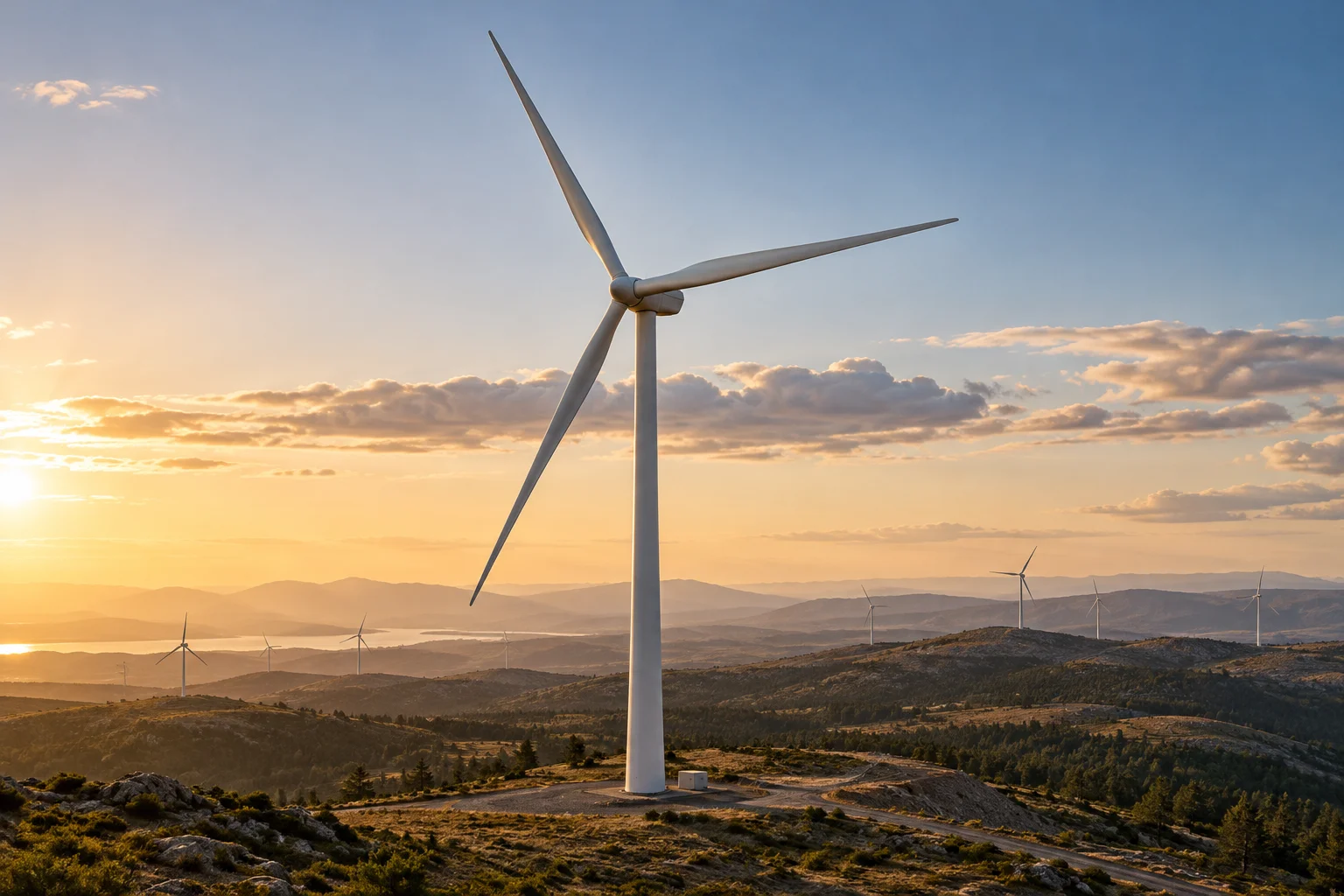
A wind turbine converts part of the kinetic energy carried by moving air into useful mechanical rotation and, usually, electricity. The familiar three bladed machine is an aerodynamic device rather than a wheel pushed only by direct impact. Air flowing around each blade creates forces with a component that turns the rotor. A shaft transfers that rotation into a drivetrain, while a generator and electrical equipment turn mechanical output into power suitable for its destination.
The wind is an energy flow through an area, not a store of fuel inside the turbine. Changing wind speed and air density alter the available resource. The rotor also changes the air passing through it, leaving a slower, turbulent wake. A turbine cannot remove all the wind's kinetic energy because air must continue moving away. This basic fact links the design of a single rotor to the spacing and performance of an entire wind farm.
Blades are rotating wings
A blade's local airflow combines the incoming wind with the movement of the blade itself. Near the tip, rotational speed is much greater than near the hub. Blade sections therefore change their shape, width, and angle along the span. This twist helps different regions interact usefully with their different relative flow conditions. The broad shape seen from a distance conceals a carefully varied aerodynamic structure.
Lift contributes useful torque, while drag and other losses reduce performance. Increasing the rotor's swept area lets the machine interact with more air, but also enlarges structural loads and transport challenges. The blade must resist bending and twisting while avoiding excessive mass. Composite construction, internal spars, bonding, surface quality, and protection from environmental damage all belong to the mechanism of energy capture rather than merely its appearance.
Loads travel down to the ground
Aerodynamic forces act on the blades and pass through the hub, main bearing, nacelle structure, tower, and foundation. Gravity adds changing loads as each blade rotates, and variable wind produces additional fluctuations. The structure must carry useful torque alongside bending forces that do not contribute to generation. Fatigue from repeated loading is consequently central to turbine engineering.
The tower places the rotor higher in the atmosphere, where conditions can be more favourable, but height brings structural and construction demands. Its flexibility also interacts with the rotor and drivetrain. Offshore foundations face seabed and marine conditions, while floating systems add platform motion and mooring behaviour. A successful turbine is therefore an aerodynamic, structural, electrical, and civil engineering system joined through a common load path.
From slow rotation to electrical output
Many turbine drivetrains use a gearbox to increase the relatively slow rotor speed before it reaches the generator. Gear stages transmit torque through meshing teeth and bearings, which require lubrication, alignment, and thermal management. Other designs use direct drive generators, avoiding a conventional speed increasing gearbox while making different compromises in generator size, mass, materials, and structure.
There is no single universally superior architecture. A gearbox allows one combination of generator speed and package size; direct drive offers another arrangement of components and maintenance considerations. Some designs sit between these descriptions with different transmission ratios and generator concepts. The useful comparison concerns the whole installation over its intended life, including reliability, service access, manufacturing, and transport, rather than the presence or absence of one component alone.
Steering and regulating the rotor
A yaw system turns the nacelle of a typical horizontal axis turbine to face the wind direction. Blade pitch systems rotate the blades around their own lengthwise axes, changing their aerodynamic interaction with the air. These motions perform different jobs: yaw establishes the rotor's overall orientation, while pitch helps regulate aerodynamic power and loading as conditions change.
Below the region of maximum intended output, control may seek efficient energy capture through a suitable relationship between rotor speed and wind. At higher available wind power, the goal changes toward limiting output and loads. Sensors and controllers coordinate rotor motion, pitch, generator torque, and other systems. These are conceptual functions, not a single operating recipe; particular turbines have their own control architectures and defined operating envelopes.
The electricity passes through another system
The generator converts shaft power through electromagnetic interaction. Depending on the design, power electronics process some or all of its electrical output before connection to the network. Transformers adapt voltage for collection and transmission. Cables, switching equipment, protective systems, and communication links complete the path from an individual nacelle to the wider electricity system.
Wind variation means electrical output is variable even when the machine is healthy. Forecasting, geographic diversity, network capacity, other generation, demand flexibility, and storage can all influence how this resource fits into an energy system. Those questions are distinct from whether the blades turn efficiently, yet they determine the practical value of the generated power. The wind turbine's mechanical story continues well beyond its tower base.
A wind farm is more than repeated turbines
A turbine wake reduces and disturbs the wind reaching machines downstream. Farm layout therefore balances terrain, prevailing conditions, access, electrical collection, and interactions between rotors. Simply packing more machines into the same site may not produce the expected increase in energy. Modelling and measurements help estimate how the installation behaves across a range of winds rather than one idealised direction.
Maintenance planning is similarly shaped by location. A component inside an offshore nacelle can be much harder to reach than an equivalent part in a factory. Condition monitoring may use vibration, temperature, oil information, and performance comparisons to detect changes. Accessible design, replaceable modules, and service logistics matter because downtime and difficult repairs can outweigh a small improvement in ideal aerodynamic efficiency.
Development through connected engineering
Wind powered machinery long predates electricity generation. Modern turbines combine that basic idea with aerodynamic analysis, lightweight structures, electrical conversion, automated control, and large scale manufacturing. Growth in size has required advances in foundations, lifting equipment, blade production, transportation, and grid connections. The visible rotor is the most recognisable component of an extensive industrial chain.
A useful way to understand the machine is to follow both energy and load. Wind becomes rotor torque, shaft power, and electrical output; unwanted forces travel through bearings and structure into the ground. Controls continually mediate between capture and restraint. The result is a machine whose achievement lies not in resisting nature completely, but in obtaining useful work while accommodating a resource that changes from moment to moment.
Sound and visual presence also influence the engineering context. Blade tip motion, airflow disturbances, mechanical sources, and the placement of equipment can affect how an installation interacts with its surroundings. These considerations join wildlife studies, access routes, and land or marine use in project development. They do not replace energy and structural calculations, but broaden the design task. A successful turbine must function as a machine and as part of a particular place. Its overall performance is therefore assessed through energy production, serviceability, reliability, and the conditions of the surrounding environment, rather than rotor diameter alone.