
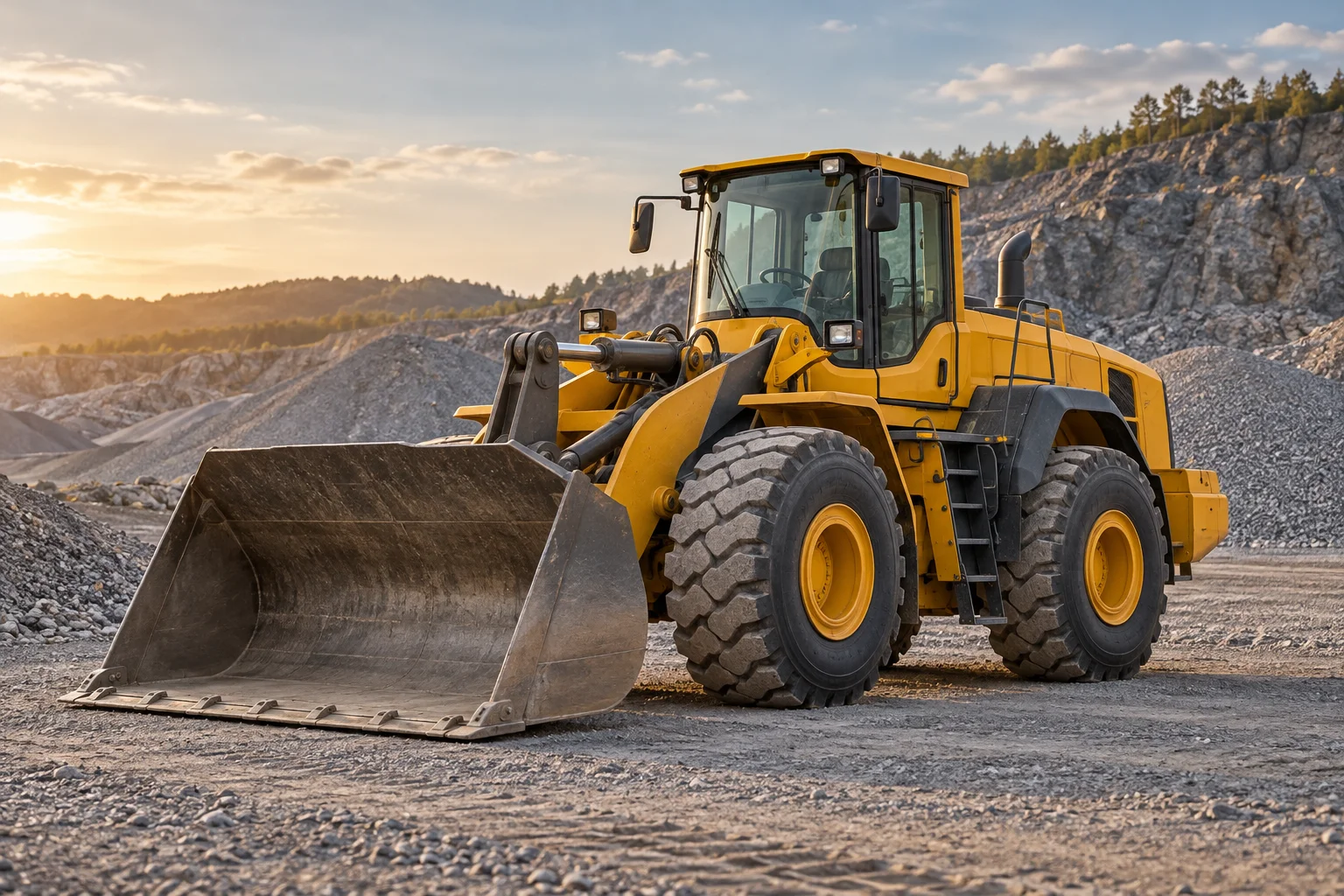
How Wheel Loaders Gather, Carry, and Place Material
A vehicle designed around the bucket
A wheel loader combines a mobile vehicle with a front mounted lifting mechanism. Its characteristic job is to enter a pile, gather loose material, carry it a short distance, and discharge it into another container or process. That cycle appears simple because the machine brings traction, steering, lifting, and bucket rotation together. Unlike an excavator that usually works from a relatively fixed base, the loader uses movement of the whole vehicle as part of the loading action. The bucket is therefore not merely an attachment carried by a tractor. It determines the vehicle's load distribution, visibility, structural proportions, and the way power must be shared during work.
Two paths for power
The source of power may drive both the wheels and a hydraulic system. Conventional machines commonly use a diesel engine with a transmission, axles, and final drives, while other designs use hydrostatic, electric, or combined arrangements. The lifting arms and bucket normally remain hydraulically actuated. During pile entry the machine may need substantial wheel torque and hydraulic force at the same time. More engine power does not guarantee more useful loading if tires lose grip or the hydraulic functions cannot cooperate. Designers must balance torque delivery, pumping losses, cooling, and response so that the machine can work against a pile without turning most of its input energy into heat or tire slip.
Articulated steering
Many wheel loaders steer by bending at a joint between front and rear frames. Hydraulic steering cylinders change that angle, causing the two halves of the vehicle to follow curved paths. This arrangement permits large tires and strong axle structures without requiring the front wheels themselves to achieve extreme steering angles. It also changes the location of the front working equipment relative to the rear counterweight and support footprint. The articulation joint carries repeated structural loads in addition to providing a steering axis. Hoses, wiring, driveshafts, and other services must cross or accommodate the joint, making it both a useful packaging solution and a mechanically demanding region of the machine.
Lifting and curling
The loader arms raise the bucket while a separate linkage controls its angle. In common arrangements the linkage converts cylinder extension into bucket rotation with mechanical advantage that varies as the arms move. Some linkages emphasize breakout force, while others favor parallel motion or versatility with forks and other tools. Raising a load also moves its center of gravity, changing the moments acting on the machine. A bucket that stays approximately level during a lift reduces unwanted spillage, but the exact motion depends on the linkage and any control system fitted. Watching the pins and cylinders reveals why apparently similar loaders may behave differently when handling the same type of load.
Entering the pile
When the bucket enters loose material, vehicle traction pushes the cutting edge forward while lift and curl movements help material flow into the bucket. The resistance depends on particle size, compaction, moisture, pile shape, and the cutting edge. Filling the bucket is not equivalent to pushing the vehicle as hard as possible. Excessive wheel slip wastes energy and damages surfaces, while a poorly chosen path can leave material compacted against the bucket rather than inside it. Reaction forces travel through the arms and front frame into the tires and ground. The pile is therefore an active part of the machine's working system, not a passive supply of identical bucket loads.
Tires and the carried load
Large pneumatic tires provide traction and accommodate surface irregularities, but they also deform under load. Their stiffness affects ride, stability, and the way the bucket moves relative to the ground. A carried load changes axle loading and places demands on the frame, brakes, and steering system. Loose ground, slopes, travel speed, and load height all influence the resulting dynamics. The rear mass helps balance the front load, yet a counterweight is not an unlimited remedy for unfavorable geometry. Machine ratings apply to defined configurations and conditions. From an engineering perspective, the loader is a moving load carrying system whose behavior cannot be reduced to the mass of material in its bucket.
The short cycle
A loader's repeated cycle often includes gathering material, reversing clear, turning, approaching a receiving point, raising and tipping, and returning. Because these movements happen frequently, small delays or losses can accumulate across a shift. Transmission response, hydraulic coordination, visibility, and braking all influence the cycle. The receiving equipment matters too: a high sided truck imposes different reach and lift requirements from a low hopper. Bucket capacity is only one part of the relationship between material density and machine capability. A larger bucket carrying lightweight material may be appropriate where the same bucket filled with dense rock would not be. Matching geometry and material is fundamental to understanding loader performance.
Beyond earthmoving
Replacing the bucket with forks, a grapple, or another compatible attachment changes the task while retaining the mobile lifting platform. A quarry loader, agricultural loader, timber handling machine, and waste handling loader may share a recognizable form but differ substantially in guards, tires, cooling, linkages, and working equipment. Dust and debris influence filtration and access for cleaning. Abrasive material changes wear requirements. Long travel distances can shift the design balance toward transport efficiency rather than pure short cycle loading. These variations show why the wheel loader is a family of related solutions, with its configuration shaped by an entire work environment rather than by one universal ideal machine.
Efficiency and the longer development story
The wheel loader emerged from efforts to combine powered vehicles with loading mechanisms that previously demanded more separate equipment or labor. Its continuing development concerns how intelligently energy and motion are coordinated. Efficient hydraulics, driveline control, electric components, machine assistance, and improved material measurement can all contribute, but the benefits depend on the actual task. A useful way to observe a loader is to follow the whole path: energy becomes wheel force and cylinder force, those forces move material, and the vehicle then positions that material for another process. Its importance lies in connecting excavation, transport, storage, and production into a continuous flow.
The bucket is a measuring problem too
A bucket has a geometric volume, but the material it carries is not defined by volume alone. Voids between particles, moisture, how the material heaps, and whether part of the load spills all change the mass being transported. The position of that mass within the bucket changes the moment acting on the lift arms and vehicle. This explains the value of weighing systems that estimate payload from hydraulic pressure and machine geometry, while also showing why an estimate needs an appropriate model and calibration. Loading is therefore both a motion problem and an information problem. The machine has to gather a useful quantity, keep it contained during travel, and place it where the next process can accept it without unnecessary handling.