
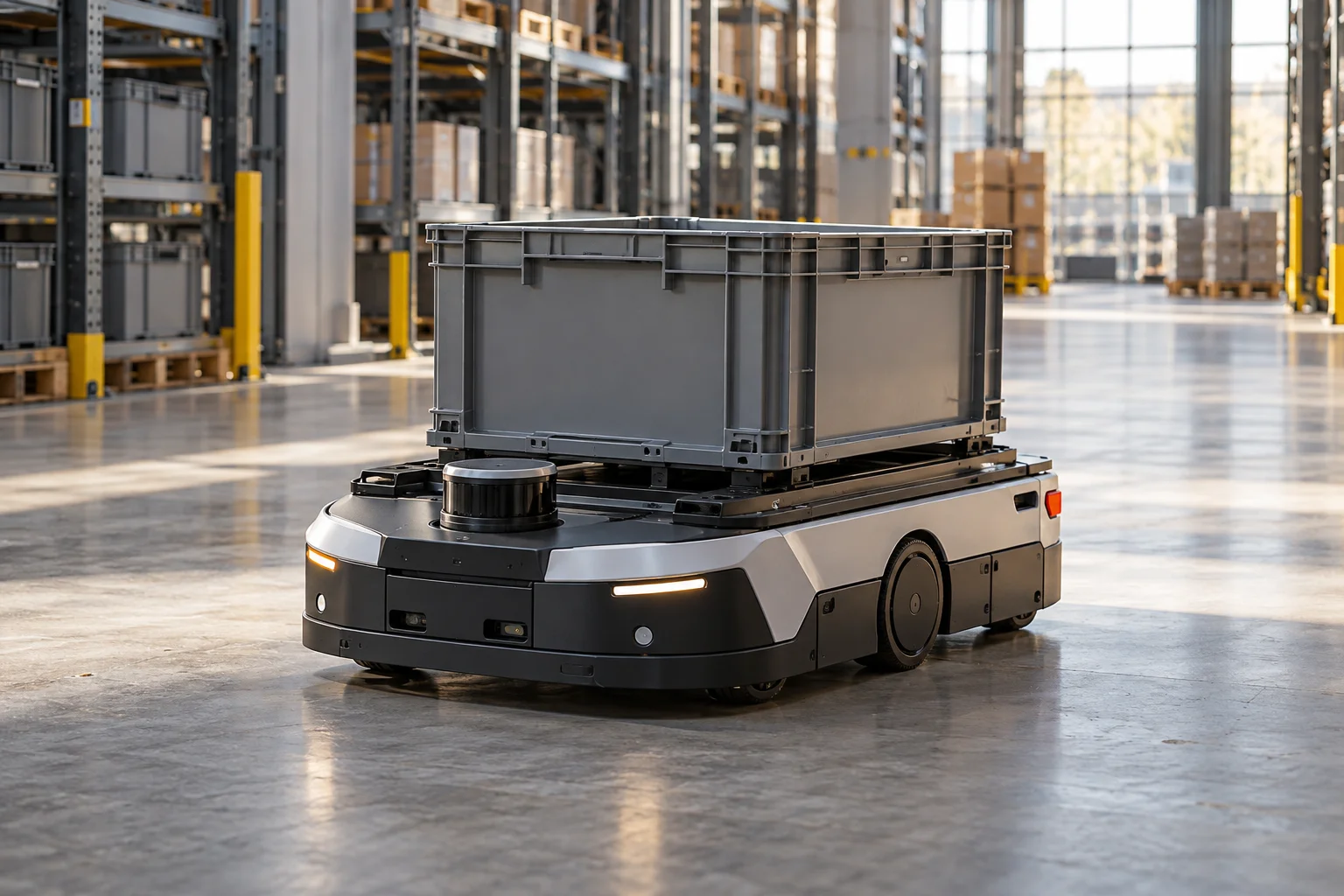
How Warehouse Robots Work
Automation takes several physical forms
Warehouse robots are machines that move or manipulate goods under automatic control within a storage and distribution system. Some carry shelves or totes, some transport pallets, and others pick individual items with an arm. A mobile platform and a stationary picking cell solve different problems even when both are called robots. Their shared purpose is to connect information about work with dependable physical action. The machine must know enough about its task, its own condition, and the relevant surroundings to produce a useful result repeatedly rather than merely perform an isolated movement.
It helps to distinguish transportation from manipulation. Carrying a standard container across a prepared floor can be much more predictable than grasping an unfamiliar object inside it. A warehouse may therefore automate travel while leaving selection to people, or use specialised picking systems for a limited range of goods. Different levels of automation can coexist. This directory treats warehouse robotics as a family of engineered arrangements, not a single machine destined to replace every task. The practical question is which movements and decisions can be made reliable within the actual operating environment.
A mobile base still obeys ordinary mechanics
A mobile robot needs a structure that supports its load, wheels or other running gear, motors, power transmission, brakes, and an energy supply. The load's position affects stability and wheel loading. Acceleration demands traction, while stopping requires the vehicle to dissipate kinetic energy through a controlled process. Floor joints, gradients, contamination, and wheel wear influence behaviour. Software cannot cancel these conditions. The platform must be mechanically suited to the load and route before navigation can make its movement productive.
Drive arrangements differ. A platform using independently driven wheels can turn by commanding different wheel speeds, while other designs use steered wheels or specialised wheel geometries. These choices influence turning space, positioning, efficiency, and floor contact. The payload interface is equally important. A robot might lift a support from beneath, carry a tote on a conveyor module, or tow a cart through a coupling. Each arrangement adds structural and control requirements. Moving the base to the correct position is only part of the task; transferring the load reliably completes the useful action.
Navigation requires several connected estimates
Navigation begins with representing the environment and estimating the robot's position within it. Systems may follow prepared guidance features, use installed markers, or interpret natural features detected by sensors. Wheel measurements can estimate movement, but small errors accumulate. Other observations help correct that estimate. A navigation system combines imperfect information rather than receiving an infallible location signal. Its map may represent walls and routes, while a separate layer describes destinations, restricted areas, or preferred directions of travel.
Perception, localisation, route planning, and motion control are related but distinct. Detecting an obstacle does not by itself determine a useful route around it. Choosing a route does not guarantee the wheels will follow it accurately. A changing environment may require the robot to pause, choose another path, or request assistance. Manufacturers of autonomous mobile robots describe sensor-based navigation as a central capability, but the surrounding site still needs suitable routes and clear operating assumptions. Autonomy works within designed limits; it is not a general understanding of every object or intention in the warehouse.
Manipulation begins with the object interface
A picking robot must establish where an item is and how to interact with it. Cameras or other sensors provide observations, and software estimates a usable grasp or contact location. The end effector then creates a physical connection through suction, fingers, or another suitable mechanism. Shape, packaging, surface condition, porosity, stiffness, and neighbouring items all affect success. A grasp that works on a clean rigid carton may fail on a flexible bag or a partly hidden object. This variability explains why demonstrations do not automatically translate into dependable handling across a complete inventory.
The arm itself needs controlled joints, an appropriate working envelope, and a relationship between its coordinate system and the observed scene. Calibration links image measurements to real movement. Feedback can detect whether the expected action occurred, while recovery procedures address unsuccessful attempts. Placing the item introduces another set of constraints: orientation, support, clearance, and the condition of the receiving container. Robust manipulation is therefore a sequence of observation, planning, action, checking, and correction. It is usually more informative to examine that complete cycle than to focus only on how quickly an arm moves.
A fleet is a scheduling system
When many robots share a facility, local navigation becomes part of a wider coordination problem. Work must be assigned, routes must remain available, and charging must be planned without depriving essential tasks of vehicles. Intersections and transfer stations can become bottlenecks even if each robot performs well individually. Fleet management connects orders and inventory information to the physical resources available at a particular moment. It must also handle exceptions such as a blocked destination, an unavailable lift, or a load that was not present where expected.
Interfaces with doors, conveyors, storage systems, and workstations need clear handshakes. One machine must know whether another is ready and whether a transfer has completed. Communications can support this coordination, but physical confirmation remains important because a digital instruction does not prove that goods actually moved. A useful system keeps identities and locations aligned through each handoff. Poor records can send a robot on a perfectly executed journey to the wrong place. Warehouse robotics consequently depends on disciplined information management as much as on sensors, motors, and route planning.
Designing for dependable shared work
People remain part of robotic warehouses as operators, maintenance technicians, planners, pickers, and exception handlers. Their interaction with machines should be understandable. Signals, interfaces, access arrangements, and predictable behaviour affect whether the whole operation runs smoothly. Introducing robots may change walking patterns and work allocation rather than eliminate human involvement. It can also move effort into preparing containers, maintaining maps, cleaning sensors, resolving faults, and keeping inventory records correct. Those activities belong in any serious account of what automation accomplishes.
The economic and engineering value of a system emerges over repeated working cycles. Useful measures include completed tasks, reliability of transfers, recovery time, maintainability, and the ability to cope with the expected product range. A faster vehicle may contribute little if workstations are already congested. A more flexible gripper may be worthwhile where item variety dominates. Studying warehouse robots through these relationships reveals a practical synthesis of mechanics, control, perception, and organisation. Their significance is the ability to turn selected parts of a complex logistics process into repeatable physical actions that remain connected to accurate operational information.