
Tunnel boring machines
Cutting heads & continuous excavation
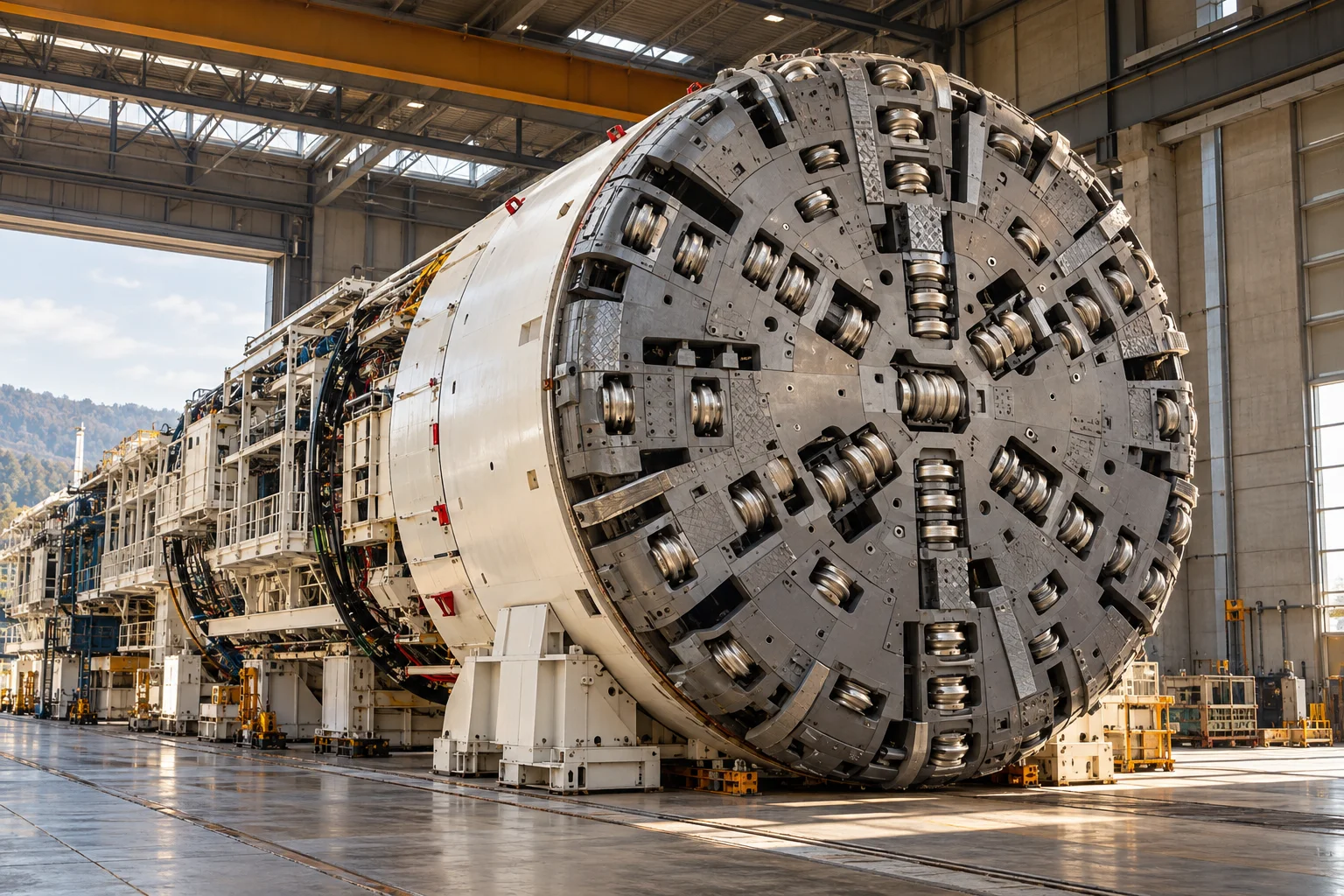
How Tunnel Boring Machines Build a Route Through the Ground
A construction process carried underground
A tunnel boring machine, or TBM, combines excavation with a moving construction system. Its rotating cutterhead is visually striking, but the machine's task extends far behind that face. Material must be removed, the opening must remain supported as required by the ground, equipment must advance, and people and supplies must move through an increasingly long tunnel. Some machines also erect precast lining segments as they proceed. The correct mental model is therefore a compact underground factory rather than a giant drill. The design is shaped by geology, groundwater, tunnel geometry, support requirements, and the logistics that connect the excavation face to the surface.
Cutting rock and excavating soil
In hard rock, disc cutters can apply concentrated loads that fracture material as the cutterhead turns and the machine thrusts forward. In softer ground, cutting tools break and gather material through a different interaction. Tool arrangement and opening geometry must suit the expected conditions. Abrasive rock, sticky soil, mixed faces, and obstructions create different demands. The cutterhead transfers torque into the ground, while the ground returns forces into its structure and bearings. Cutting tools wear because their role is to work at an intensely loaded interface. A design that is effective in one formation may be unsuitable in another, which is why TBMs cannot be treated as one universally interchangeable machine type.
Torque, thrust, and the reaction path
Drive motors provide cutterhead rotation, and thrust systems push the machine or cutting assembly forward. Those actions require reaction forces. A hard rock gripper machine can brace against the tunnel walls, while a shield machine may push against a completed lining ring through hydraulic jacks. The structural path must carry both forward thrust and torque reaction while maintaining alignment. Large bearings support the cutterhead under combined loads, and the surrounding frame must keep drives and services in their intended positions. Excavation progresses only when cutting force, thrust, ground support, and removal of material cooperate. Additional installed power cannot resolve a weak reaction point or an unsuitable support strategy.
Keeping the face supported
In some soft or water bearing ground, the excavation face must be supported to control the interaction between the tunnel opening and surrounding material. An earth pressure balance machine uses excavated material in a pressurized chamber as part of that support system. A screw conveyor removes material in a controlled way. A slurry shield uses a pressurized fluid circuit and separation equipment to support the face and transport excavated material. These approaches involve different ground suitability and process arrangements. Their shared challenge is maintaining a controlled balance while material continually enters and leaves the chamber. The face is not simply an empty surface from which a machine cuts identical fragments.
Removing what has been excavated
Spoil removal can use belts, rail vehicles, pipelines, or combinations appropriate to the machine and tunnel. In a slurry system, separation equipment outside the face machinery becomes an essential part of the excavation process. In other systems, material conditioning may help spoil move through a chamber or conveyor. The removal rate must be coordinated with excavation and face control. A machine that cuts faster than its transport system can accept material has not increased the useful construction rate. As the tunnel grows, distances and transfer points change, so logistics must be considered over the whole project rather than only at the cutterhead.
Installing a tunnel behind the shield
Many shield machines erect rings of precast segments within the protected region behind the cutting face. An erector positions each segment, and connections and seals help create the required lining arrangement. The space outside the lining may require filling according to the construction design. Segment geometry, delivery, handling, and ring sequence all influence the process. A lining ring can also form part of the reaction system for the next advance. Excavation and structural installation are consequently interdependent. The tunnel does not become a finished usable opening merely because rock or soil has been removed; it requires a support and lining solution appropriate to its intended service and surrounding conditions.
Steering a very long machine
A TBM follows a planned alignment through adjustments in its thrust and articulation arrangements, supported by surveying and guidance systems. Small deviations matter because the completed route must meet other works and preserve the intended geometry. The machine has length, stiffness, and limits to how sharply it can turn. Its steering behavior is affected by contact with the ground and, for segmental tunnels, by lining geometry. Guidance therefore combines measurement with a model of how the whole system responds. This is not the same as steering a road vehicle through an open space. The machine creates the space it will occupy while simultaneously using that developing space as part of its support.
The backup train
Behind the principal shield or cutting assembly, a train of equipment carries pumps, power distribution, ventilation services, material handling, stores, and other systems. Its exact contents depend on the machine and construction method. These supporting systems may extend a considerable distance and are connected to the moving front through hoses, cables, conveyors, and transport routes. Electrical energy, cooling, compressed air, water, and ventilation must reach the locations where they are needed. Maintenance access is a design problem in an environment with restricted space. The backup equipment is therefore not an optional collection of accessories: it is what allows the excavation mechanism to function repeatedly rather than perform a single demonstration cut.
Matching the machine to uncertainty
Ground investigations inform machine selection, but the ground is not a manufactured component with perfectly uniform properties. Designers and project teams must consider variation, wear, possible interventions, and how the process can respond to changing conditions. Machines may be equipped for particular mixed formations or for changes between operating modes, but flexibility brings additional complexity. Access to cutting tools, pressure boundaries, seals, and critical components has to be planned as part of the construction system. General educational descriptions cannot establish an appropriate intervention procedure or operating pressure. The important engineering lesson is that tunnelling requires a strategy for uncertainty, not just confidence in a powerful cutting mechanism.
A machine whose product is infrastructure
TBMs connect the history of mining, mechanical excavation, hydraulic power, surveying, and industrial logistics. They enable transport, water, utility, and other infrastructure to pass through environments where an open excavation would be impractical or disruptive. Their output is a route whose quality depends on both excavation and the structure left behind. Observing the cutterhead explains only the beginning of that transformation. To understand the complete machine, follow the reactions into the ground, the spoil toward the surface, the segments toward the lining, and the services along the backup train. Successful boring is the sustained coordination of all these flows through an underground construction process.