
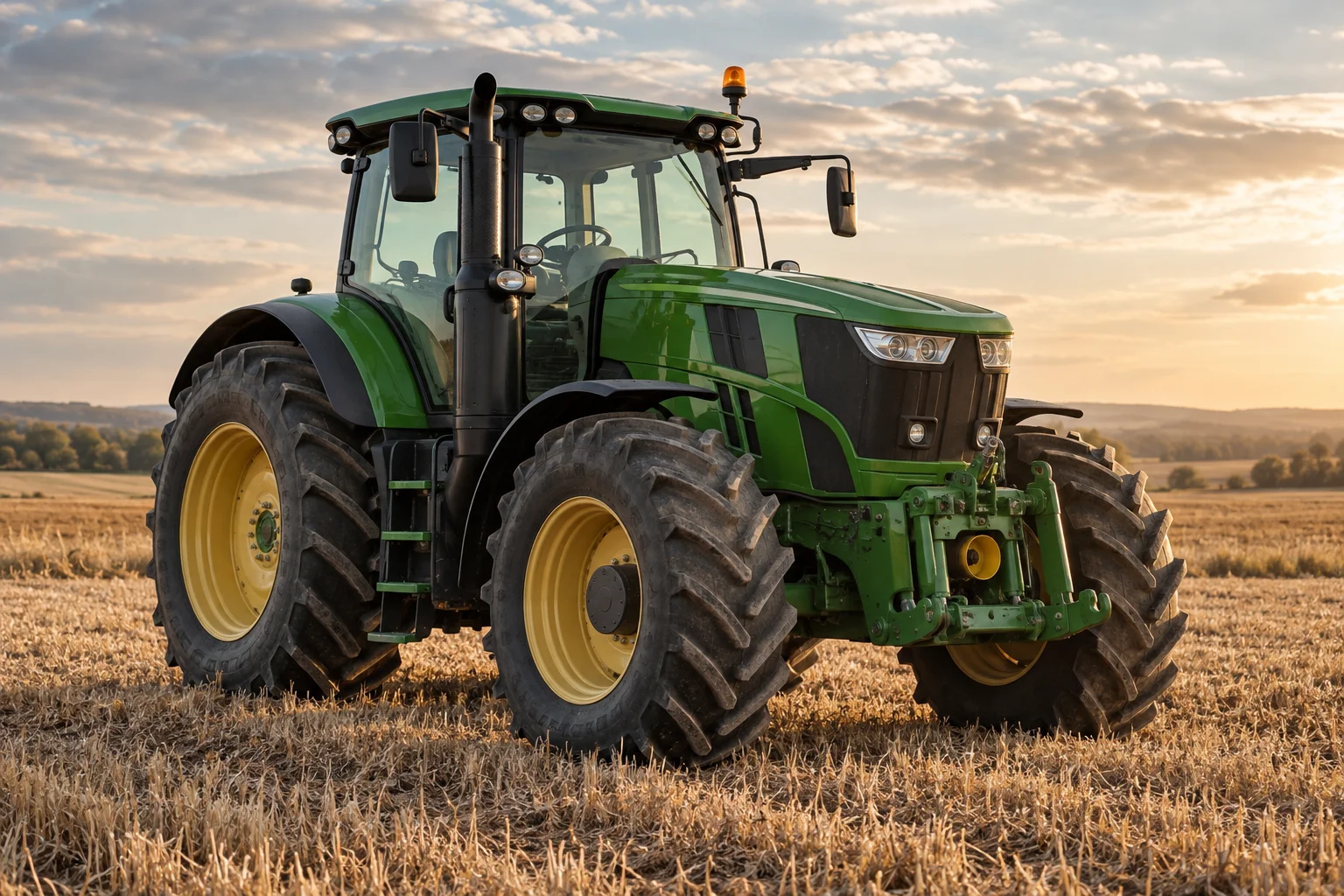
How Does an Agricultural Tractor Work?
A mobile source of useful power
An agricultural tractor is more than a vehicle that pulls heavy objects. It is a moving power station whose engine can send energy to the ground, to a rotating implement shaft, to hydraulic cylinders, and to electrical equipment. A plough mainly needs a sustained pull. A mower needs a turning cutter. A loader needs controllable lifting force. A precision planter may need all these outputs together. Understanding a tractor means following how one machine divides its power among several different jobs.
Its appearance reflects that task. Large tires create a substantial contact patch, the chassis accepts changing attachments, and gearing allows the engine to work at a useful speed while the vehicle moves slowly. Unlike a road car, its success is not measured chiefly by acceleration or maximum speed. The important question is how effectively it performs agricultural work under changing field conditions.
From engine torque to traction
In many tractors a diesel engine produces torque at the crankshaft. A transmission changes the relationship between engine speed and wheel speed, and the final drives increase torque again before it reaches the wheels. Mechanical gearboxes, powershift arrangements, continuously variable transmissions, and hydrostatic drives solve this problem in different ways. None creates extra energy: increasing wheel torque trades away speed and introduces some losses.
The tire must then convert axle torque into a force against soil. The tread deforms the ground and the ground pushes back. Too little available grip means that more engine power simply increases wheel slip. Soil moisture, tire shape, inflation, axle loading, and surface condition therefore affect the outcome. Tracks spread the load differently and can offer advantages in particular conditions, but they also bring their own mass, complexity, and turning characteristics. Traction is an interaction between the complete vehicle and the field, not just a property of the engine.
Carrying and controlling an implement
The connection between tractor and implement determines how forces travel through the combination. A drawbar provides a towing point for a trailed machine. A three point linkage supports an attached implement and controls its position relative to the tractor. The familiar triangular arrangement resists unwanted movement while allowing the implement to be raised for transport or repositioning.
Hydraulic lift cylinders move the linkage. Depending on the machine, the control system can respond to position, loading, or a combination of signals. An implement engaging soil can alter the load on the tractor as it moves, and that load can change traction and steering behavior. Linkage geometry consequently matters as much as cylinder force. A compact attachment held close to the rear axle behaves differently from a long implement projecting far behind it. Tractor and attachment form one mechanical system even when they are bought separately.
Rotating power and fluid power
A power take off provides a mechanical route from the tractor to an implement that needs rotation. The shaft may drive a baler pickup, a mower, a pump, or another mechanism through the implement's own gearbox. This separates the work of moving the vehicle from the work of operating the attachment. Some arrangements allow the driven machinery to continue turning while vehicle motion changes, although the exact behavior depends on the transmission and clutch design.
Hydraulic outlets provide a different form of power. An engine driven pump moves oil, control valves direct it, and remote cylinders or motors convert the fluid's energy into motion. Pressure is associated with the resistance to that motion; flow is associated with its speed. Increasing hydraulic demand can reduce the power available for propulsion. Oil cooling, filtration, and reservoir design matter because fluid circuits must remain controllable and reliable while operating across long working days.
Steering, structure, and field geometry
A tractor's shape depends on the crops and implements around it. Row crop machines may need ground clearance and adjustable track width. Orchard tractors fit within narrow spaces. Large articulated tractors steer by bending at a central joint, while many conventional tractors turn their front wheels. These are different solutions to the same problem of placing a heavy power unit accurately in a field.
A turning maneuver also moves the attached equipment. The implement follows its own path, and a wider machine can sweep a large area even when the tractor itself appears compact. Designers balance turning ability against tire scrub, traction, frame loads, and implement clearance. The frame and axles must tolerate not only steady pulling but repeated impacts and changing vertical loads. That explains why tractor construction often looks heavier than a comparison based on engine output alone would suggest.
Information joins the mechanical system
Modern tractors can use satellite positioning, wheel or radar speed measurements, implement communication, and automatic steering to improve repeatability. These systems do not replace the mechanical connection to the ground. They help coordinate it. A guidance controller can request a steering correction, but the tires still need enough grip to produce that turn, and the attached implement can still move differently on a slope or soft surface.
Likewise, an electronic display may combine information about fuel use, hydraulic demand, engine loading, and implement performance. The benefit comes from understanding relationships rather than displaying isolated numbers. A tractor working faster is not automatically accomplishing more useful work if the attachment loses accuracy or field conditions deteriorate. Sensors make previously hidden behavior more visible; the agronomic and mechanical objectives still determine what counts as a good result.
A platform rather than a single purpose machine
The tractor's historical importance lies in this ability to share one power source across many seasonal tasks. Replacing an attachment changes the job without replacing the complete vehicle. That flexibility helped distinguish tractors from stationary engines and from highly specialized harvesting machines. It also means that there is no universally ideal tractor: the right balance of mass, gearing, hydraulic capacity, clearance, and maneuverability depends on its intended work.
Looking at a tractor in operation, follow three paths at once. Trace energy from the engine to the driven wheels, trace force through the attachment connection, and trace control signals to the steering and working mechanisms. The machine becomes easier to understand when these paths are kept separate and then brought together. What appears to be a rugged vehicle is also an adaptable interface between power, soil, tools, and agricultural knowledge.
Why weight is a working variable
A tractor often needs mass to transmit a useful pull, yet the same mass can increase soil loading and consume energy during transport. Ballast therefore illustrates a fundamental engineering tradeoff rather than a simple preference for a heavier machine. The distribution of weight matters too: an attached rear implement can unload the front axle, while a front loader can move the combined center of gravity forward. Axle loads change during work even though the tractor itself has not been rebuilt.
This also explains why a tractor cannot be understood from an engine label alone. A vehicle can have ample power but insufficient traction, or suitable traction but inadequate implement control. The meaningful unit is the tractor, attachment, and ground together. Comparing different machines requires asking which part of that complete system limits the intended task, and whether added complexity resolves that limit or merely moves it elsewhere.