
How Ships Work
A floating structure and a moving machine
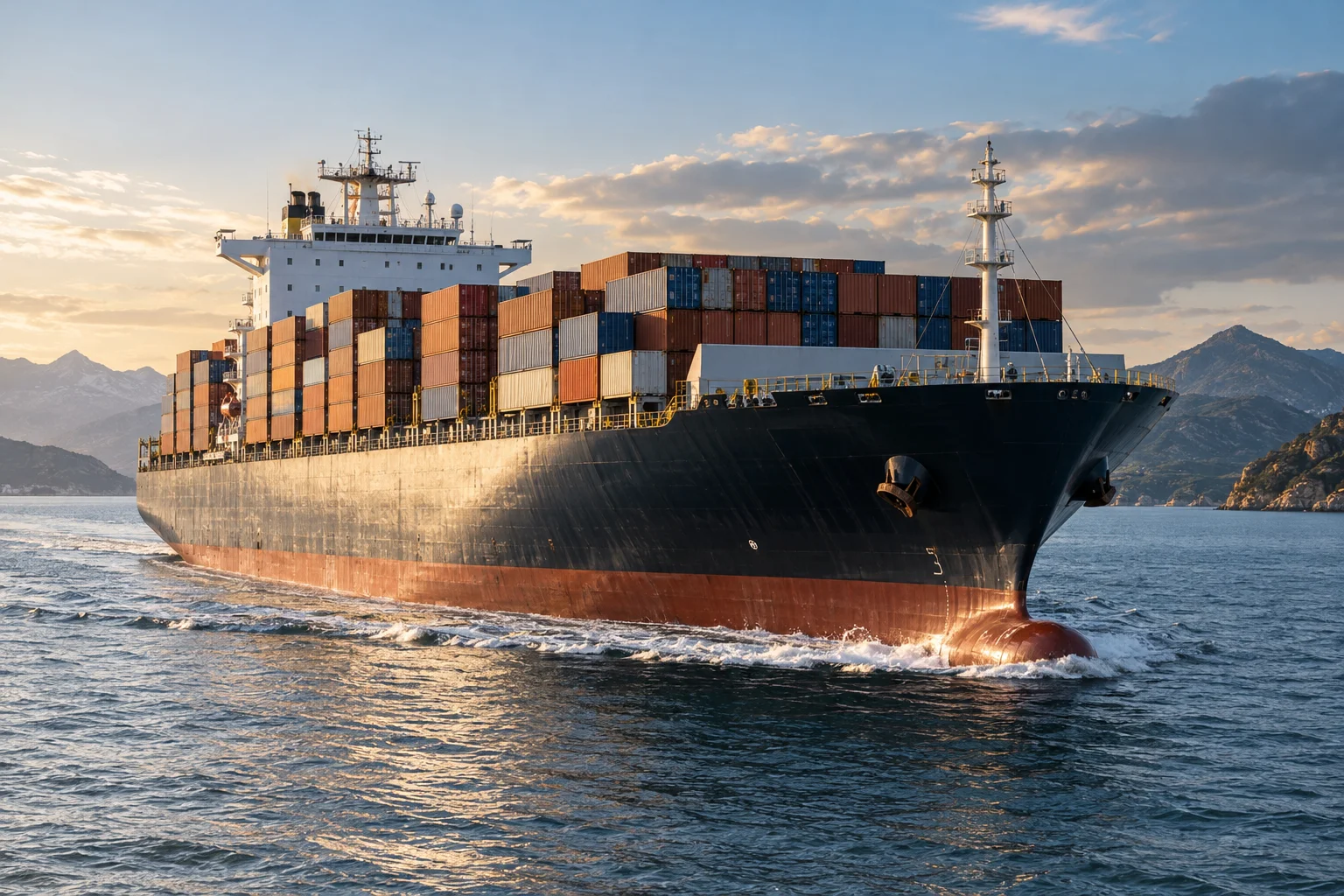
A ship combines a buoyant structure with propulsion, steering, cargo systems, and the services needed to operate away from land. Some vessels carry containers or liquid cargo; others transport passengers, support offshore work, or conduct research. Their external shapes differ because their tasks differ, but each must support its weight through displaced water and move against resistance. Unlike a wheeled vehicle, a ship has no fixed ground contact through which to steer or brake. Water pressure, propeller thrust, wind, and waves determine its movement. Understanding the ship therefore begins with the hull and its surroundings, before considering the engine room inside it.
Displacement supports the whole vessel
An immersed hull displaces water, and the resulting buoyancy balances the ship's weight when it floats in equilibrium. Adding cargo makes the vessel settle deeper until it displaces enough additional water. The distribution of that displaced volume matters as well as its total. Weight acts through the center of gravity, while the resultant buoyancy acts through the center of the underwater volume. As the vessel heels, the submerged shape changes and the buoyancy force moves relative to the hull. Whether that produces a useful restoring moment depends on geometry and loading. Floating successfully is consequently different from possessing adequate stability under the conditions a vessel will encounter.
Loading changes the behavior of the hull
Cargo, fuel, ballast, machinery, and people all contribute to the position of the center of gravity. Their fore and aft distribution affects trim, while vertical distribution affects stability. Liquid moving in a partly filled tank can reduce stability through its free surface effect, illustrating why internal arrangements matter even when the exterior shape is unchanged. Ballast systems allow selected tanks to carry water for loading and balance purposes, subject to the ship's design and environmental requirements. These systems are not a way to ignore loading limits. They are part of a carefully engineered arrangement that connects the ship's structure, cargo plan, draft, and seakeeping behavior.
The hull carries bending and local pressure
A long ship experiences changing support as waves move along its length. At one moment a wave may support the middle strongly; at another, the ends may be supported more. The hull must resist the resulting bending and repeated stresses, while plating and stiffeners withstand local water and cargo pressures. Decks, longitudinal members, bulkheads, and bottom structure form a connected load carrying system. Watertight subdivisions can limit the spread of flooding, although their effectiveness depends on the complete arrangement. Corrosion protection and inspection matter because a ship's working environment continually attacks its materials. The hull is thus both a hydrodynamic surface and a large engineered structure with a long fatigue life to manage.
Propulsion begins with an energy source
Many commercial ships use combustion engines, but the relationship between engine and propeller varies. A large slow speed engine may drive the shaft directly, while a faster engine can use reduction gearing. Other vessels generate electricity and supply propulsion motors, giving designers more freedom in machinery placement and power distribution. Multiple generating sets can also serve hotel loads and other equipment. Steam turbines, gas turbines, batteries, and hybrid combinations suit particular applications. The important distinction is between producing power and applying it usefully to the water. An efficient engine installation still needs a suitable propulsor, transmission arrangement, and hull interaction to achieve good overall performance.
A propeller exchanges momentum with water
A rotating propeller accelerates water and experiences an opposing thrust that moves the vessel. Its blades operate as lifting surfaces in a rotating flow, so diameter, blade shape, pitch, rotational speed, and inflow conditions all matter. Excessive local pressure reduction can cause cavitation, with consequences for noise, vibration, performance, and material damage. The flow arriving at the propeller is affected by the hull ahead of it, making the stern and propeller a coupled design problem. Some propellers have fixed pitch; others change blade pitch through a mechanism in the hub. A larger engine cannot guarantee more useful thrust if the propeller and hull are poorly matched.
Steering requires controlled water forces
A conventional rudder changes the direction of water flowing past it, creating a lateral force and a turning moment on the hull. Its effectiveness depends on flow, including the stream produced by a nearby propeller. Steerable propulsion units turn their thrust direction, combining propulsion and maneuvering in another arrangement. Bow or stern thrusters help provide transverse force for particular low speed situations. The ship's response includes inertia and hydrodynamic resistance, so turning and stopping unfold over time and distance rather than immediately following a command. Different vessels therefore use different combinations of rudders, propellers, thrusters, and controls to suit open water travel, port maneuvering, or precise position keeping.
Resistance shapes the working speed
A moving hull encounters frictional resistance along its wetted surface, pressure related resistance, and the energy associated with generating waves. Appendages, surface condition, draft, and speed influence the result. A ship optimized for carrying heavy cargo at moderate speed looks different from a fast ferry because the operating priorities are different. Increasing speed can demand disproportionately more power, so commercial service speed is an important design choice. Fouling of the underwater surface changes resistance over time, linking maintenance with fuel use. The propulsion problem cannot be separated from the intended route, sea conditions, cargo requirement, and the economic value of arriving sooner.
Machinery supports life and cargo at sea
Beyond propulsion, ships contain electrical generation, cooling circuits, pumps, ventilation, fire protection, bilge arrangements, and control systems. Passenger vessels require extensive accommodation services, while refrigerated cargo creates continuous temperature control demand. Tankers and bulk carriers need cargo handling arrangements suited to their materials, and container ships depend on securing systems and terminal interfaces. Seawater can help remove heat, but it introduces corrosion and fouling challenges into heat exchangers and piping. Redundancy and compartment arrangements help maintain essential functions when individual equipment becomes unavailable. A ship is therefore closer to a mobile industrial facility than an enlarged boat with a single engine doing all the work.
A long history of changing energy systems
Ships connect ancient woodworking and sailmaking to modern metallurgy, engines, electrical drives, and global logistics. Steam propulsion freed many routes from direct dependence on wind, while later machinery and cargo systems changed vessel scale and commercial organization. Standardized containers made the relationship between ships, ports, railways, and trucks particularly visible. Current propulsion development revisits fuels, electrical integration, and wind assistance while retaining older concerns about displacement, stability, resistance, and reliability. The enduring engineering lesson is that ship performance emerges from coordination. A successful vessel carries the intended load, withstands its environment, supplies its services, and converts available energy into useful transport across the whole voyage.