
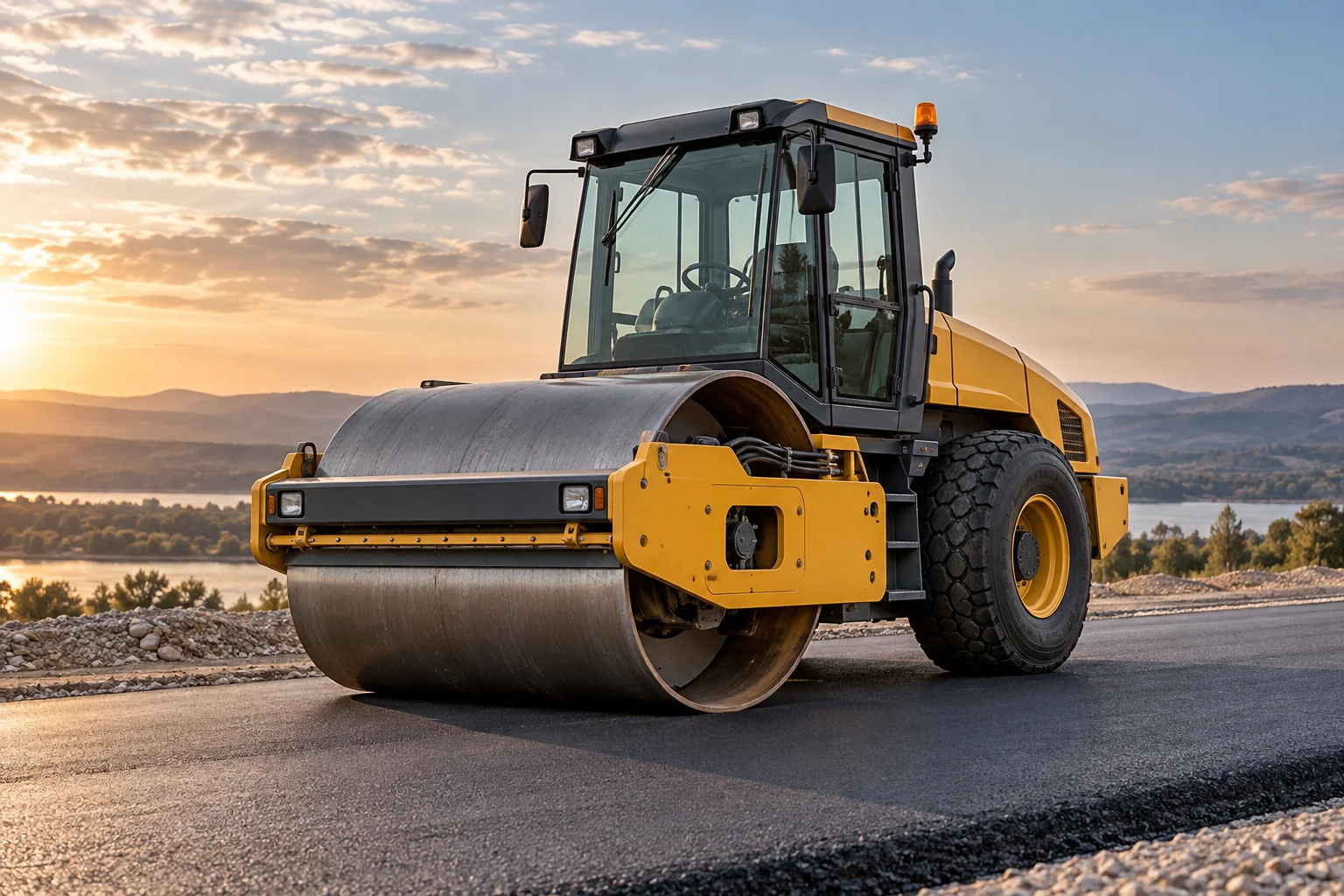
How Road Rollers Change the Structure of the Ground
Building strength through compaction
A road roller changes the arrangement of material beneath it. Whether it works on soil, aggregate, or asphalt, its purpose is not merely to make a surface look smooth. Compaction can reduce voids and help a layer achieve the density and mechanical behavior required by a larger construction system. Different materials respond to different combinations of pressure, movement, moisture, temperature, and repeated loading. A roller is therefore a machine for transmitting controlled mechanical energy into a material whose properties change as the work proceeds. Its drum or tires are the visible contact tools, but the complete system includes the drive, frame, vibration equipment, controls, and the layer being compacted.
Static weight and contact pressure
A static roller relies on the load applied through its contacting surfaces. A steel drum produces a different stress distribution from a pneumatic tire, and the distribution changes with contact width and how the surface deforms. The machine's total mass does not act uniformly through every square centimeter. Drum geometry, layer stiffness, and vehicle load distribution determine the local interaction. As the drum moves, it loads a region and then releases it, so material behavior is affected by a sequence rather than by one permanent pressure. A heavier machine is not automatically suitable for every layer: excessive loading or an unsuitable contact mechanism can produce undesirable deformation instead of a useful increase in density.
Adding vibration
Vibratory rollers commonly use rotating eccentric masses to create an oscillating force. A drive turns the mechanism inside or associated with the drum, producing dynamic loading that supplements static weight. The frequency of the loading and its amplitude influence how energy enters the material. These quantities are not interchangeable, and their useful settings depend on the machine and application. The drum, isolating mounts, frame, and ground form a coupled dynamic system. Some energy rearranges particles, some is dissipated, and some is transmitted back into the machine. This explains why vibration is not simply a device for shaking harder: useful compaction depends on how the mechanical excitation matches the material response.
Oscillation and other contact actions
Not every dynamic compaction system moves the drum in the same way. Some arrangements emphasize an oscillating tangential action or control the direction of the dynamic force. Their goal is to adapt the interaction between drum and surface to particular requirements. A pneumatic tire roller takes another route, with multiple tires producing a kneading action and contact conditions different from a smooth steel drum. Padfoot rollers concentrate contact through projecting feet and are associated with particular soil compaction tasks. The machine family includes these variations because soils and bound mixtures do not all strengthen through the same mechanism. Choosing a form of contact is part of the engineering problem, not just a matter of vehicle appearance.
Power and mobility
The roller must propel itself at a controlled speed while also supplying any vibration system. Hydraulic drives are common, distributing power to drums, wheels, and eccentric mechanisms as required by the design. Steering can involve articulation between frame sections or another arrangement suited to the drum layout. A tandem roller with two steel drums has different packaging and contact behavior from a machine with one front drum and rear tires. Travel motion determines how long a particular region experiences loading and how loading cycles overlap. The propulsion system is consequently part of the compaction process itself: changes in speed alter the interaction even when the drum and vibration mechanism remain unchanged.
Material condition matters
A loose granular layer, a cohesive soil, and a hot asphalt mixture are mechanically different systems. Water can influence particle movement and soil behavior; temperature strongly affects the workability of asphalt mixtures. Layer thickness changes how surface loading reaches deeper material. A roller can act only through the mechanical path available to it, so a surface that appears satisfactory does not prove that the entire layer has the intended condition. Compaction requirements are established through project design, testing, and applicable methods. A general account can explain why material condition matters, but it cannot supply universal settings or replace the evidence needed for a particular construction layer.
A repeated process with feedback
Compaction normally develops over repeated passes. The material becomes stiffer or otherwise changes as voids close and its structure evolves. The response to later passes may therefore differ from the response to early ones. More passes do not indefinitely produce better material; the useful process has limits. Operators and engineers need feedback about what the machine is doing and what the material has achieved. Traditional methods use observations and tests, while instrumented machines can measure drum behavior, location, and other signals. These signals can help map work, but the measured quantity must be interpreted appropriately rather than treated as a direct reading of every property of the finished layer.
Protecting the machine from its own excitation
A roller deliberately generates repetitive forces, yet the operator and the rest of the machine should not experience those forces without control. Isolation mounts, bearing arrangements, structural design, and cab suspension help manage vibration transmission. Eccentric mechanisms and their drives require careful attention to alignment, lubrication, and fatigue. Noise and heat also accompany the process. These less visible systems explain why a roller is more than a heavy cylinder on wheels. The mechanism must repeatedly excite the ground while supporting its own components and retaining predictable control. Designing for that environment is a practical exercise in dynamics, materials, and the separation of useful vibration from unwanted vibration.
From observation to mapped construction
Positioning systems and onboard displays can record where a roller has traveled, count coverage, and combine location with machine response. Such tools make it easier to see gaps and variation across a work area. Their value is strongest when linked to an appropriate understanding of materials and verification methods. A colored coverage map alone cannot establish that every underlying condition is correct. The important development is the connection between a physical compaction machine and an information system that makes its work more legible. Modern rollers increasingly serve as both actuators that change the ground and sensing platforms that help explain the changing interaction.
The machine within a road system
The roller's result becomes part of a structure that must carry traffic, resist weather, and interact with drainage and underlying layers. That broader role is why compaction quality matters beyond the moment the machine passes. Historically, powered rolling helped construction handle larger areas and more demanding surfaces than manual methods could efficiently address. Vibration and measurement extended that capability further. The enduring principle is controlled energy transfer: the roller applies mechanical action, the layer responds, and the process is judged by the resulting material properties. Understanding a roller means following that chain all the way from its rotating machinery to the future behavior of the road.