
Reach stackers
Telescopic booms & heavy-load handling
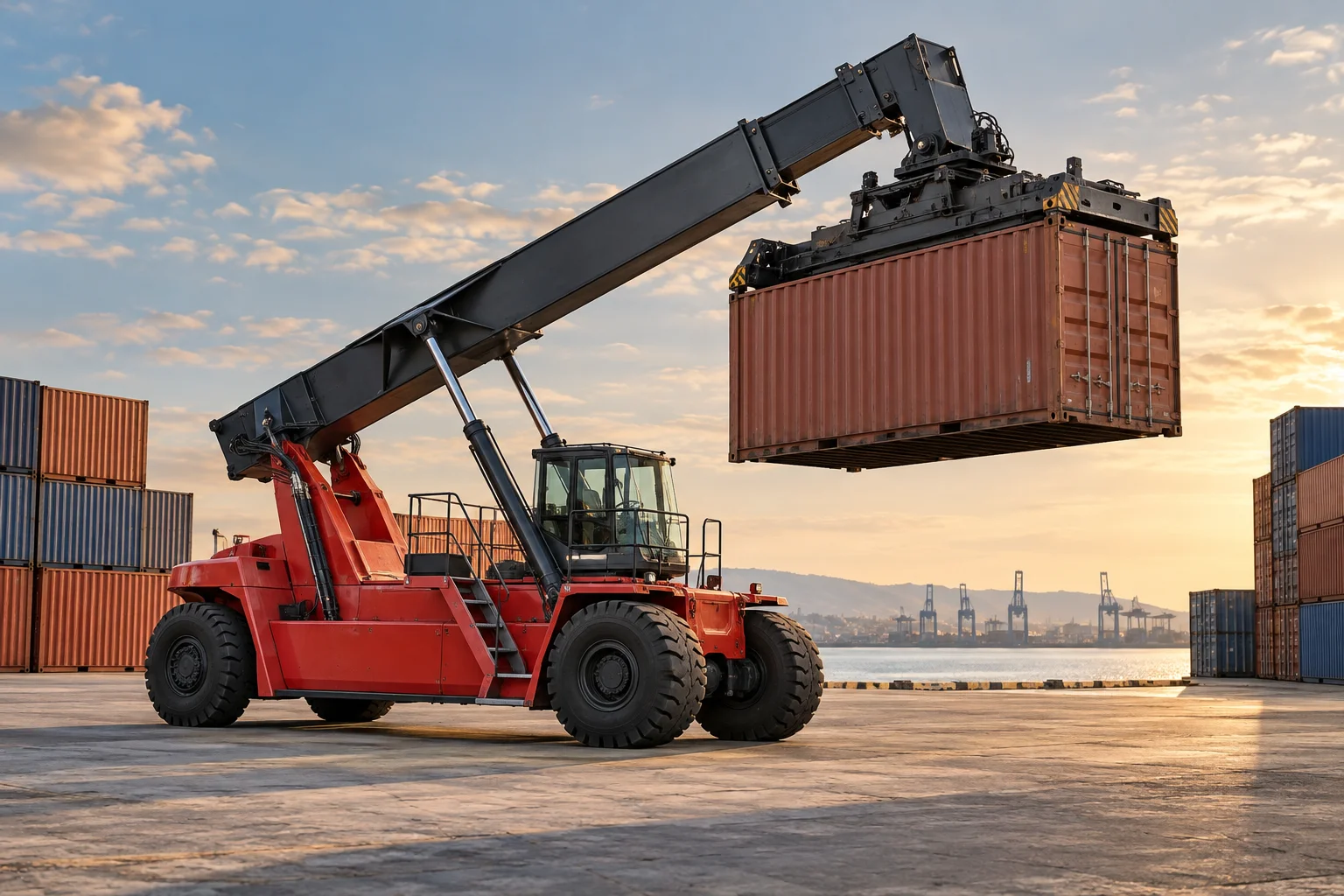
How Reach Stackers Work
A mobile link in container logistics
A reach stacker is a large mobile handling machine with a telescopic boom and a load interface suited to its intended work. In container terminals, that interface is commonly a spreader engaging the top corner fittings of a freight container. The boom allows the machine to lift, extend, and position the container beyond the immediate front of the chassis. This differs from a conventional mast-type lift truck and gives useful flexibility in stacking and transfer. Its purpose is not simply to lift a heavy box but to position that box within a working logistics system.
Container yards connect ships, road vehicles, rail services, storage positions, and inspection or maintenance activity. Different terminals use different combinations of cranes and mobile equipment. A reach stacker can provide flexible handling where loads and destinations change, while the layout determines how effectively that flexibility can be used. Turning areas, pavement, stack arrangement, visibility, and the flow of arriving vehicles all matter. The machine's productivity therefore depends on the organisation of the yard as well as its ability to raise and extend a boom.
The telescopic boom changes geometry
The boom is a structural member that pivots relative to the chassis and changes length through nested sections. Raising the boom changes the height and horizontal location of its head; extending it moves the load farther along the boom's direction. Hydraulic cylinders provide the forces for these movements, with guides and bearing surfaces controlling how the sections slide relative to one another. The boom must transmit bending and other loads through its nested structure while maintaining suitable alignment. Its overlap and section geometry are therefore central engineering features rather than mere packaging details.
Extension increases reach but changes the relationship between the load and the supporting machine. The same container placed farther forward produces a greater overturning moment about the relevant support region. Boom angle, extension, attachment mass, and the load's location all influence the complete geometry. Consequently, a reach stacker does not have one lifting capacity that applies at every position. Manufacturers describe capacities for particular configurations and reach conditions. This is a direct consequence of leverage and structural demand, not an arbitrary reduction imposed when the boom happens to be extended.
A spreader connects machine and container
A container spreader provides a controlled interface across the top of the container. Telescopic arrangements can accommodate the container sizes for which the attachment is designed, while locking mechanisms engage compatible corner fittings. The spreader distributes the lifting connection rather than concentrating it at one point. It also provides information about whether the intended engagement has occurred. The exact mechanism and indicators depend on the equipment, but the underlying purpose is consistent: convert a mobile boom into a reliable handling system for a standardised freight unit.
Rotational or side-shift capabilities help align the attachment with a container and its destination. The head arrangement must accommodate the required motions while transferring substantial forces. Alignment is not just a matter of placing a hook above a centre point. The spreader's connection geometry must match the container, and the container must be supported in the intended manner. This interaction shows how standardisation can make complex handling practical. The container's fittings, dimensions, and structural role form a shared interface across otherwise very different ships, wagons, trailers, cranes, and yard machines.
Hydraulics supplies force and controllability
Hydraulic power serves several demanding functions on a reach stacker, including boom lifting, extension, and attachment movements. A pump supplies flow to controlled circuits, and cylinders convert pressure into mechanical force. Large forces can be produced within a compact package, while valves regulate which functions move and how quickly. The system must support smooth positioning as well as substantial lifting effort. Its useful performance depends on the interaction among pump output, available input power, cylinder geometry, load, and the controls that manage flow through the machine.
The hydraulic system also produces heat and experiences losses. Repeated cycles demand suitable cooling, filtration, sealing, and maintenance access. A large cylinder's theoretical force is only one part of its design: rods must resist the forces imposed by their installation, connections must transfer loads, and movement must remain aligned. The boom's geometry changes as it rises and extends, so the relationship between cylinder force and the load is not constant. This makes reach stacker motion an integrated mechanical problem in which structure, actuators, and controls must be considered together.
Chassis, tyres, and pavement complete the load path
The chassis supports the boom and provides the mass and geometry needed for stability. Axles and tyres transfer the resulting forces to the ground. A lifted container changes how those forces are distributed, and travelling introduces dynamic effects from acceleration, braking, turning, and uneven surfaces. Tyres deform under load, while the pavement itself has to withstand concentrated wheel forces. A reach stacker is therefore not independent of civil engineering. A suitable working surface is part of the handling system, particularly where heavy movements repeat along the same routes.
Vehicle design also has to address manoeuvrability and visibility around a large load. The operator needs useful information about the attachment, the intended destination, and nearby activity. Cameras, displays, and other aids can support this task, depending on configuration, but the machine's physical envelope remains substantial. Yard organisation determines where vehicles can pass, wait, and approach transfer positions. A layout that creates frequent conflicting movements can limit the benefit of an otherwise capable machine. Understanding handling performance requires watching the entire cycle, including approach, engagement, movement, placement, and departure.
Reach creates flexibility and trade-offs
The ability to reach beyond the first accessible position is a defining advantage, but it comes with changing capacity and geometric constraints. Stack depth, container sequence, and the need to retrieve particular units influence the number of movements required. Moving an obstructing container can consume time without advancing the intended shipment. Yard information systems therefore matter: knowing what is stored where helps determine useful stacking decisions and machine assignments. Physical reach and accurate records work together, and neither alone can eliminate poor sequencing.
Reach stackers also illustrate how specialised machines develop around a widely shared standard. The container made freight into a transferable unit; the reach stacker provides one flexible way to handle that unit on land. Its principles connect directly to other machinery in this directory: hydraulic amplification, telescopic structures, mobile stability, controlled attachments, and coordinated logistics. Studying it means following forces from the container fittings through the spreader, boom, chassis, tyres, and pavement while following information from an arrival record to a confirmed destination. That combined view explains both its impressive capability and the limits that shape its useful work.