
How Pumps and Compressors Work
Machines that raise fluid energy
Pumps and compressors use mechanical work to move fluids and raise their useful pressure or energy. A pump generally serves liquids, whose volume changes comparatively little with pressure. A compressor serves gases, whose density and temperature can change substantially during compression. Both machines support countless other systems: water supply, hydraulic equipment, refrigeration, manufacturing, process plants, and vehicle engines all depend on controlled fluid movement.
The distinction is more than vocabulary. A liquid pump and a gas compressor face different thermodynamic behaviour even when both contain an impeller. Compressing a gas heats it and changes the volume occupied by a given mass. Moving a liquid often focuses more directly on pressure, elevation, and flow resistance. A useful explanation therefore follows the fluid's changing condition as well as the moving parts that supply energy.
Dynamic machines transfer momentum
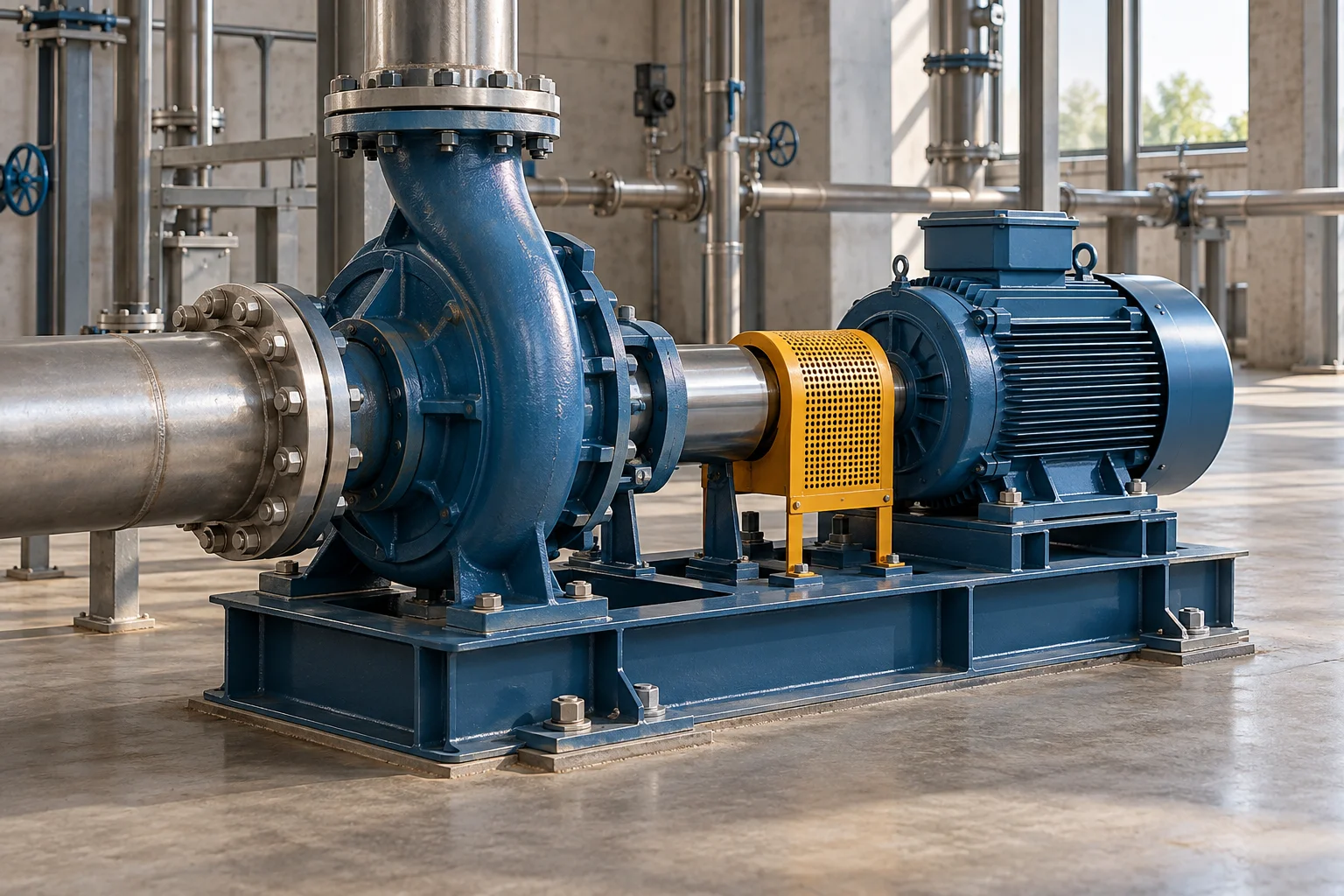
A centrifugal pump admits liquid near an impeller's centre and accelerates it through rotating passages. The impeller transfers shaft energy into the fluid. A surrounding casing or diffuser then helps collect the flow and convert part of its velocity into pressure. The useful pressure rise belongs to this combination of rotating and stationary geometry, rather than to the impeller acting alone.
Centrifugal compressors apply related momentum transfer principles to gases, while axial compressors guide flow through rows of rotating and stationary blades. The details differ because density, speed, and compressibility affect the flow. Multiple stages can divide a required overall pressure increase into smaller steps. At each stage, blade geometry, clearances, and passage design influence losses and the range over which the machine operates effectively.
Positive displacement machines trap a volume
A positive displacement machine works by enclosing fluid and changing the volume or moving that enclosed quantity toward an outlet. A piston compressor draws gas into a cylinder and reduces the chamber volume during the compression stroke. Valves direct the flow. A reciprocating liquid pump uses a similar broad arrangement, although the liquid's limited compressibility changes the pressure response and structural demands.
Rotary machines achieve displacement through other geometries. Screw compressors use intermeshing rotors that form changing gas spaces. Gear and vane pumps carry liquid through spaces created by their moving components. These mechanisms can supply useful flow at conditions that suit their particular designs, but leakage, friction, temperature, pulsation, and materials determine practical performance. Positive displacement is a family of principles rather than a guarantee that every machine behaves identically.
The surrounding system sets the duty
A pump connected to pipes does not deliver an arbitrary flow independent of its surroundings. Pipe friction, valves, elevation differences, and downstream pressure create a system requirement. The resulting operating condition depends on the interaction between that requirement and the pump's performance characteristics. Changing a pipe arrangement or valve condition can therefore change the machine's actual flow and power demand.
Gas systems add changing storage and temperature effects. A receiver can hold compressed air, while downstream equipment draws it intermittently. The compressor and its controls must respond to that demand. A pressure reading alone does not describe useful capacity, because the required mass flow and the conditions under which volume is quoted also matter. Clear comparisons need a defined basis rather than unrelated headline numbers.
Heat accompanies gas compression
When mechanical work compresses a gas, temperature commonly rises. Cooling between compressor stages can change the work required and control temperatures entering later stages. Aftercoolers remove heat from delivered gas, and condensation can occur as compressed air cools. Separation and treatment equipment then become part of the useful supply system, depending on the application and required air quality.
Lubricated and oil free compressor architectures make different choices about sealing, cooling, contact, and contamination control. The label describes an important design feature, but the complete installation still needs appropriate filtration and treatment for its intended use. Clean process air, workshop tools, and sensitive production equipment do not necessarily require the same system. The compressor's mechanical design and the user's fluid quality requirement must be considered together.
Seals, bearings, and unwanted losses
A shaft entering a pressurised casing creates a sealing problem. Mechanical seals, packing, or other arrangements limit leakage while accommodating rotation and temperature. Bearings maintain alignment and support radial or axial forces. Internal clearances also matter: fluid leaking backward through a machine consumes work without contributing fully to useful delivery. Reducing clearance can improve one aspect of performance while increasing sensitivity to wear, expansion, or contamination.
Fluid properties influence these decisions. Viscosity changes friction and leakage behaviour, while abrasive particles can damage surfaces. Corrosion and chemical compatibility affect material selection. A machine designed for clean water is not automatically suitable for a hot chemical or a particle laden slurry. The apparent simplicity of an inlet and outlet conceals a design shaped by the particular fluid, not just by the desired pressure.
Control is part of energy efficiency
Different controls match supply to changing demand. Variable speed drives alter the mechanical input, while unloading, staging, throttling, or other methods suit particular machine families and duties. Their energy consequences differ. An installation that repeatedly produces more pressure or flow than required may waste substantial input even if its individual components appear efficient at their rated conditions.
For liquid systems, cavitation can arise when local pressure allows vapour formation, affecting noise, surfaces, and performance. Compressors have their own flow stability limits, including conditions associated with surge in some dynamic designs. These are reasons to match equipment and system carefully, not operating instructions. Performance maps, fluid conditions, and manufacturer defined limits belong together when engineers evaluate the complete installation.
Hidden infrastructure with visible consequences
Pumps have a long history in water management, mining, and industry. Compressors expanded the reach of pneumatic tools, refrigeration, process chemistry, and gas turbines. Advances in machining, seals, bearings, motors, and control made these machines more capable and dependable. Many modern products owe part of their existence to fluid movement occurring far from the final assembly line or consumer.
The clearest way to understand either machine is to trace an energy path. A motor or engine turns a shaft; moving elements add energy to fluid; pipes and equipment distribute or consume that energy; heat and leakage account for part of the loss. Comparing displacement and dynamic mechanisms then reveals why different duties require different machines. Pumps and compressors are fundamental translators between rotating mechanical power and the pressure systems that organise modern life.
Distribution losses can be easy to overlook because they occur outside the machine casing. Long narrow lines, unnecessary restrictions, leakage, and poorly matched demand can reduce the useful result obtained from shaft power. In compressed air systems, a leak continues consuming supplied air without doing intended work. In liquid systems, excess resistance becomes additional pumping duty. These examples explain why improving an installation often requires examining the entire fluid route. Replacing a machine without understanding that route can preserve the original problem. The best arrangement matches fluid properties, demand, controls, and distribution rather than optimising one component in isolation.