
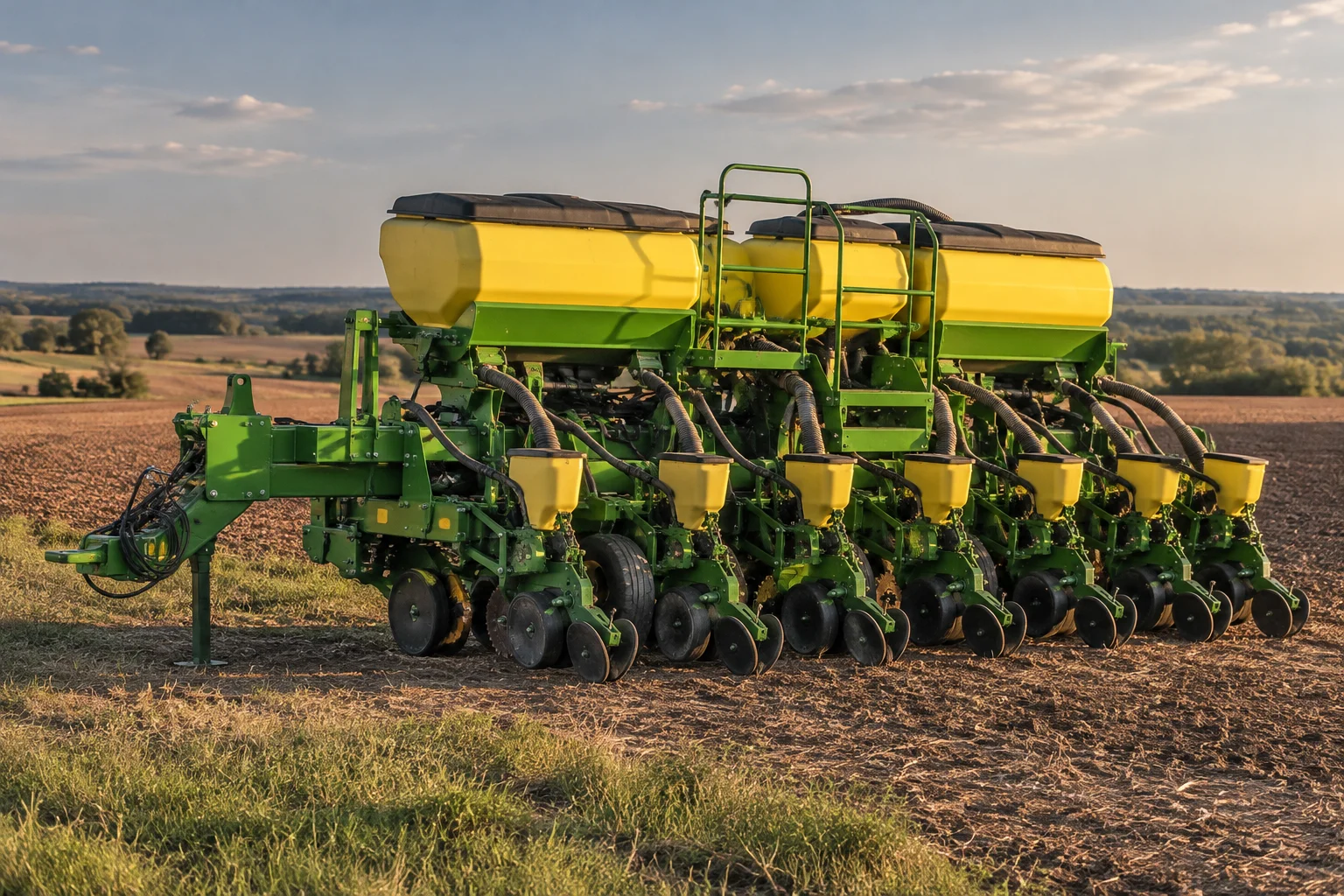
How Does a Precision Seeder Work?
The beginning of a crop as an engineering problem
A precision seeder turns a moving supply of seeds into an organized pattern in soil. The pattern includes the distance between rows, the spacing of seeds along a row, and the depth at which each seed is placed. These are separate dimensions, and a machine can control one well while struggling with another. Good metering is not enough if the delivery path makes seeds bounce or the ground engaging unit cannot follow the surface.
The term covers several arrangements. A precision planter often aims to separate individual seeds, while a seed drill may meter a continuous quantity into closely spaced rows. Both connect biological material to mechanical motion. Seeds differ in shape, size, coating, fragility, and surface texture, so a seeder must handle objects that are much less consistent than manufactured screws or bearings.
Metering transforms bulk material into a sequence
Seed begins in a hopper or a central storage system. It must reach a metering mechanism without bridging, starving the meter, or damaging the supply. Meter designs can use shaped cells, plates, belts, or air pressure differences to capture and release seeds. In a singulating planter, the objective is to deliver one seed at each intended interval rather than an uncontrolled handful.
The meter's rotation must correspond to the desired pattern and the machine's forward motion. A ground driven mechanism links this relationship mechanically. An electrically driven meter can vary its speed using a controller and speed information. Electronic control adds flexibility, but it cannot make a poorly filled meter deliver nonexistent seeds. The physical capture and release process remains central. Shape, friction, air flow, and the consistency of the incoming supply determine whether the commanded sequence becomes a real one.
Delivery is a controlled journey, not an empty gap
After release, a seed has to travel from the meter to the soil. A simple tube permits a largely gravity driven descent. More actively controlled systems constrain the seed along belts or other delivery elements. The final placement depends on the seed's relative motion when it leaves that path and meets the furrow, not merely on the instant at which the meter released it.
Vibration, forward speed, tube geometry, and collisions can disturb the intended pattern. Two perfectly timed releases can produce uneven spacing if their journeys differ. That is why the delivery system is a major part of precision planting technology. Its task is to preserve order between a rotating meter and a moving soil surface. Designs trade additional mechanical complexity against the possibility of keeping placement more consistent as travel speed and field roughness change.
The row unit makes a place for the seed
Ground engaging components create the furrow. Depending on the machine, discs, tines, coulters, or combinations of these elements open a route through soil and crop residue. Gauge wheels or other reference elements help establish the position of the opener relative to the local ground surface. The row unit needs enough loading to penetrate, but simply increasing force can create other problems such as unnecessary compaction or poor response to changes in soil condition.
Individual row units often move relative to the main frame. This allows a wide machine to follow smaller changes in ground height that the full chassis cannot match. Springs, hydraulic systems, and linkages manage that motion. The resulting structure is a small terrain following mechanism repeated across the working width. Its geometry determines how depth control responds when the wheels rise, the frame pitches, or the soil resists the opener differently.
Closing the furrow completes the placement process
Placing a seed in an open trench does not complete the job. Closing wheels or related mechanisms move soil back around it. The aim is a suitable physical environment for emergence, including useful contact between seed and surrounding soil. Soil texture and moisture affect how readily the furrow closes and how much pressure is appropriate.
Residue handling is connected to this process. Material dragged into the furrow can interfere with consistent placement, while aggressive disturbance may conflict with an intention to retain a protective surface cover. Seeders consequently differ in how they clear, cut, or move residue. The visible collection of wheels and discs around a row unit is not a redundant set of accessories. Each component addresses a distinct stage in making, filling, and closing a narrow strip of disturbed ground.
A wide machine needs coordinated distribution
Across a large planter, each row must receive seed and respond to movement in a coordinated way. Central seed distribution reduces the need for many separate bulk containers, but introduces pneumatic or mechanical transport systems. Sections may fold for transport, bringing hinges, hydraulic cylinders, flexible hoses, and locking structures into the design. The working machine and the transported machine can have remarkably different shapes.
Turning adds another geometrical complication: rows on the outside of a turn travel farther than those on the inside. With independent metering drives, control systems can account for different local speeds, although the details depend on the machine. Section control can also reduce duplicated planting where paths overlap. These features are best understood as attempts to make a wide array of small planting mechanisms behave correctly over a complicated two dimensional path.
Measuring performance without confusing it with agronomy
Sensors can observe seed passage, monitor meter behavior, report downforce, and record the machine's route. These measurements help distinguish a missing seed from a disrupted delivery pattern or a depth control problem. They do not by themselves establish the eventual condition of the crop. Germination, weather, soil biology, and subsequent field events remain outside the immediate mechanical cycle.
The seeder's development illustrates the move from distributing a quantity toward controlling individual placements. Its performance emerges from the full chain: bulk storage, singulation or metering, delivery, furrow formation, depth response, and closure. Follow a single seed through that chain and the many components become easier to understand. Precision is not concentrated in one expensive meter or a bright control screen. It is the preservation of a pattern through a series of physical transfers, each exposed to disturbance and biological variability.
Precision is a chain of references
Each part of a seeder measures or constrains something relative to another part. The meter follows a rotational reference; the opener follows a ground reference; the delivery system follows a spatial path; and the closing arrangement acts on the furrow left behind. Errors can accumulate when these references disagree. A wheel slipping on the surface can disturb a mechanically derived rate, while a bouncing row unit can change depth even when the meter remains consistent.
This is why the most informative explanation follows one seed instead of listing components. At each transfer, ask what establishes its position and what can disturb it. That method also applies to other machines that place individual objects into moving environments, including packaging and assembly equipment. A precision seeder is a distinctive agricultural example of a much broader problem: preserving a planned sequence as it passes from a controlled mechanism into a variable physical world.