
How Pallet Trucks Work
Lifting only as far as the task requires
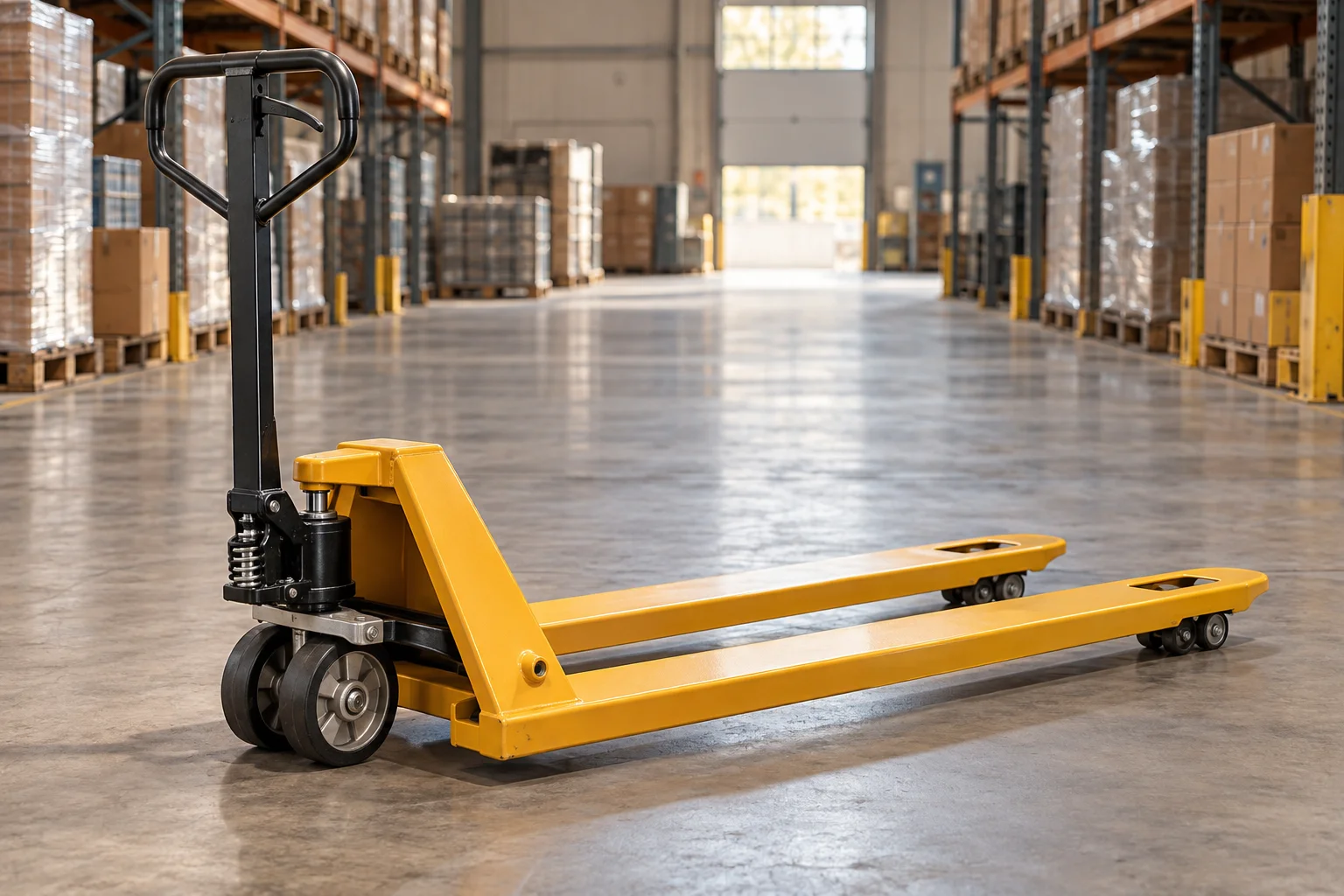
A pallet truck is designed around a modest but powerful idea: a pallet often needs to rise only a short distance before it can be moved on wheels. High stacking ability is unnecessary for many horizontal transfers. By limiting the lift, designers can build a compact machine with low forks, small load wheels, and a comparatively simple structure. A hand pallet truck uses human effort for both pumping and travel; powered versions add electric assistance to some or all of that work. The family ranges from basic workshop equipment to sophisticated warehouse vehicles.
Its usefulness depends on compatibility with the pallet and floor. Fork length, spacing, lowered height, and load wheel arrangement determine which pallets can be approached and supported. A pallet truck cannot make an unsuitable or damaged load into a coherent unit. It relies on the pallet to distribute weight and provide access. The apparent simplicity therefore conceals a carefully defined interface. Standardised goods handling allows a relatively small machine to move substantial loads because packaging, supports, equipment geometry, and prepared surfaces have already made the task manageable.
A small hydraulic circuit supplies lifting force
In a common manual design, moving the handle operates a pump that transfers oil into a lifting cylinder. Each stroke supplies a small volume. Check valves establish the intended direction of flow, while a control arrangement allows the load to remain raised or permits fluid to return for lowering. Pressure acting on the cylinder's effective area produces lifting force. The operator does not raise the entire load directly through the handle. Instead, many manageable strokes accumulate a short displacement of a more heavily loaded hydraulic element.
This is an exchange of force and distance, not a creation of energy. The handle travels farther than the lift mechanism, while friction and hydraulic losses add to the required effort. A compact cylinder can generate substantial force because the lifting travel is short. Controlled lowering requires a return path that regulates fluid movement under the load's weight. Components must retain fluid and resist pressure repeatedly. The machine's durability consequently depends on sealing, bearing surfaces, fluid condition, valves, and the mechanical connections that translate cylinder movement into fork elevation.
Linkages coordinate the two ends
The steering and pumping unit is located near the handle, but the far ends of the forks must also rise. Mechanical links connect movement near the hydraulic unit to the load wheel assemblies under the forks. As the mechanism changes position, those wheels move relative to the fork structure, lifting the supported frame. The links keep a compact machine coordinated along its length. They also explain why the forks contain more engineering than two solid prongs: the underside must accommodate wheels, joints, and moving parts within a very limited height.
The arrangement needs enough clearance to enter the pallet while still providing useful travel. Wheel size influences rolling resistance and the ability to cross small surface discontinuities, but larger wheels compete with the required low profile. The frame must resist bending from an unevenly distributed load and twisting during movement. Pins, bushes, and joints experience many repeated cycles even in a machine with no engine. The design is successful when this coordinated movement remains predictable with ordinary wear and when the equipment can be serviced economically rather than treated as disposable.
Rolling effort is different from lifting capacity
Once the pallet is clear of the floor, moving it becomes a rolling problem. Required effort depends on total mass, wheel materials and diameters, bearings, surface condition, gradients, and the way the load is distributed. A load that the hydraulic mechanism can lift may still demand considerable effort to start or control horizontally. Small load wheels can be especially sensitive to joints, thresholds, debris, or damage in the floor. The machine's nominal lifting ability therefore does not describe the whole experience of using it in a real facility.
The steering wheels near the handle change direction with the tiller assembly, while the load wheels follow the fork geometry. Tight turns involve different paths and can increase resistance. The operator also needs space to move the handle without meeting surrounding racks or goods. These details influence workplace layout. A pallet truck works best as part of an organised route with compatible transfer points, rather than as a universal answer to every short movement. Improvements to floors and access can sometimes contribute as much to handling efficiency as a more powerful machine.
Electric power changes the working cycle
Powered pallet trucks reduce the muscular effort required for travel and, in many designs, lifting. A battery supplies energy to a traction motor and associated controls, while another motor may drive the hydraulic pump. The tiller communicates commands and may carry displays or switches. A walk-behind model supports short movements with an operator on foot; rider versions are arranged for longer travel or repeated distribution work. These configurations alter dimensions, speed capability, turning requirements, and the space shared with other activity.
Electrical assistance does not remove the underlying mechanics of rolling, support, and load placement. It adds a control problem: translating commands into predictable acceleration, braking, and direction changes. Battery capacity, charging arrangements, and component temperatures affect availability across a shift. Drive wheels must maintain suitable contact with the floor while the load wheels carry their share of the mass. The useful machine is therefore the one matched to the travel pattern, transfer frequency, and site conditions. More installed power does not automatically improve a task whose main constraint is congestion or poor access.
A link between larger handling systems
Pallet trucks commonly bridge the gaps between storage, transport, and processing equipment. They move a load from a delivery position to a working area, reposition goods near a production line, or connect a vehicle with a warehouse transfer point. Their short lift distinguishes them from stackers and forklifts, which are designed to reach elevated positions. This distinction helps explain equipment selection through the task itself. If the work is primarily horizontal, a lower and simpler machine can provide an effective interface without carrying an unnecessary high-lifting structure.
Their history and continuing presence also challenge the idea that industrial progress always means greater automation. A repairable manual truck can remain valuable where movements are infrequent and routes change. A powered version may be appropriate where repeated travel dominates the work. Automated pallet movement becomes attractive in still other conditions. Each arrangement shifts the balance among investment, labour, infrastructure, flexibility, and maintenance. Studying the pallet truck reveals how much practical engineering is contained in a small everyday tool: hydraulic amplification, coordinated linkages, structural support, steering, and a precise relationship with the standardised load it carries.