
How Does a Metal Forming Press Work?
Making shape through controlled deformation
A metal forming press changes the shape of material by applying force through tools. Instead of cutting away a chip, it can bend, draw, stretch, compress, or otherwise deform the workpiece. Some presses also perform shearing operations, so the machine's name does not identify one single manufacturing process. The tools and material path determine what the applied motion accomplishes.
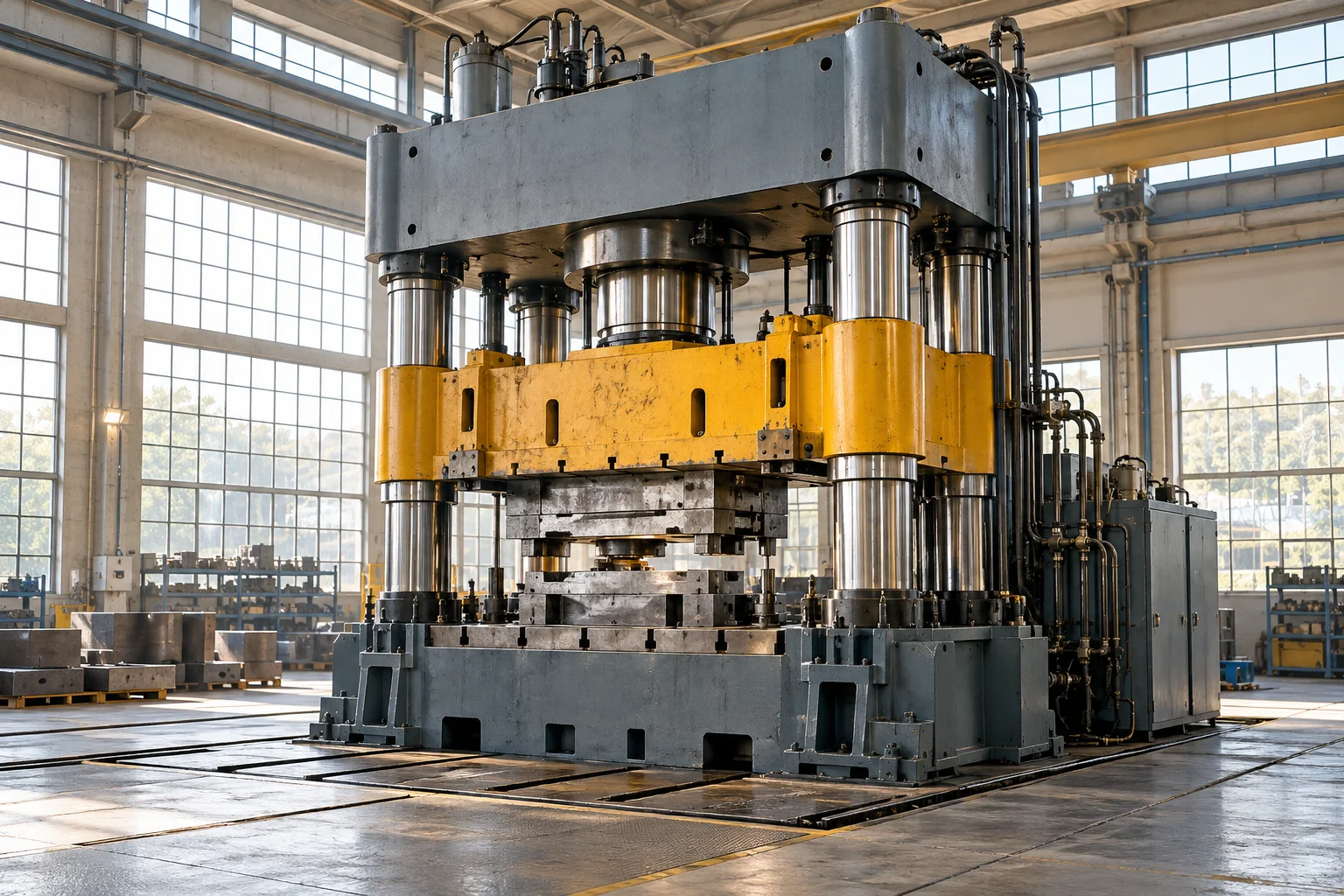
The recognizable frame, moving slide, and lower bed establish a space where large forces can act in a controlled way. That force must travel through the tools and return through the structure. The press is therefore both a motion producing machine and a load carrying loop. Its engineering cannot be understood by considering the actuator alone, because the frame, guides, tooling, and workpiece all influence the resulting shape.
Mechanical presses convert rotation into a stroke
A mechanical press can use a crank, eccentric, linkage, or related arrangement to convert rotary motion into slide movement. A motor supplies energy, and a flywheel may store part of it between working events. As the slide approaches the material, the linkage changes its mechanical advantage. The available force and useful working region therefore depend on the mechanism's geometry, not merely on a constant motor output.
This arrangement is well suited to repeated cycles when the process and tooling match the motion. The slide follows a mechanically constrained path, and the tool performs work during the relevant portion of the stroke. Changes in material resistance affect energy demand and loading. The motor, flywheel, transmission, and frame must be considered together. A headline force rating describes only part of what the machine can provide over an actual forming cycle.
Hydraulic presses use pressure and piston area
A hydraulic press moves its slide through cylinders supplied by a pump and controlled by valves. Fluid pressure acting over piston area produces force, while the flow delivered to the cylinder influences movement speed. The circuit also determines how the machine changes direction, approaches the work, applies a forming load, and returns for another cycle.
Hydraulic operation provides ways to shape the force and motion sequence differently from a fixed mechanical crank arrangement. It can be useful when a process needs a particular pressure history or a sustained load. That flexibility carries its own design requirements, including fluid cleanliness, heat management, leakage control, and stable regulation. Hydraulic force is not free multiplication of energy: a large force acting over a distance still requires work, and losses in the system become heat. The useful comparison concerns the complete process cycle rather than force alone.
Tooling makes the force selective
The die and punch establish where material can move and where it is constrained. In bending, the tooling creates a controlled change in angle or curvature. In drawing, material flows into a cavity while other surfaces manage how it enters. Blank holders and other auxiliary elements can restrain the workpiece separately from the main slide movement. Several force paths may consequently exist within one press tool.
The material responds according to its thickness, strength, ductility, shape, and prior condition. Too little restraint can permit wrinkling, while excessive restraint can limit useful flow. A formed component may also change shape when the load is removed because some elastic deformation recovers. This springback is one reason the unloaded product cannot be inferred simply by copying the tool's loaded geometry. The machine must produce a process that accounts for how the material behaves throughout and after deformation.
The frame and guides preserve relationships
Large loads tend to stretch, bend, and twist the press structure. The bed and slide can deflect, and off center work can impose uneven loading. Guides control the moving slide's relationship to the fixed tools while the frame closes the force loop. A strong frame is not necessarily rigid enough in every relevant direction, so stiffness and load distribution matter alongside ultimate strength.
Tool dimensions and alignment can make small structural changes significant. The forming space must remain predictable while the load increases and decreases. Designers use frame architecture, support spacing, guide arrangements, and monitoring to manage this behavior. The visible columns or side frames are not simply a heavy stand for the actuator. They establish how accurately the tools remain related under the very forces the press was built to produce.
Feeding and unloading create a production system
Sheet metal may arrive as separate blanks or from a coil through straightening and feeding equipment. A progressive die can perform several operations at successive locations as a strip advances. Transfer arrangements move separate workpieces between stations, while robotic handling can connect presses to other processes. The cycle therefore includes locating material and removing the product, not just the moment of deformation.
Timing must ensure that feed motion and tool motion remain compatible. Material position affects the operation, and a correctly shaped tool acting in the wrong location still produces the wrong result. Lubrication and process media can influence friction and material flow, while scrap handling removes material separated by trimming or shearing. These auxiliary systems explain why a press installation can occupy much more space than the central frame would suggest. The forming machine is embedded in a flow of material and information.
Controlling motion without confusing methods
Servo driven mechanical presses add programmable motor behavior to a mechanical transmission. They can alter aspects of the slide motion within the machine's physical architecture, providing another route between a traditional fixed motion press and hydraulic operation. This does not make all press types interchangeable. Each architecture has particular relationships among energy storage, force availability, speed, and control.
The process determines which relationships matter. A rapid stamping cycle, a deep drawing operation, and a slow forming trial can favor different motion histories. It is therefore misleading to compare presses only by their maximum force or by how dramatic their movement appears. The relevant question is how the machine supplies the required work through the appropriate part of the stroke while maintaining tool alignment and material control. That system view explains the continuing coexistence of several press technologies.
Reading a formed part as a record of forces
The history of pressing connects simple hand and screw mechanisms with mechanized mass production, hydraulic power, and programmable motion. Across those changes, the central achievement remains the same: directing material flow through a repeatable sequence of constrained movements. The machine does not merely overpower metal. It creates conditions under which deformation produces a useful shape.
A good way to understand any example is to trace the force from its drive through the slide, tools, material, bed, and frame. Then trace the workpiece from entry to exit and notice which surfaces restrain it at each stage. Finally, consider what changes when the load is removed. Those three views explain why a press must integrate motion generation, structural stiffness, process tooling, and material behavior rather than relying on one exceptionally powerful component.
A finished panel also records the history of the material entering the die. Thickness variation, lubrication, grain direction, and previous deformation can change its response. Consequently, modern forming development increasingly joins material testing, simulation, toolmaking, and press control. The press supplies the movement, but the quality of the result belongs to this entire connected process.