
How Heavy Trucks Work
Transporting useful mass
A heavy truck is designed around a different balance of priorities from a passenger car. Its main purpose is to move a substantial payload repeatedly and economically, often over long distances or demanding terrain. The vehicle must support that load, transmit enough tractive force, reject heat, stop predictably, and remain serviceable. The cargo body may be a box, tank, tipping body, concrete mixer, or detachable trailer, each changing the forces entering the chassis. Understanding a truck begins with the distinction between carrying capacity and pulling ability: a powerful engine cannot compensate for inadequate axle capacity, braking capacity, tire adhesion, or structural strength.
A frame that distributes the load
Many heavy trucks use a ladder frame made from longitudinal members connected by crossmembers. This gives body builders a strong and adaptable foundation for different equipment. Cargo loads pass through the body mounts into the frame, then through suspension and axles to the tires. The frame must resist bending while accommodating the twisting imposed by uneven ground. Excessively rigid attachments can concentrate stresses when a body and chassis respond differently to that movement. Axle spacing, wheelbase, overhang, and the position of heavy components determine how weight is distributed. The same total mass can therefore produce very different loads at individual axles depending on where it sits.
Engines matched to sustained work
A combustion truck commonly uses a diesel engine because this engine type suits sustained high load operation and substantial torque demand. Fuel combustion produces pressure that drives pistons and a crankshaft, while turbocharging uses exhaust energy to supply additional intake air. Cooling, lubrication, and air filtration are essential supporting systems rather than minor accessories. The engine must work efficiently through a duty cycle that might include climbing, idling, slow maneuvering, and steady cruising. Its useful performance depends on the complete installation, including gearing and cooling airflow. Electric and alternative fuel trucks alter parts of this arrangement, but the requirement to provide dependable wheel power remains unchanged.
Gearing connects the engine to the job
A truck transmission offers ratios that let the engine operate usefully while road speed and load change. Starting a heavy combination requires substantial wheel torque, so a low gear reduces speed while multiplying torque. As speed rises, higher gears reduce engine revolutions for efficient travel. Automated transmissions can control the clutch and select gears, but the underlying mechanical exchange is still between rotational speed and torque. Propeller shafts carry power to driven axles, and final drive gears provide further reduction. Multiple driven axles improve the ability to transmit force in some conditions, although they also add mass, mechanical losses, tire interaction, and complexity.
The tractor and trailer form one system
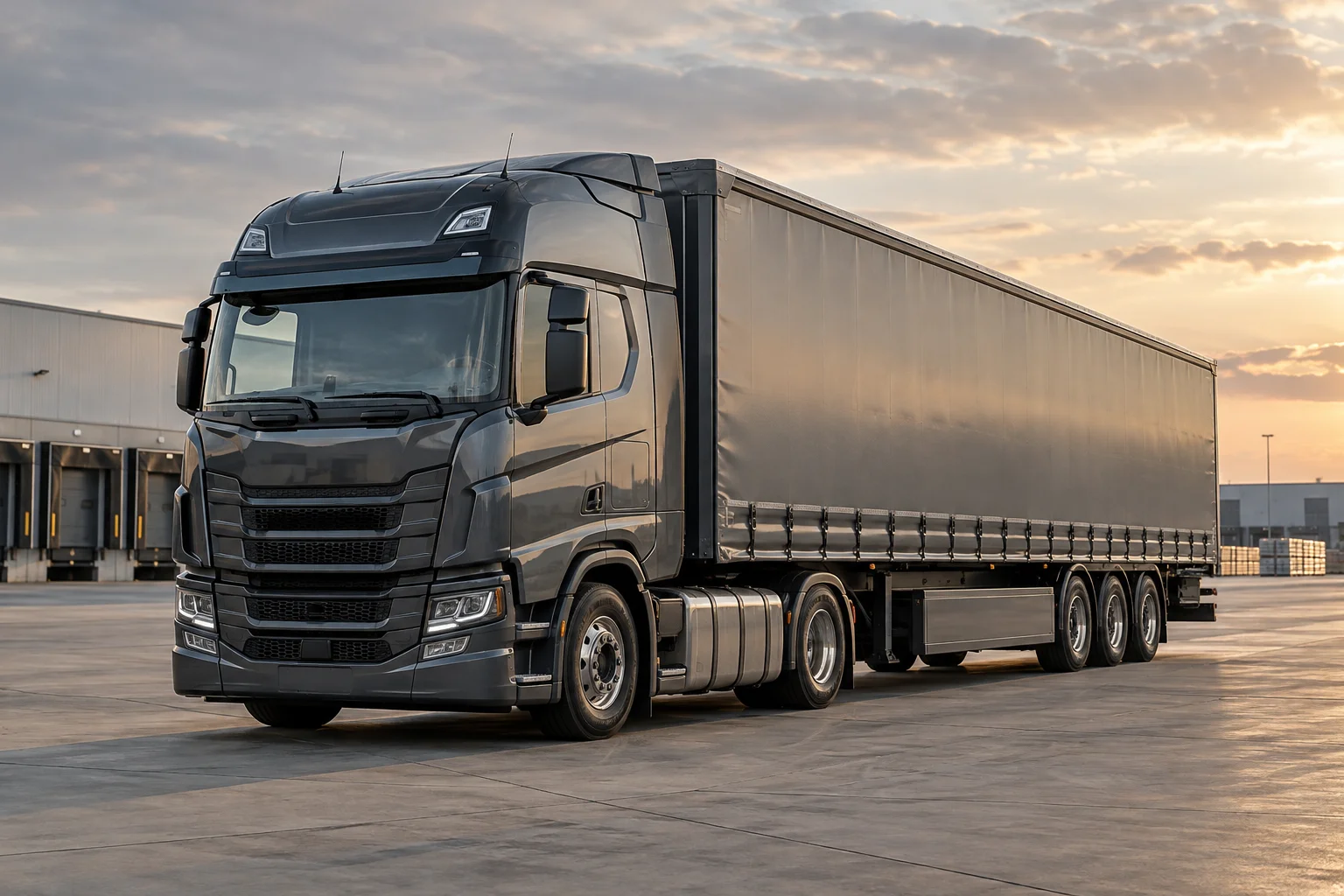
In an articulated combination, the tractor supplies propulsion and supports part of the semitrailer through a fifth wheel coupling. The remainder of the trailer load reaches the road through its own axles. This articulation allows a long cargo platform to turn, but it introduces motion and stability relationships absent from a rigid truck. The trailer follows a different path through a corner, and forces at the coupling influence both units. Cargo distribution affects axle loading and the combination's response to acceleration, braking, and lateral motion. A trailer is therefore not a passive box behind the engine; it is a major structural and dynamic part of the vehicle.
Air turns a command into braking force
Heavy road vehicles often use compressed air braking. An engine driven compressor supplies reservoirs, and controlled air pressure acts on brake chambers that operate friction brakes. The stored air provides a practical way to distribute braking commands around a large vehicle and across detachable combinations. Parking brake arrangements commonly use springs whose force is released by air pressure, giving them a different function from ordinary service braking. The complete system includes valves, circuits, monitoring, and connections rather than a single pressurized pipe. At the wheels, friction still turns motion into heat, so brake size, thermal behavior, adjustment, and tire grip remain fundamental even when the control medium is air.
Descents reveal the thermal problem
A truck descending a long hill must deal with both its existing kinetic energy and the gravitational energy released as it loses height. Repeated or continuous friction braking can generate significant heat. Engine braking and retarders provide other paths for absorbing energy, depending on the vehicle's design. Some retarders use fluid resistance, while other systems use electromagnetic effects or the engine's gas cycle. These mechanisms do not make the energy disappear; they move its dissipation into different components and cooling systems. The important engineering distinction is between a brief maximum braking event and sustained energy absorption. A truck designed for mountainous routes must address both situations as separate demands.
Suspension protects cargo and preserves contact
Truck suspension supports a changing load that can vary greatly between an empty return journey and a loaded outward trip. Leaf springs combine structural simplicity with substantial load capacity, while air suspension can help maintain ride height and distribute load according to the installation. Dampers control oscillation, and axle location links transmit braking and propulsion reactions to the frame. Tires must cope with high loads, heat, wear, and long service distances. Dual wheels or multiple axles distribute forces, but they create additional packaging and maintenance demands. Comfortable ride matters for drivers and fragile cargo, while consistent tire contact matters for braking, steering, and the usable traction of driven axles.
Efficiency is a whole vehicle question
On a fast road, aerodynamic resistance becomes an important power demand. Cab shape, trailer height, gaps, underbody airflow, and external equipment all affect drag. At lower speeds, rolling resistance, repeated acceleration, auxiliary equipment, and idling may dominate the energy account. A refrigeration unit, hydraulic pump, or concrete mixer adds work beyond merely moving the truck. Reducing empty running can improve transport efficiency without changing the engine at all. Electrification introduces battery mass, charging arrangements, and regenerative braking into this calculation. No single fuel consumption number describes every application, because a long haul tractor and an urban collection truck experience fundamentally different patterns of work.
From motor wagon to logistics infrastructure
Heavy trucks extended the older work of wagons and traction engines by combining self contained propulsion with flexible road routes. Their development depended on stronger tires, reliable engines, better brakes, standardized cargo systems, and roads capable of carrying repeated loads. The modern truck is closely linked to warehouses, ports, factories, and distribution schedules. Its mechanical architecture reflects these connections: interchangeable trailers, accessible service points, specialized bodies, and extensive monitoring make the vehicle useful as part of a larger process. Studying trucks reveals how engineering evolves around an economic task. The most successful design is often the one that delivers dependable transport over its working life, rather than the one with the most dramatic isolated specification.