
How Does an Agricultural Crop Sprayer Work?
Distributing liquid across a moving field
A crop sprayer is a mobile fluid delivery system. It takes liquid from a tank, moves it through pipes and valves, and divides it among many nozzles positioned above or within a crop. The intended result is a controlled distribution over an area. That connects several quantities: the flow leaving the machine, its travel speed, the width being treated, and the spatial pattern produced by each nozzle.
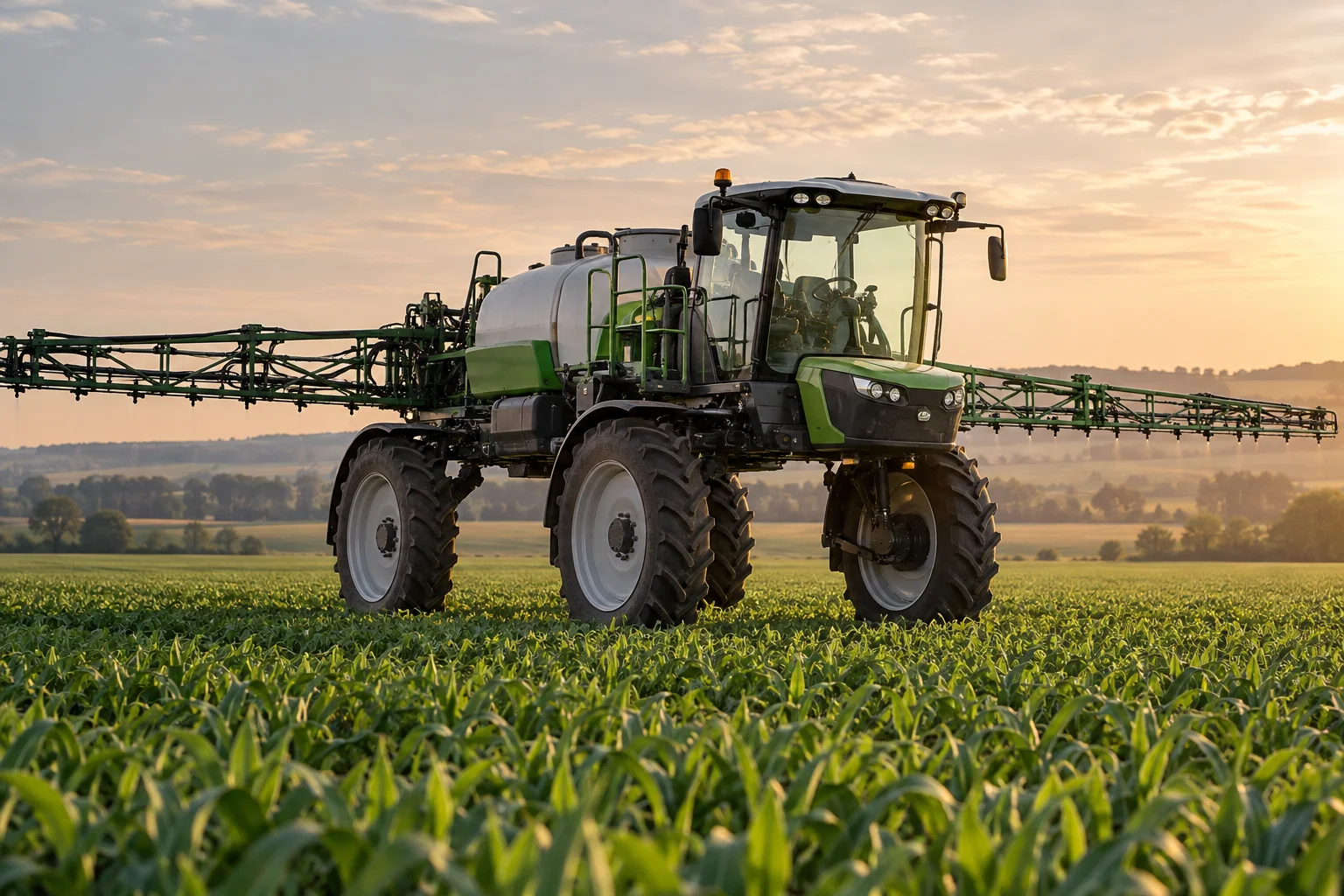
The familiar self propelled sprayer combines this fluid system with a high clearance vehicle and a long folding boom. Trailed machines use a tractor for movement and sometimes for other power requirements. Mounted sprayers can be much smaller. Despite differences in scale, all must transform a variable journey over uneven ground into a reasonably consistent application pattern. The machine is a meeting point between vehicle dynamics and liquid mechanics.
The tank is part of the process
The main tank stores the liquid supply, but its shape and internal flow matter. A changing liquid level alters the moving mass carried by the vehicle. Liquid can surge as the chassis turns or changes speed, so tank placement and internal arrangements influence stability and ride. The location of the tank also determines how axle loading changes as the supply is used.
Some mixtures require agitation to remain suitably distributed. A return flow or a dedicated agitation arrangement can circulate liquid within the tank. Filters and strainers protect downstream components from particles, while plumbing provides filling, circulation, and delivery paths. These functions are not identical, even when they share a pump. Understanding the tank as an active part of a circuit helps explain the number of pipes and valves visible around a modern sprayer.
Pumps and regulators establish a useful flow
The pump supplies energy to the liquid. Sprayers can use different pump types, each with a characteristic relationship between flow, pressure, rotational speed, and fluid properties. The resistance of the plumbing and nozzles helps determine the resulting operating condition. A pressure reading consequently describes the behavior of the system at a particular point, not a promise that every nozzle receives exactly the same flow.
Regulation can use bypass arrangements, speed control, or other mechanisms to match delivery to demand. Changes in active boom sections alter the number of open outlets. A controller may need to respond so that closing one group does not unintentionally change the output of all the remaining nozzles. Pressure losses along a long supply line make pipe sizing and distribution layout important. The fluid system has to behave coherently as a network rather than as isolated pieces of hose.
Nozzles convert a liquid stream into droplets
At each nozzle, liquid passes through a controlled geometry and breaks into a spray pattern. The shape and size of droplets depend on the nozzle design, operating condition, and liquid properties. A nozzle is therefore a process component rather than merely a convenient hole. Different designs can produce different distributions even when their total flow is similar.
Adjacent patterns need to combine across the boom. Their spacing and height affect how those patterns overlap at the target surface. Droplets also interact with air movement and the crop canopy after leaving the machine. This introduction concerns the engineering of delivery, not selection of chemicals or application instructions. It is enough to recognize that droplet formation and placement are connected but distinct: a consistent quantity leaving the tank does not guarantee an identical spatial distribution when it reaches the crop.
The boom is a long flexible structure
A wide boom increases the area covered in one pass but introduces structural and dynamic challenges. It must carry plumbing and nozzle bodies while staying light enough to fold, transport, and control. Hinges divide it into sections, and hydraulic cylinders change its configuration. Suspension systems reduce the influence of vehicle roll and local impacts on its height above the target.
The tips of a long boom can move substantially even when the chassis motion seems small. Pitch, yaw, structural bending, and uneven ground all affect nozzle position. Sensors may measure boom height, while controllers adjust actuators to follow terrain. Their success still depends on response time, structural stiffness, and the physical range of movement. The boom demonstrates why agricultural machines often need flexible structures that are also carefully controlled, rather than simply being made as rigid and heavy as possible.
Vehicle motion and delivery must agree
For a fixed working width, a faster journey covers more area in the same time. Maintaining the same average quantity per area then requires a greater delivery rate. Conversely, slowing down without changing liquid output would increase that quantity. Speed measurement is consequently part of the fluid control problem. The relationship becomes more complicated during turns because the outer parts of a wide boom follow longer paths than the inner parts.
Individual nozzle control and section control can respond to these geometrical effects and to previously covered areas. Such features depend on reliable sensing and communication, but their purpose remains mechanical and spatial: aligning the liquid emitted from many moving points with an intended ground pattern. A map in the cab represents instructions. The pump, valves, nozzles, boom, chassis, and ground motion determine whether those instructions become a consistent physical result.
An integrated machine with competing priorities
The high clearance chassis allows some sprayers to pass over established crops. Large tires, suspension travel, steering arrangements, and weight distribution balance that clearance against maneuverability and ride. A larger tank can reduce refill interruptions but adds mass. A wider boom can reduce the number of passes but requires more sophisticated folding and motion control. Greater speed can increase theoretical coverage while making dynamic disturbances harder to manage.
These tradeoffs explain why sprayers range from modest mounted units to highly integrated vehicles. Their development is not simply a progression toward larger tanks and longer booms. It is also a history of better metering, sensing, structural control, and coordination between liquid flow and movement. Follow the liquid from tank to pump, along the boom, through the nozzle, and toward the crop. Then follow the vehicle path beneath it. The quality of a sprayer emerges where those two journeys meet.
Why the whole pattern matters
A single nozzle is convenient to examine on a bench, but the field receives the combined work of an entire moving array. Small deviations can accumulate across that array: nozzle output may differ, boom motion can change height, and a turn changes the distance traveled by different sections. The result is a spatial pattern rather than a single flow measurement. This makes sprayers an instructive contrast with machines whose product can be weighed or inspected at one final outlet.
Design development increasingly concentrates on this distributed behavior. More precise local control is useful only when it is supported by a sufficiently stable structure and trustworthy motion information. The engineering objective is to manage variation across both space and time. That perspective helps explain why long booms, individual valves, position sensing, and suspension belong in the same discussion even though they initially appear to be unrelated parts of the vehicle.