
How Conveyors Work
Movement becomes part of the workplace
A conveyor creates a prepared path along which goods or materials can move repeatedly. Instead of sending a vehicle to collect each load, the facility provides a moving surface, rotating supports, or another guided mechanism. This makes conveyors especially useful where the same transfer occurs many times. They can carry parcels through a sorting centre, pallets through a production facility, or bulk material between processing stages. The common principle is continuous or repeated movement along an engineered route, although the equipment differs greatly with the load and the process.
A conveyor is therefore more than a belt stretched between two rollers. Its working system includes supports, drives, transfer points, controls, guards, and a relationship with upstream and downstream operations. The Material Handling Institute describes conveyors in terms of transporting cases, totes, pallets, and other loads through facilities. That perspective is useful because the purpose is flow rather than motion alone. A machine can move quickly while the overall system performs poorly if goods arrive in the wrong order, accumulate at a blocked transfer, or require repeated correction by people.
A belt transmits motion through contact
In a belt conveyor, a continuous flexible member circulates around pulleys and supports the material being transported. The drive applies torque to a pulley, and friction between pulley and belt transmits the force needed to move the loaded run and overcome resistance. Tension keeps the belt suitably engaged and controls its shape between supports. Too little tension can lead to slip or poor tracking, while excessive tension increases demands on the belt, bearings, and structure. Effective design balances these relationships rather than simply tightening the system as much as possible.
The belt may slide over a bed or ride on idlers, depending on the application. Its material and surface influence friction, flexibility, wear, and suitability for the product. Bulk handling introduces further requirements, including troughing, containment, and the effects of impacts where material enters. Inclines change the relationship between gravity and the transported load. Cleats or specialised surfaces may help retain material, but each addition affects cleaning and transfer. The belt has to suit both the items being moved and the complete circuit through which it repeatedly bends.
Rollers, chains, and alternative supports
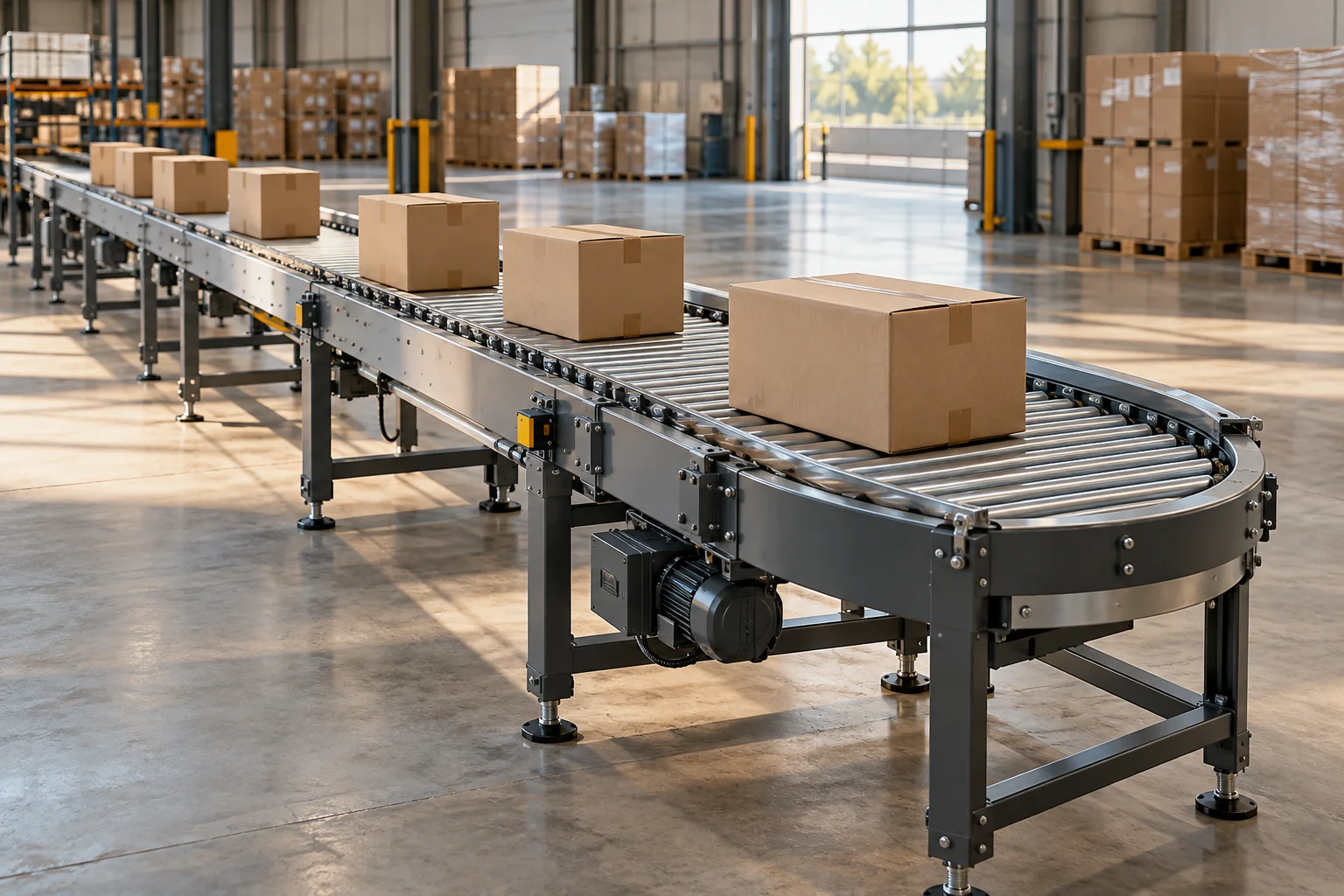
Roller conveyors support unit loads on a sequence of rotating elements. Gravity versions use a suitable slope and controlled resistance to produce movement without a powered drive along the whole route. Powered versions transmit motion through belts, chains, motorised rollers, or other arrangements. The bottom of the load matters: a rigid tote and an irregular soft package do not interact with spaced rollers in the same way. Roller spacing, diameter, bearings, and frame alignment determine how smoothly a particular item crosses the surface and transfers to the next section.
Chain conveyors offer another means of transmitting positive motion and supporting heavy or specially arranged loads. Slat and apron systems provide more continuous support while retaining a linked construction. Screw conveyors and other bulk-handling equipment use entirely different interactions between rotating elements and material. These alternatives show why selecting a conveyor begins with the load's behaviour. Size, shape, rigidity, abrasiveness, temperature, tendency to spill, and the need for cleanliness all influence the mechanism. A technically effective conveyor is one whose method of support and propulsion matches the material rather than forcing every product onto a standard belt.
Transfers often determine performance
The point where a load leaves one conveyor and enters another is frequently more demanding than a straight run. Gaps, changes in height, differing speeds, and changes of direction can tip, trap, rotate, or damage an item. Small packages may require close support; fragile goods may need gentle acceleration; bulk materials can generate dust or spillage. Transfer design establishes continuity between separate machines. It must consider the whole range of expected loads rather than only the most convenient demonstration object travelling under ideal conditions.
Merging and sorting add decisions to this physical problem. Two incoming streams need an agreed sequence, sufficient spacing, and a way to prevent conflicting movements. A sorter directs an identified item towards a selected destination using an appropriate mechanical action. Identification might come from labels, sensors, or information already associated with the load. The mechanism must then act at the correct time for the item's actual position. This creates a direct connection between information quality and physical reliability: a correct destination is useless if its command reaches the wrong package.
Controls coordinate flow and accumulation
Sensors allow a system to detect occupied zones, count items, estimate spacing, and recognise when downstream movement is unavailable. Controllers use that information to start, stop, or regulate sections. Accumulation arrangements hold loads temporarily without necessarily pressing the entire queue together. Their value is organisational: individual operations rarely run at exactly the same rate all the time. A buffer allows one part of the process to continue through a brief interruption elsewhere, but finite storage means it cannot compensate indefinitely for a persistently slower downstream stage.
Throughput depends on spacing, product length, operating speed, transfer performance, and the availability of the wider system. Increasing belt speed may reduce travel time but create more difficult transfers or leave an unchanged bottleneck at a workstation. Drives also have to manage acceleration and the combined inertia of moving parts and goods. Maintenance access and the ability to isolate sections affect how quickly faults can be resolved. The best control system makes the physical process understandable to the people responsible for it, rather than concealing every problem behind an impressive total item count.
Fixed infrastructure with lasting consequences
A conveyor can reduce repeated carrying and make movement predictable, yet its prepared route also commits space and shapes how a facility operates. Changes in product mix or business organisation may require new transfers, altered supports, or substantial rearrangement. Mobile handling equipment can offer flexibility where routes vary; conveyors offer dependable repetition where flow is sufficiently stable. Many facilities combine the two. Their interfaces deserve attention because goods must pass reliably from vehicles or robots onto fixed equipment and eventually to a person, process, or dispatch position.
The historical importance of conveyors lies in turning movement into a designed part of production and distribution. They connect extraction to processing, assembly to inspection, and picking to shipment. Their engineering combines friction, tension, rolling, structural support, sensing, and timing, while their usefulness depends on the organisation around them. Studying a conveyor means asking what moves, what supports it, what supplies force, and what happens when the next stage is unavailable. Those questions reveal a system whose apparent simplicity rests on careful management of continuous physical and informational flow.