
How Internal Combustion Engines Work
Turning chemical energy into shaft power
An internal combustion engine releases fuel energy inside a working chamber and converts part of that energy into mechanical motion. In the familiar piston engine, pressure acts on a piston, a connecting rod transmits its force, and a crankshaft turns the reciprocating movement into rotation. That rotating output can propel a vehicle, drive a pump, or turn an electrical generator. The engine is therefore an energy converter rather than an independent source of energy: its output depends on fuel, air, heat transfer, and the losses inside its mechanisms.
The striking feature is repetition. A single combustion event lasts only a small part of a running engine's life, yet a coordinated sequence of admission, compression, expansion, and exhaust repeats continuously. Several cylinders can stagger their contributions around the crankshaft. A flywheel and the inertia of connected components help smooth the variations between individual power events. The smooth rotation heard from outside conceals a rapid sequence of changing pressures and forces.
The cylinder as a changing chamber
In a common four stroke arrangement, the piston moves down while an intake valve admits fresh charge. The next upward movement compresses that charge. Combustion then raises its temperature and pressure, and expansion pushes the piston downward. Finally, an upward stroke expels spent gas through an exhaust valve. These four piston strokes occupy two crankshaft revolutions. A camshaft, timing drive, and valve mechanism coordinate the openings with piston position.
Actual valve events do not occur exactly at the simple boundaries drawn in elementary diagrams. Gas needs time to move, and the moving column has inertia. Valve timing, passage shape, and engine speed therefore interact. Variable valve systems can change this relationship for different conditions. Two stroke engines organise the same essential gas exchange and energy conversion tasks differently, completing their cycle in one crankshaft revolution and often using ports controlled by piston movement.
Ignition and mixture preparation
A spark ignition engine uses an electrical spark to initiate combustion of a prepared fuel and air mixture. Fuel may enter an intake passage or be injected directly into the cylinder. A compression ignition engine compresses air until it becomes sufficiently hot for injected fuel to ignite. These descriptions identify different combustion strategies; they do not mean every engine within either group shares the same injection equipment, fuel, or chamber geometry.
Combustion must spread through the available charge in a controlled way while the piston is moving. Mixing, droplet formation, chamber shape, turbulence, and injection timing all affect that process. Electronic control links measurements of temperature, pressure, speed, and other conditions to fuel delivery and ignition decisions. Increasing fuel alone does not guarantee useful additional output, because the available oxygen and the engine's thermal and mechanical limits also matter.
Following forces through the structure
The piston crown receives gas pressure, but the reaction travels into the cylinder head, block, bearings, and mounting structure. The connecting rod alternately transmits combustion and inertia loads. The crankshaft experiences bending and twisting while delivering torque. Bearing surfaces depend on a suitable oil film to separate moving metal surfaces. Even apparently simple parts therefore belong to a complex, repeatedly loaded structural system.
Piston rings help limit gas leakage and manage oil at the cylinder wall. Their sealing function competes with friction. The piston must also accommodate temperature differences and dimensional expansion. Designers balance mass, strength, stiffness, lubrication, and heat flow rather than maximising only one property. A lighter reciprocating assembly can reduce inertia loads, but it still has to survive the pressure and temperature environment of the combustion chamber.
Air supply and exhaust flow
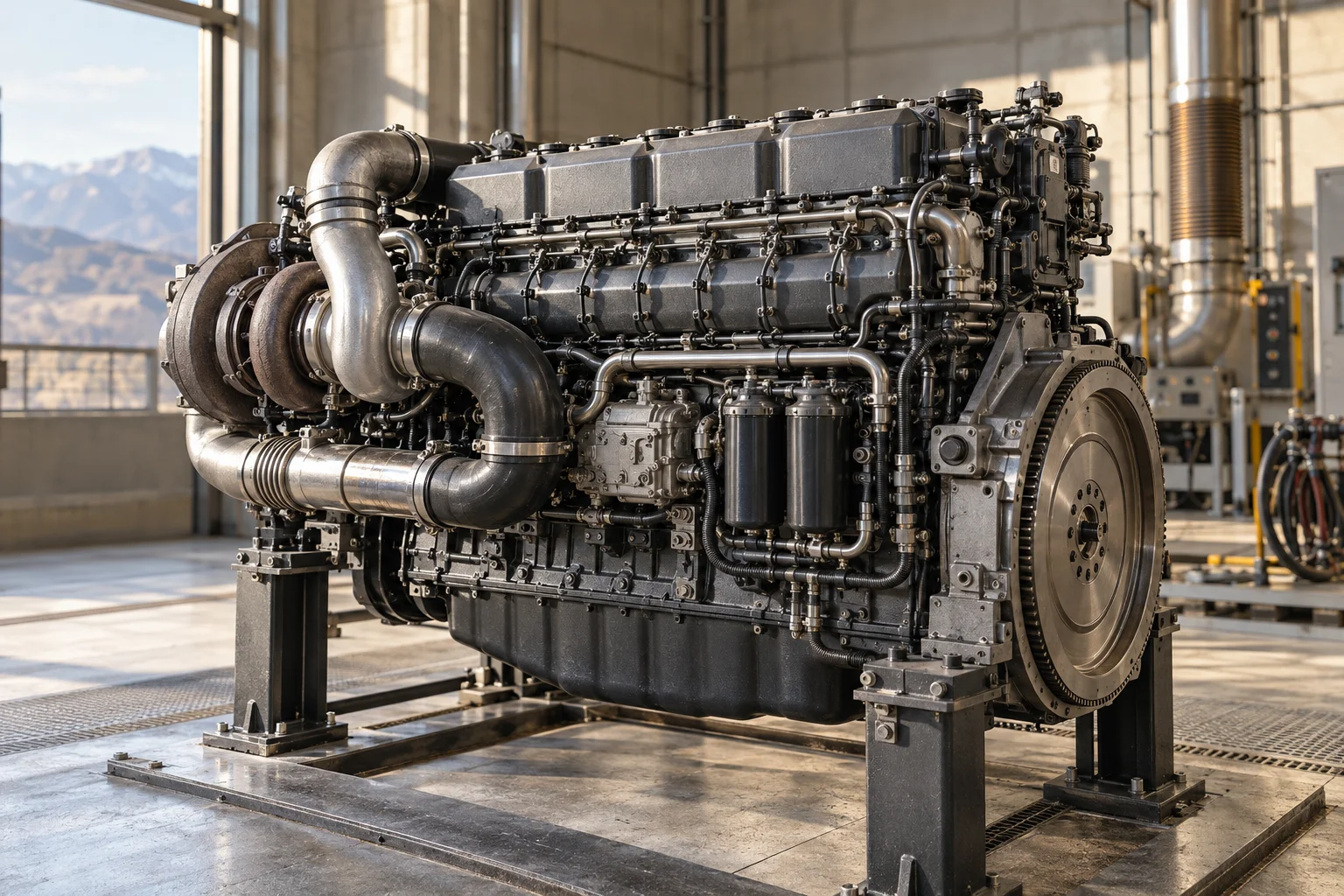
The intake system supplies oxygen and influences how easily cylinders fill. A naturally aspirated engine depends on pressure differences generated during its cycle. A turbocharger uses an exhaust driven turbine to power a compressor that increases intake air density. A mechanically driven supercharger obtains compressor power through the engine's shaft system. Each arrangement changes the energy balance as well as the response of the engine.
Compressed intake air becomes warmer, so charge cooling can improve density and manage temperature. On the exhaust side, manifolds, turbines, and treatment devices impose flow resistance while serving other purposes. Exhaust treatment may address different pollutants through catalysts, filtration, or additional chemical reactions. These components cannot be understood as decorative attachments: the modern engine operates as a connected air, fuel, thermal, and exhaust system.
Cooling and lubrication complete the machine
Only part of the fuel's released energy reaches the output shaft. Considerable energy leaves with exhaust gas or passes into engine components. Liquid cooling transfers heat from passages in the block and head to a radiator or another heat exchanger. Air cooled designs use surfaces and airflow to accomplish the same broad task through a different architecture. Cooling must maintain appropriate material temperatures without wasting unnecessary auxiliary power.
Lubrication serves bearings, piston assemblies, valve gear, and other contacts. An oil pump circulates lubricant through galleries, while filtration removes some contaminants and an oil cooler may manage temperature. Oil also transports heat and helps protect surfaces. Its condition is consequently connected to combustion contamination, operating temperature, and mechanical wear. These supporting circuits are essential to sustained power even though the crankshaft remains the most visible output.
Efficiency is a system question
Compression, expansion, friction, pumping losses, combustion quality, and heat transfer all affect efficiency. An engine's best operating condition may differ from the variable demand imposed by a road vehicle or working machine. Transmission ratios, hybrid electrical systems, and control strategies can shift how often the engine operates near a favourable region. A stationary generator faces a different duty pattern from a vehicle accelerating through traffic.
Power density also competes with durability, noise, cost, and cooling demand. Downsizing and boosting can obtain substantial output from a smaller package, but place greater demands on combustion control and component loading. Larger displacement may provide a different response and duty capability. There is no universal engine configuration that simultaneously optimises every application, because the surrounding machine determines which compromises are valuable.
A continuing mechanical story
Internal combustion engines developed through improvements in manufacturing, fuels, ignition, injection, lubrication, and control. Their history is broader than a sequence of famous cylinders: reliable bearings, interchangeable parts, accurate fuel delivery, and affordable production made the principle practical at scale. Modern versions retain the recognisable piston and crank while surrounding them with sophisticated sensing and thermal management.
Understanding an engine begins with following three paths together. Fuel and air enter and become exhaust; pressure becomes force and shaft torque; heat moves into gas, coolant, lubricant, and surroundings. These paths explain both the engine's achievements and its constraints. They also connect a vehicle engine to the wider mechanical world of compressors, turbines, generators, and the machines that consume its output.
The surrounding installation determines how the shaft output is experienced. A vehicle uses a clutch, torque converter, or another coupling and a transmission to adapt engine speed to wheel demand. A stationary engine may instead connect directly to equipment selected for its preferred speed range. This distinction helps explain why identical displacement figures cannot describe the usefulness of two complete machines. The engine, load, and connecting mechanisms form one practical power system.