
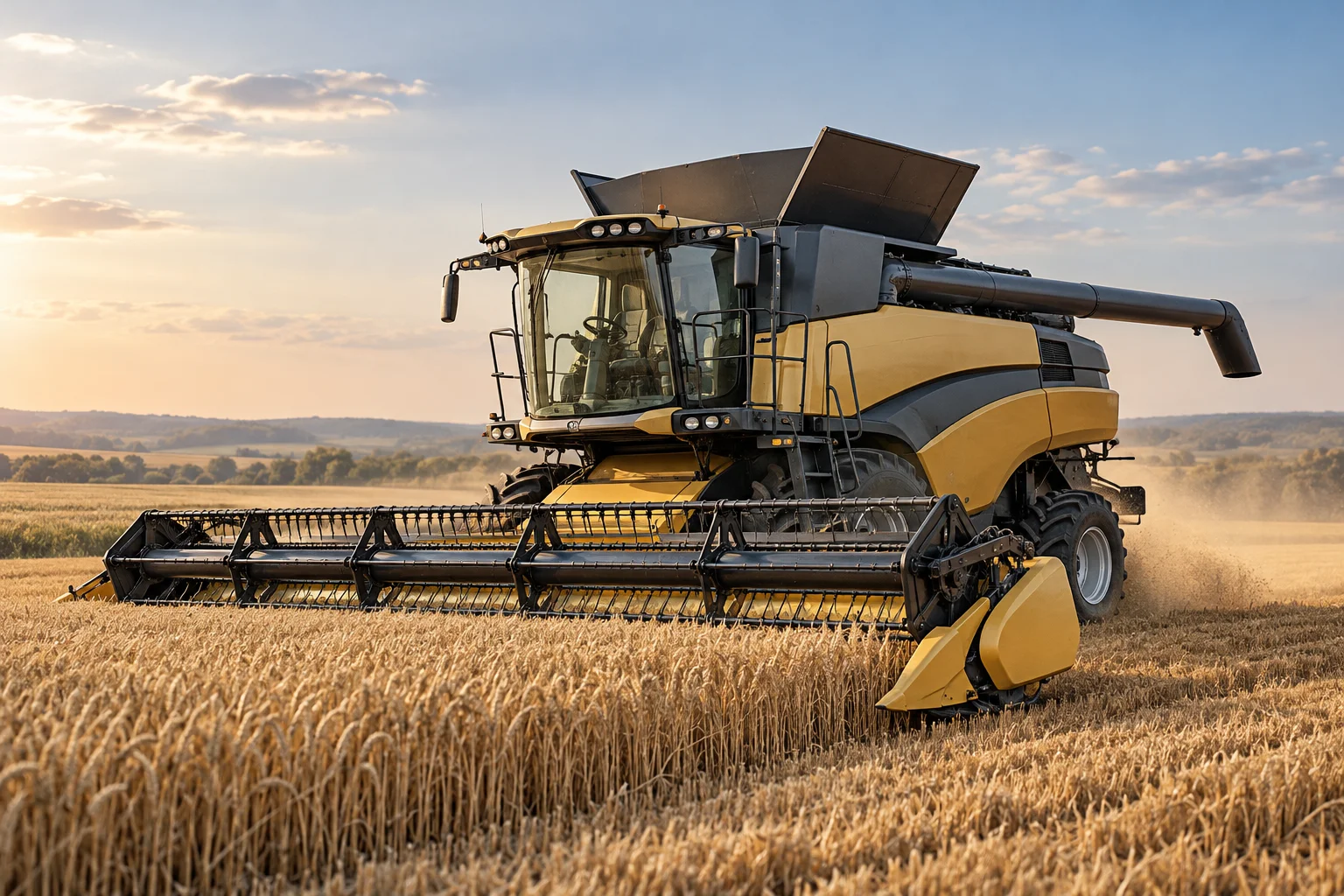
How Does a Combine Harvester Work?
Several harvest operations inside one machine
A combine harvester gathers a standing crop and separates useful grain from the surrounding plant material while moving across a field. Its name reflects the combination of operations that once demanded separate machines or repeated handling. The machine must cut or collect the crop, feed it evenly, release the grain, separate it from straw, clean it, and move it into storage. All these processes happen along a connected material path.
That makes a combine very different from a truck with a large cutting attachment. It is a mobile processing plant. The crop is not a uniform industrial feedstock: stalk length, moisture, density, and maturity can vary over short distances. The engineering challenge is to keep the material moving through several interacting stages without treating delicate grain as though it were indestructible gravel.
The header determines what enters
The header is the machine's first conversation with the crop. A grain platform typically uses a cutter bar to sever stems and a reel to help guide plants inward. Belts or an auger move the cut material toward the center, where a feeder carries it into the combine. A corn header handles plants differently, demonstrating why interchangeable headers are important rather than merely optional accessories.
An uneven incoming stream creates difficulties downstream. A thick slug of material can overload a threshing stage even when average crop flow looks reasonable. Header height, the relationship between travel and gathering motion, and the physical arrangement of the feeding components all influence the process. The header therefore does more than collect as much crop as possible. It establishes the quality and consistency of the flow that every subsequent mechanism must handle.
Threshing releases grain from the plant
Threshing applies controlled mechanical action to separate grain from the structures holding it. Conventional systems may use a rotating cylinder and a closely arranged concave. Other machines employ axial rotors that move the crop along a longer processing path. As material travels through the working space, impacts, rubbing, and compression help free the grain.
The aim is selective separation, not indiscriminate crushing. Stronger mechanical action can release difficult grain, but it can also damage kernels, break straw excessively, or increase the amount of small material reaching the cleaning system. Crop properties influence that balance. The rotor or cylinder is only one part of the story: the surrounding concave, clearance, crop residence time, and feeding pattern determine how the material experiences the mechanism. Different architectures manage the same competition between completeness, capacity, and gentleness.
Separation recovers what threshing leaves behind
Some grain leaves the threshing stage mixed with a much larger stream of straw. Separation gives that grain further opportunities to fall away from the lighter plant material. Straw walkers lift and move the straw in some conventional machines. Rotor based systems can continue separating material along the rotor housing. Gravity, agitation, and the shape of the crop path all contribute.
A longer path is not automatically a better one. Extra processing can consume power and change the condition of the straw, while excessive material loading can prevent grain from finding a route through the crop mat. The volume of straw entering a combine can therefore be just as important as the amount of grain it produces. This explains why two fields with similar grain yields may place very different demands on the same machine. The whole plant, not just the harvested product, moves through much of the system.
Air and sieves create the clean grain stream
The cleaning shoe handles the mixed grain, chaff, and small fragments arriving from threshing and separation. Oscillating sieves arrange and move the material while a fan supplies airflow. The different aerodynamic behavior of grain and lighter residue helps divide them. Clean grain passes into its collection route; material needing further processing may enter a return path.
This is not a simple choice between a strong fan and a weak fan. Air must pass through a moving bed of material, and the sieve openings determine where particles can travel. Distribution across the shoe matters, particularly when the machine works on uneven terrain. A concentrated stream can overload one area while another area remains lightly used. Cleaning performance is an example of several modest mechanisms becoming effective through coordination rather than through one spectacular component.
Grain handling and residue management
Once cleaned, grain travels through elevators and conveyors to the grain tank. An unloading auger transfers it to another vehicle or container. These mechanisms must move a valuable product continuously while avoiding unnecessary damage. The tank also acts as a buffer between the continuous field process and the more intermittent logistics of moving harvested grain away.
The material that is not stored still requires management. Straw may be left in a windrow for later collection or chopped and spread. Chaff distribution can affect the following field operation. These rear systems are part of the harvest process, not an afterthought at the end of a successful cleaning operation. Uniform residue distribution, useful straw recovery, power consumption, and the needs of subsequent crops can lead to different choices. The combine changes the field behind it as well as collecting what is in front.
Coordinating capacity and understanding development
A diesel engine commonly supplies the combine's mechanical, hydraulic, and electrical demands. Propulsion competes with processing systems for available power. Belts, shafts, gearboxes, hydrostatic drives, and control systems coordinate mechanisms operating at different speeds. Sensors can monitor loading, grain flow, losses, and tank status, but their information must be interpreted in the context of the crop and the machine's configuration.
The development of the combine is a history of integrating material handling with selective processing. A larger header or engine alone cannot guarantee proportionately greater output if another stage becomes the limiting factor. The best way to read the machine is to follow a stalk through the header and then follow the grain and straw along their diverging routes. That journey explains its size, its many drives, and the continuing variety of competing combine designs.
The importance of a bottleneck
A combine can be limited by crop intake, threshing, separation, cleaning, power, or the logistics of unloading. These limits need not appear at the same time. More straw may burden separation without a corresponding increase in stored grain. More moisture may change the response to threshing. A delay in grain transport may leave an otherwise capable machine waiting. Capacity is consequently a relationship between stages rather than one fixed quantity implied by its physical size.
The comparison with a factory is useful because a factory also needs balanced material flow. It is incomplete because the combine carries its own factory into a feedstock that changes continuously. The machine must combine structural durability with rapid process adaptation, and it must do so while the ground beneath it changes. That combination makes harvesting a particularly rich subject for studying how mechanical design and information work together.