
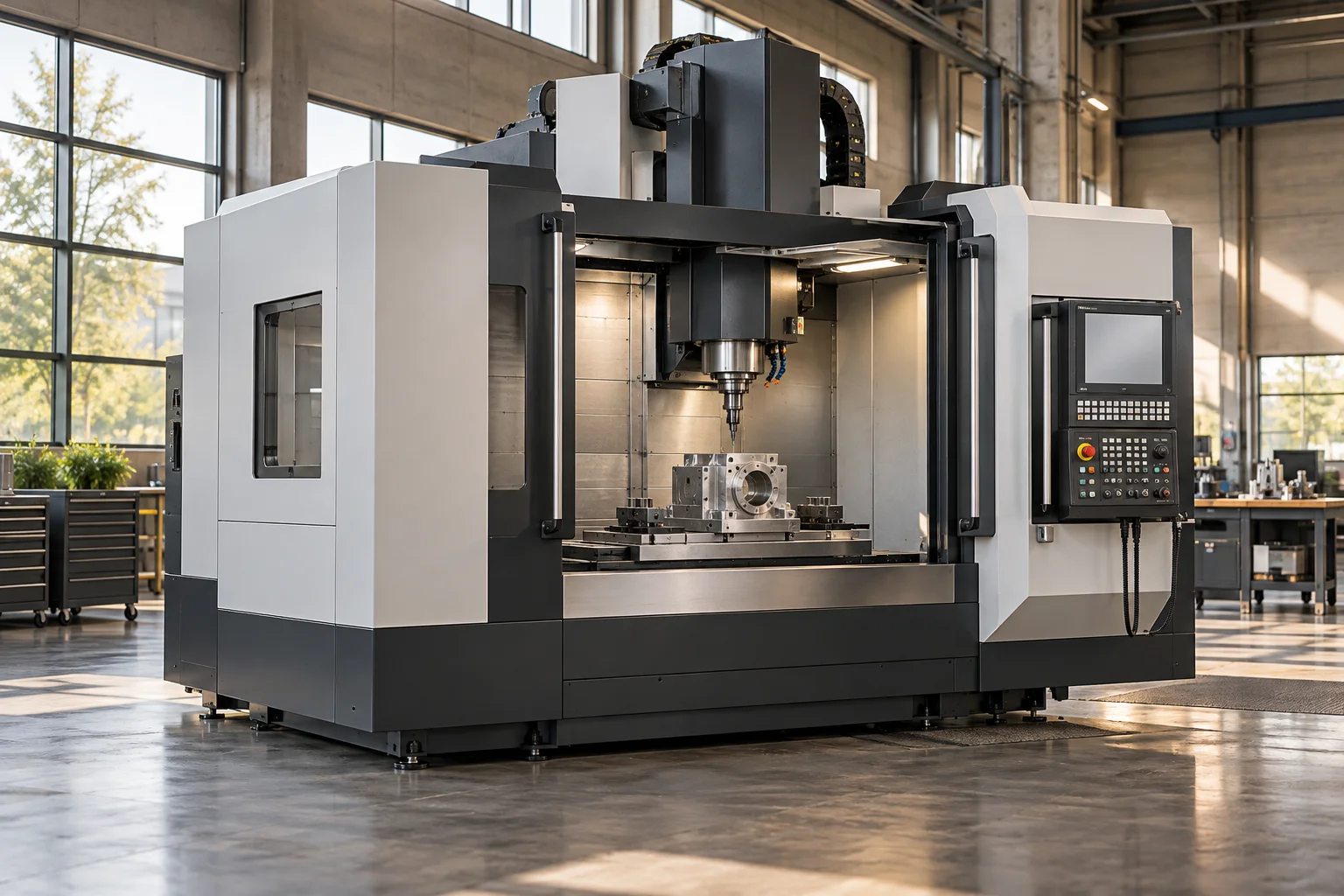
How Does a CNC Machine Tool Work?
Coordinates become a physical shape
A CNC machine tool converts a description of motion into controlled movement between a cutting tool and a workpiece. The computer coordinates the motion, but material removal still depends on familiar mechanical processes: a cutting edge loads the material, a chip forms, and forces return through the tool, spindle, workholding, and machine structure. Numerical control does not replace those physical relationships. It makes them repeatable and allows complex paths to be coordinated.
The category includes mills, lathes, machining centers, grinders, and machines combining several processes. In a mill, a rotating tool commonly moves relative to a constrained workpiece. In a lathe, the workpiece usually rotates while tools approach it. Knowing which object turns and how the remaining axes move is the first step toward understanding a particular machine's architecture.
The structure closes the force loop
A cutting force does not stop at the point where a chip separates. It travels through the toolholder and spindle into the machine frame, and through the workpiece and fixture into the same structure. These two paths form a loop. Any deformation along that loop can change the relative position of the cutting edge and the surface being created.
This explains the attention given to castings, guideways, bearing supports, and the spacing of structural elements. A machine that looks massive may still be flexible in a particular direction, while a compact arrangement can be stiff if its load path is short and well supported. Designers must also manage vibration. Cutting is not always a steady load: interrupted engagement and rotating imbalances can excite the structure, producing marks or chatter. Accuracy therefore depends on behavior under load, not simply on how precisely an unloaded axis can be positioned.
Spindles provide controlled cutting motion
The spindle holds and rotates either the cutting tool or the workpiece. Its bearings locate the rotating assembly while permitting motion with manageable friction. A motor supplies torque, directly or through a transmission, and the assembly must cope with speed, heat, and cutting loads. Different spindle arrangements favor different combinations of torque, speed, stiffness, and tool access.
A faster spindle is not inherently more capable for every material or process. A large cutter removing a heavy chip imposes different demands from a small tool making a fine feature. The connection between spindle and toolholder also matters. A precise bearing system cannot compensate for an unstable connection or a poorly supported tool. The spindle is consequently a complete mechanical and thermal system rather than merely a motor at the end of an axis.
Axes turn a path into coordinated motion
Linear axes commonly use motors, ball screws or other drive arrangements, and guides that constrain movement. Rotary axes add controlled orientation. Encoders provide feedback about position or rotation, although the measured quantity and its location vary by design. A controller compares intended motion with feedback and commands the drives to reduce the difference.
The problem becomes more complex when several axes move together. Following a curve requires coordinated changes in velocity and acceleration; changing tool orientation can require additional axes to act in a carefully related sequence. The machine also has physical limits on acceleration, stiffness, and motor force. A mathematically sharp corner cannot necessarily be traversed at an unchanged speed. Motion planning manages these constraints so that the programmed geometry becomes a practical mechanical trajectory rather than an impossible command.
The workpiece needs a trustworthy reference
Workholding locates the material and resists the loads produced during cutting. Vises, chucks, fixtures, and pallets provide different combinations of access and restraint. Excessive restraint can distort a part, while insufficient restraint can allow it to move. The location chosen for a reference surface also affects how later features relate to earlier ones.
The control needs to know how the physical setup corresponds to its coordinate system. Tool length, tool diameter, and workpiece position enter that relationship. Probes and measuring systems can help establish or inspect those quantities, but they remain part of a chain of references. A measuring device touching a flexible surface does not automatically reveal its unloaded shape. Reliable machining therefore requires consistent relationships among the model, machine coordinates, tool geometry, fixture, and actual material.
Supporting systems make sustained machining possible
Chips must leave the cutting zone rather than repeatedly obstructing it. Coolant or other process media can help manage heat, lubrication, and chip movement where appropriate. Enclosures contain the working environment, and chip conveyors or collection systems handle the material removed. These mechanisms influence both process consistency and the practical capacity of the machine.
Tool changers add another coordinated sequence. A machining center may select a tool, transfer it into the spindle, identify its working dimensions, and resume the planned path. The value is not only reduced interruption: multiple operations can be performed while preserving a common workpiece setup. A machine's usefulness often depends on these supporting sequences as much as on its nominal axis count. Automated handling, inspection, and process monitoring can extend the same idea into a complete manufacturing cell.
Heat, measurement, and the meaning of precision
Motors, bearings, cutting, and the environment all affect temperature. Different parts of a machine can expand by different amounts, changing the relative locations that establish a part's geometry. Designers use structural choices, thermal management, compensation, and measurement to limit these effects. Precision is consequently a changing relationship that must be maintained, not a permanent number engraved into the frame.
Repeatability and accuracy also mean different things. A machine may return consistently to the same slightly incorrect location, or it may be accurate on average but inconsistent from cycle to cycle. Surface finish introduces another dimension, influenced by tooling, vibration, material, and motion. Comparing machines requires separating these measures rather than treating them as interchangeable descriptions of quality. A successful part combines the relevant dimensional, geometric, and surface requirements in its intended condition.
A programmable machine with physical limits
The historical transition from manually guided tools to numerical control changed how motion could be described, stored, and repeated. It did not eliminate craftsmanship or process judgment; it moved much of that knowledge into planning, fixtures, tool selection, measurement, and programs. Computer aided design and manufacturing provide another link, translating desired geometry into paths that a real machine can execute.
The clearest way to read a CNC machine is to follow two loops. One is informational: geometry becomes commands, commands become motion, and measurements return information. The other is mechanical: force moves from tool through structure and back through the workpiece. Good machining requires the two loops to agree. The computer may describe a perfect surface, but the surface that exists is determined by the complete machine acting on actual material.
Process planning connects the part drawing to all these mechanisms. A thin wall may spring away from the cutter even when the axes follow their commands perfectly. Changing the order of cuts can preserve supporting material until the final passes. A deep pocket can demand a long tool whose flexibility limits useful cutting conditions. These examples explain why a capable machining centre still depends on decisions about access, sequence, datum surfaces, and inspection. Computer control supplies repeatable motion; engineering judgment makes that motion produce the intended part.