
How Bulldozers Turn Traction into Earthmoving Force
Moving the ground in front of the machine
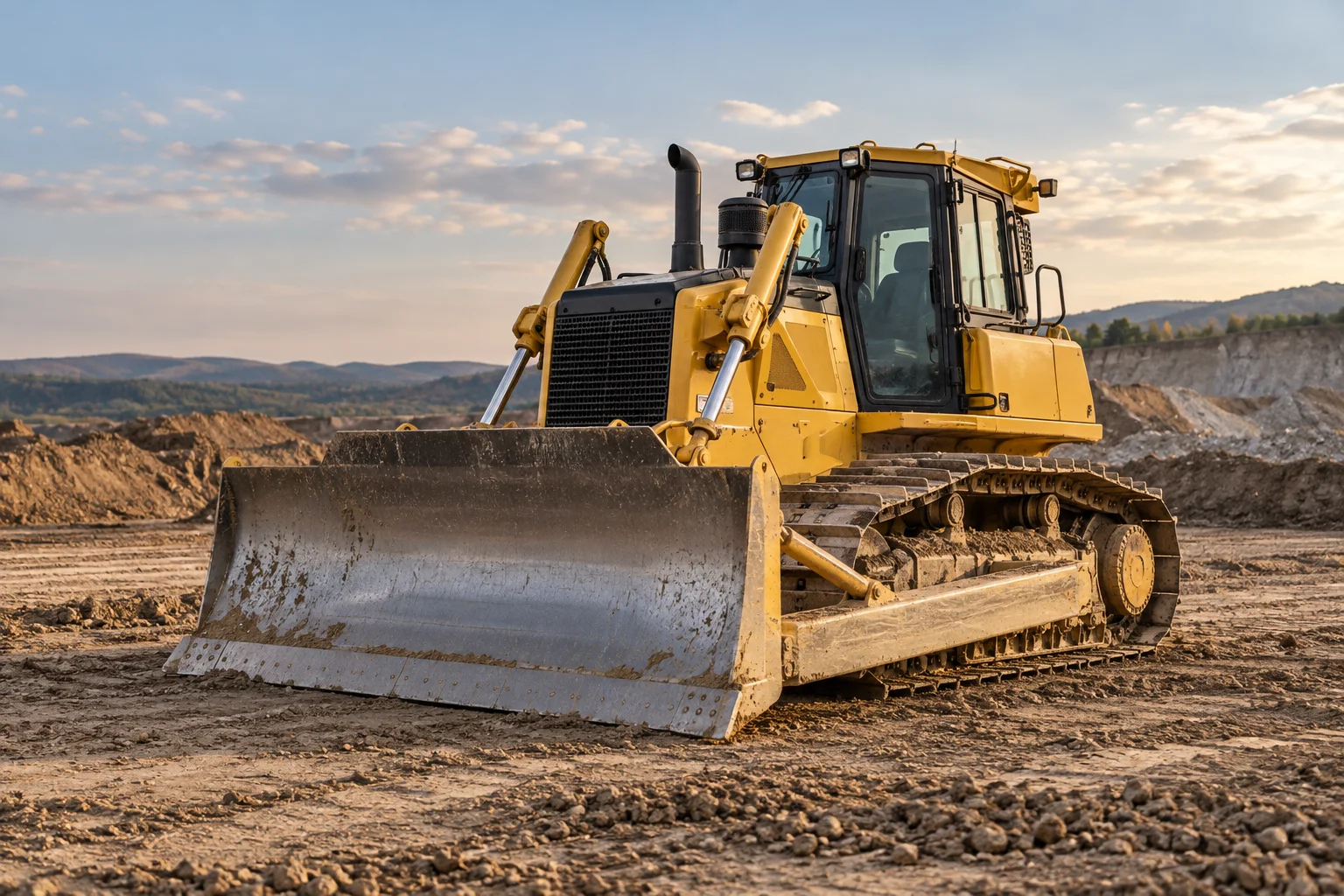
A bulldozer is designed to push, spread, and shape material with a blade carried ahead of a powerful mobile chassis. Its task is different from the repeated scoop and carry cycle of a loader. The blade moves a body of soil while the vehicle advances, making the whole machine part of the cutting and transporting mechanism. Tracks are common because they distribute weight over a substantial contact area and provide a robust interface with disturbed ground. Yet the essential identity of a dozer is not simply a tractor with tracks. It is the integration of traction, blade geometry, structural reaction paths, and controllable low speed movement around an earthmoving task.
Where the pushing force comes from
The engine or other power source sends torque through a driveline to the track sprockets. Depending on design, that path can include mechanical gearing, a torque converter, hydrostatic transmission, electric components, or combinations of these. The sprockets pull the tracks around their supporting structure. Ground reaction against the track shoes produces the force that moves the machine and pushes the blade into material. Engine torque is useful only to the extent that the machine can transmit it through that ground interface. When available traction is exceeded, track slip can increase without a corresponding increase in productive earthmoving. The soil underneath the machine is therefore as important as the power source inside it.
The blade and its supporting structure
A blade has a cutting edge and a curved working surface that helps collect or roll material as the machine moves. Different shapes suit different jobs. A relatively straight blade offers a different balance of penetration, control, and material retention from one with large wings that hold a greater volume. Push arms, frames, and joints transfer blade loads into the chassis. Hydraulic cylinders control lift and, on suitable arrangements, tilt or angle. These functions change how the cutting edge meets the surface. The forces are not confined to a simple forward push: uneven material can impose vertical loads, twisting, and side loads that the supporting structure must accommodate repeatedly.
Cutting, rolling, and spreading
The first contact between blade edge and ground establishes a cut. As material accumulates, its behavior depends on cohesion, moisture, particle size, and how easily it can move across the blade. Some material rolls continuously ahead of the blade, while other material builds a resistant mass that demands more traction. The dozer can also spread loose fill into a layer or shape an existing surface rather than cut deeply into it. A deeper cut does not automatically mean greater productivity, because a machine that loses forward movement may move less useful material over time. Blade load, travel speed, surface condition, and transport distance interact throughout the work.
Steering with two tracks
A tracked dozer turns by creating a difference between the motion of its left and right tracks. The details vary among steering clutches, differential steering, hydrostatic drives, and other arrangements. Turning requires the ground to accommodate lateral movement beneath parts of the track footprint, so it consumes power and disturbs the surface. A machine may therefore behave differently when turning on firm ground than on loose material. Track frame geometry, roller support, and suspension arrangements influence how contact is maintained over uneven surfaces. Steering is not a separate convenience added to the vehicle; it is another way of controlling the same ground forces that make pushing possible.
Weight distribution and the terrain
The blade is carried ahead of the machine, while the powertrain and other equipment distribute mass along its length. When the blade cuts or supports material, the resulting forces change loading along the tracks. Ground irregularities can shift that loading again. The machine's support footprint is substantial, but average ground pressure alone cannot describe what happens on weak soil, near an edge, or over buried voids. The way a dozer reacts to a slope or uneven surface follows the combined effects of gravity, geometry, traction, and dynamic motion. An engineering explanation should distinguish those principles from any operating limit, which must come from the actual machine configuration and its documentation.
Working behind the machine
Many dozers carry a rear ripper or another ground engaging tool. A ripper concentrates force through one or more shanks to fracture material that would be difficult to remove with the blade alone. That changes the task from moving already loosened material toward preparing it for movement. Loads pass through the ripper frame into the chassis while the tracks provide forward force. Material properties determine whether ripping is useful: weak layered rock, compacted soil, and a strong intact rock mass present different problems. The addition of a ripper illustrates how the same traction platform can apply force at either end, with different tool geometry and different demands on the structure.
Controlling a surface rather than a single point
For grading, the important outcome is the surface left behind. The blade edge is long, and its height and angle must be controlled relative to a changing ground reference. Small chassis movements can influence the edge even if the hydraulic command remains constant. Sensors and machine guidance can help estimate position and compare it with a design surface. Some systems assist blade movement, while others primarily present information. In either case, measurements must account for machine geometry and reference quality. The result is a close connection between traditional earthmoving and surveying: controlled soil movement depends on knowing where the tool is in relation to the intended terrain.
Wear, heat, and sustained work
The dozer's visible strength rests on many components exposed to abrasive material and repeated load. Track shoes, pins, bushings, rollers, cutting edges, and ripper tips all participate in contact that changes their shape over time. Driveline and hydraulic losses produce heat that must be removed, especially during sustained high effort at low vehicle speed. Cooling airflow, filtration, access for service, and protection from debris are consequently functional design features. A dozer cannot be understood from a single force rating or a photograph of its blade. Its usefulness depends on delivering controlled force through a long sequence of cycles while keeping its mechanical condition and energy balance within the intended working range.
A link between tractors and landscapes
Bulldozers connect the history of tracked vehicles with the mechanization of construction, agriculture, mining, and land development. Their basic contribution is to convert mobile traction into deliberate changes in terrain. Modern versions can incorporate sophisticated transmissions, electronic controls, and digital site models without changing that underlying task. Watching a dozer reveals a complete force loop: the powertrain drives the tracks, the ground reacts against them, the blade loads the material, and that resistance returns through the frame. The machine shapes the landscape because its structure and the landscape act on each other, not because its engine produces power in isolation.