
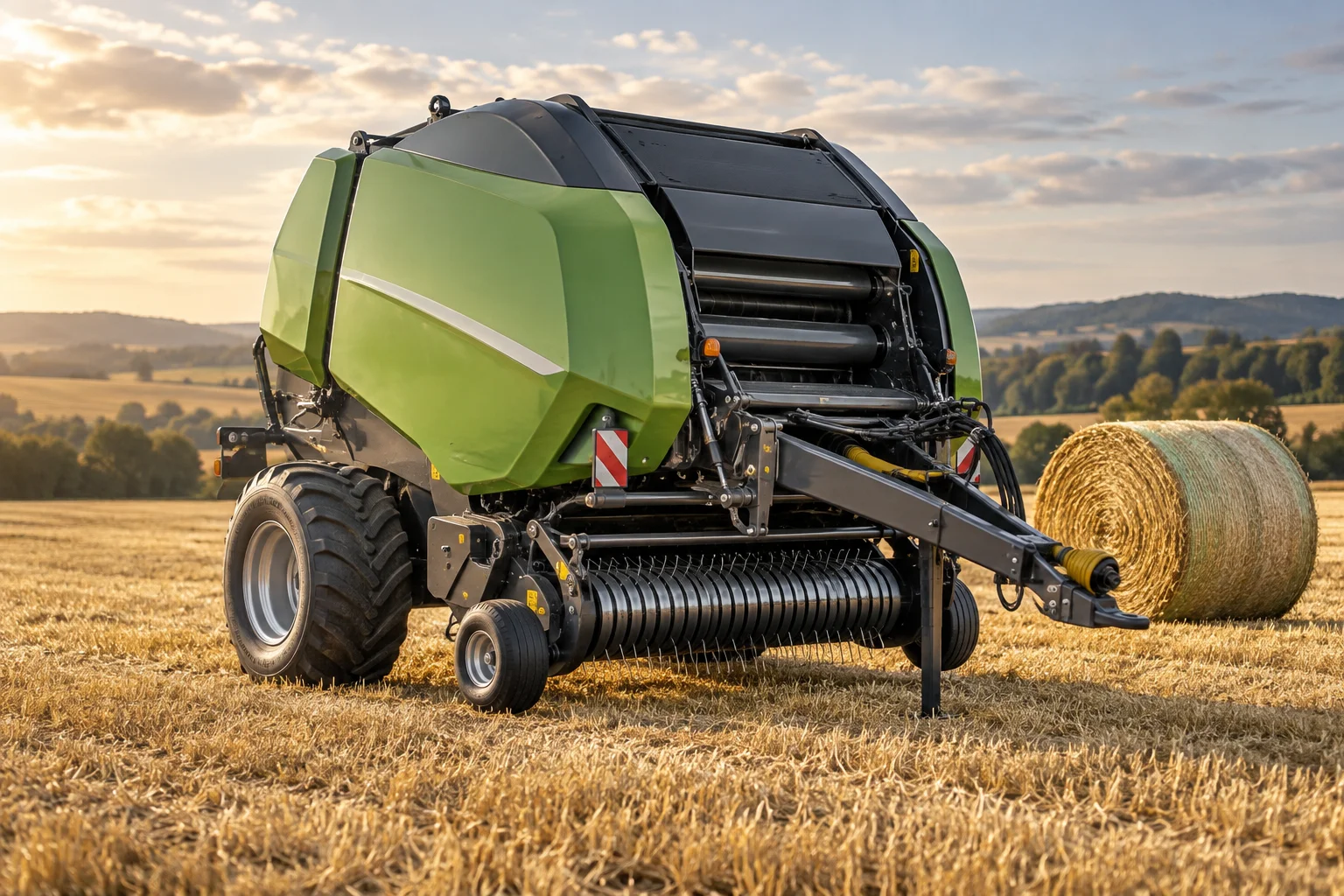
How Does an Agricultural Baler Work?
Turning scattered crop into a handleable package
A baler takes loose agricultural material and forms it into a package that can be transported, stacked, stored, or processed more easily. Hay, straw, and other crops enter as an irregular stream spread along the field. The machine gathers that stream, compresses it, and secures the finished shape. Its output is not just smaller material. It is a more predictable object for a wider chain of handling equipment.
Round balers and square balers approach this transformation differently. A round baler rolls crop within a chamber, while a square baler commonly uses repeated strokes to compress material through a rectangular chamber. Both must reconcile continuous collection with a forming and binding cycle. The differences between their mechanisms are more revealing than the simple observation that one produces cylinders and the other produces blocks.
Pickup and feeding establish the material flow
The pickup uses rotating tines to lift crop from a windrow. The tines must pass close enough to gather material while their supports and guards allow crop to leave the rotating path. Wheels and suspension help the pickup follow ground contours. An auger, rotor, or other feeder then moves the collected material toward the forming chamber.
The amount entering can change abruptly as the baler crosses a thicker or thinner part of the windrow. A feed system must manage this variability without allowing the crop to accumulate in the wrong place. Some machines include knives that shorten the material before it enters the chamber. Cutting changes how the crop packs and how it may later be used, but it also demands energy and introduces another interaction with moisture and stem toughness. Feeding is consequently a controlled preparation stage rather than simple transportation.
How a round bale begins and grows
In a round baler, belts, rollers, chains, or combinations of these elements set the incoming crop rotating. The first material forms a core, and additional material is wound around it. The chamber may have a fixed geometry or expand as the bale grows. A variable chamber arrangement lets its working elements move outward while maintaining contact with the increasing diameter.
Tension in belts or loading on the chamber mechanisms influences the resistance against which the crop is compressed. The machine must keep the forming bale turning while the material becomes denser and heavier. Crop flow across the width matters because an uneven feed can produce an uneven package. The growing bale is both the product and a temporary rotating element within the machine. Its changing size continually alters the conditions under which the chamber works.
How square balers make discrete layers
A conventional square baler feeds material into a chamber where a reciprocating plunger compresses it. Repeated charges become layers within a lengthening rectangular bale. The chamber resists the material's movement, allowing each stroke to add compression. The drive train has to coordinate the feeder, plunger, and binding mechanisms so that they occupy shared spaces at compatible times.
Large square balers and smaller rectangular balers differ in capacity and construction, but the basic relationship between intermittent plunger motion and advancing crop remains recognizable. The repeated loading creates significant cyclic forces. Flywheels, gearing, bearings, and the frame distribute those forces over time and through the structure. The finished bale may look static, but its shape records a carefully timed succession of feeding and compression events. Consistency depends on how those events respond to an uneven incoming windrow.
Binding converts temporary compression into a product
Compressed crop tends to expand when the chamber releases it. Twine, net, or another binding medium restrains that expansion sufficiently for the package to remain useful. Round balers may wrap the rotating bale, whereas square balers commonly use knotting mechanisms to secure lengths of twine around the material. These are different mechanical solutions to the problem of keeping the product together after the machine stops supporting it.
A knotter is a particularly instructive example of coordinated motion. Needles position twine, gripping elements control it, and rotating or reciprocating components form and release the knot. The details vary by design, and a functioning sequence depends on timing rather than on one part acting independently. Binding material delivery also has to correspond to the dimensions of the developing bale. The baler's most delicate mechanisms can therefore be just as important to usable output as its strongest compression components.
Ejection, power, and the wider handling chain
Once a round bale is complete and bound, a chamber gate can open to release it. In many arrangements this interrupts pickup while the package leaves and the chamber returns to its forming state. Rectangular bales can advance through a chamber and leave in a more continuous sequence. The difference affects how the machine's theoretical collecting capacity relates to its actual cycle across a field.
A tractor power take off commonly supplies rotary power, while hydraulic connections operate gates, pickups, or other actuated functions. Electronics can monitor bale size, loading, binding status, and moisture information. The relevant measurements depend on the design and intended crop. The finished package must also suit loaders, trailers, storage space, and subsequent users. A baler is therefore best judged as one part of a complete material logistics system, not simply by the size of the package it can make.
What the machine reveals about agricultural engineering
Baling involves compressible, variable, sometimes springy material. Unlike machining a metal blank, it does not produce dimensions by removing matter until a rigid surface is reached. Instead, it creates a controlled shape through applied force, confinement, and restraint. Material condition changes the relationship between those actions. Moisture and crop structure influence how the incoming mass flows, packs, and holds its shape.
The baler's history connects agricultural labor to mechanized packaging. It reduced repeated handling of loose material while enabling new storage and transport routines. To understand a modern example, follow the crop through five transformations: lifting, feeding, forming, binding, and release. Then watch how each stage is timed against the others. The distinctive engineering achievement is making an irregular stream become a repeated unit, reliably enough for other machines and people to build an entire working system around it.
Different packages create different systems
A round bale can be formed through rotation, while a rectangular bale lends itself to stacking with relatively little unused space between packages. Those geometrical differences continue far beyond the baler. They affect loading tools, trailer arrangements, storage buildings, and the way material is later fed into another operation. The forming mechanism cannot be evaluated independently of this larger handling chain.
Even the concept of density needs context. A tightly compressed package may reduce the volume moved, but compression demands work and changes how the material behaves. Binding must resist the tendency to expand, and the chamber must release the package predictably. A successful bale therefore represents a compromise among material condition, mechanical effort, shape, restraint, and later use. The baler makes those competing requirements visible in a repeated, clearly observable cycle, making it an excellent subject for understanding agricultural automation.