
Spinning
- Spindles & spinning wheels
- Spinning Jenny
- Mules & ring spinning
How did making cloth transform industry?
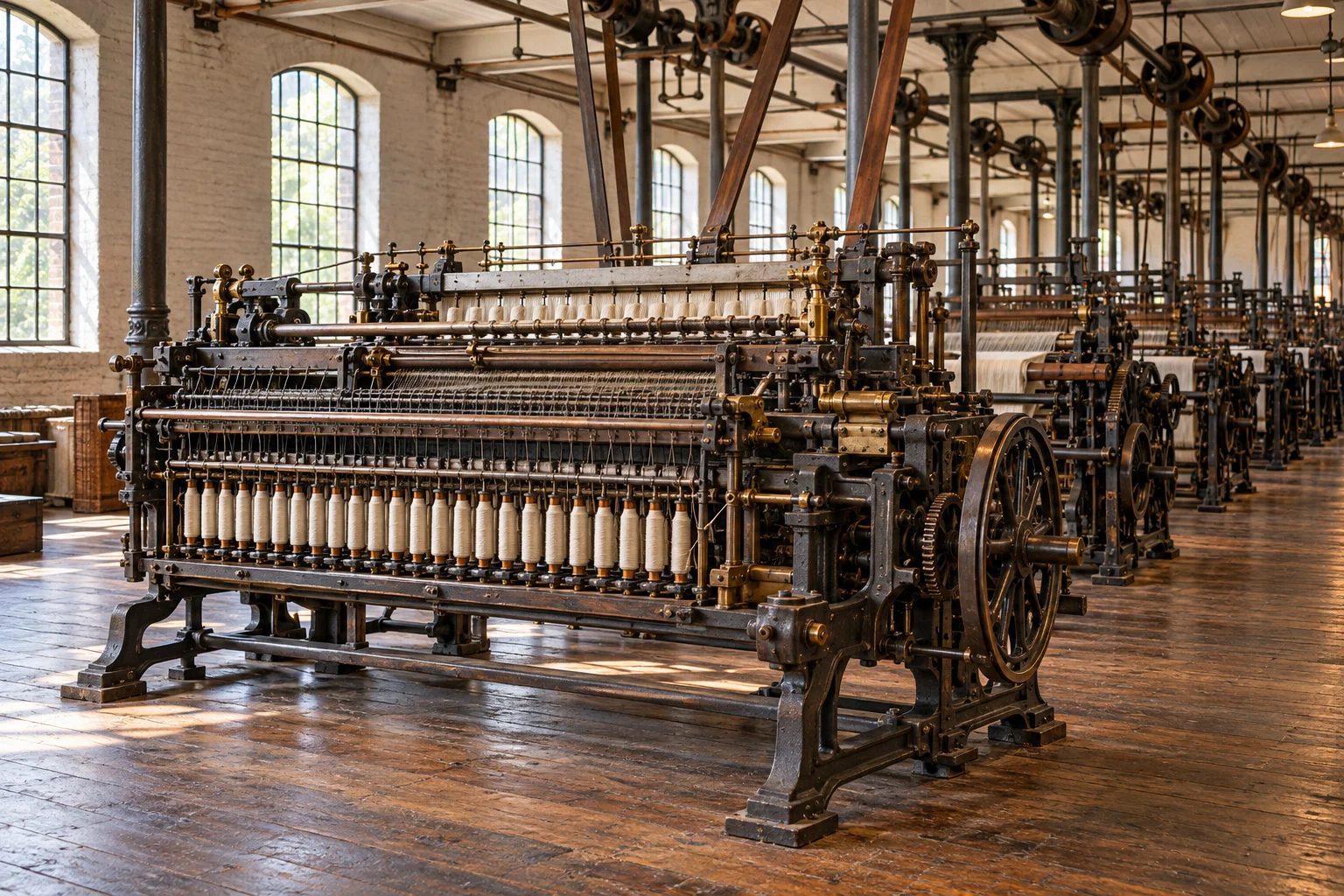
Cloth is familiar enough to hide the engineering required to make it. Loose fibres must be prepared and aligned, twisted into yarn, arranged into a structure, and finished for use. Clothing then requires additional cutting, joining, and shaping. Each stage creates a different problem of motion, force, tension, or sequence. Textile history is consequently an unusually rich way to understand mechanisation. It shows how many modest operations can be coordinated, how a bottleneck moves when one stage becomes faster, and how changes in machinery transform trade, work, and the spaces in which people live.
No single fibre or region represents the whole story. Wool, flax, silk, cotton, and later manufactured fibres have different properties and preparation requirements. Techniques also travelled through exchanges of goods, tools, workers, and knowledge. A responsible introduction should resist treating one celebrated invention as the beginning of all textile technology. Long traditions of skill established the material understanding on which powered equipment depended. What changed with industrial machinery was often the scale, concentration, and control of operations rather than the appearance of a task that nobody had previously understood.
Spinning introduces twist into a prepared supply of fibres so that they hold together as yarn. Before that can happen consistently, the material needs cleaning, opening, and some degree of alignment. The precise sequence varies with the fibre and desired product. A spindle, spinning wheel, or powered frame must coordinate drawing out the material, inserting twist, and collecting the result. Yarn quality depends on the relationship among these operations, not merely on how quickly the mechanism turns. Tension, fibre length, irregularity, and the operator's judgement all influence the outcome.
Mechanised spinning expanded the number of working positions and changed how drawing, twisting, and winding were arranged. The spinning jenny, water frame, mule, and ring frame should be studied as distinct solutions rather than interchangeable names for progress. They differed in motion, yarn characteristics, labour requirements, and suitability for particular circumstances. The Science and Industry Museum's working textile collection offers an important reminder: machines preserve only part of this history. Operating them also requires knowledge about settings, materials, faults, and sounds that is difficult to recover from an object sitting motionless on display.
A loom brings two systems of yarn into relation. Warp threads are held under controlled tension, an opening is formed between selected threads, and a weft is inserted across that opening. The structure is then brought together into cloth. Shedding, insertion, and beating must occur in a reliable sequence, while the finished material is taken up and more warp becomes available. Even a simple weave therefore depends on timing and the management of flexible material. A thread is not a rigid machine part: it stretches, rubs, breaks, and responds to moisture and handling.
Powered weaving transferred parts of that coordinated sequence into mechanisms. Pattern selection added another layer. Devices associated with Jacquard weaving made selected warp arrangements repeatable through a physical programme, famously connected with punched cards. The broader significance lies in separating a chosen sequence from the immediate movements of the operator. That connection makes the loom relevant to the history of information and control, but it should not erase its practical identity. It remained a machine for producing cloth, constrained by yarn quality, tension, wear, and the skill needed to keep production running.
Weaving does not exhaust the possible structures of textiles. Knitting forms connected loops, requiring a different set of needles and motions. Sewing joins pieces using stitches, coordinating needle movement, thread control, fabric feed, and often a second thread-forming mechanism. These machines converted particular hand movements into repeatable mechanical cycles. The challenge was not simply moving faster. A useful device had to make a sound structure, handle changes in material thickness, and permit enough control for the intended product. The workpiece remained flexible, and flexibility makes precise handling difficult.
Such equipment changed where garments could be made and repaired, but adoption was uneven. A household sewing machine, a workshop of skilled garment makers, and an industrial production line created different relationships between machine and worker. Operators continued to guide material, recognise defects, and adapt to unfamiliar fabrics. The social history of clothing therefore includes skill alongside speed. Standardisation helped increase output, yet people still had to negotiate fit, style, comfort, and affordability. The machine's repetitive cycle was only one part of the much larger task of producing an item someone would actually wear.
A textile mill connected machinery to power, building structure, material circulation, and labour discipline. Water or steam could drive shafts and belts serving many positions. Floor layouts affected supervision, movement, maintenance, and the transfer of material between processes. Noise, heat, dust, and the danger of moving parts shaped working conditions. The factory was not simply a collection of clever inventions placed beneath one roof. It was a system that made coordinated production possible while concentrating authority, investment, and risk. The physical arrangement of the building became part of the production method.
Trade extended that system far beyond the mill walls. Raw fibres arrived through networks whose labour conditions and political structures deserve attention. The Science Museum Group's educational material explicitly connects the cotton industry with enslaved labour supplying raw material. Finished textiles travelled to distant markets, affecting other producers and patterns of consumption. Machinery could increase output while the distribution of benefits remained unequal. This is why studying technical performance without supply chains gives an incomplete history. A loom's productivity and the conditions under which its fibre was produced belonged to the same material economy.
A productive way to approach this field is to follow the fibre. Ask what changes at each stage: its cleanliness, alignment, thickness, twist, arrangement, or surface. Then identify which part of the machine controls that change and which variables remain in human hands. This approach reveals why improvement at one stage can expose weakness at another. Faster spinning requires preparation capable of supplying it; faster weaving requires yarn that can survive its demands. Mechanisation is frequently a story of balancing linked processes rather than simply increasing the speed of a single machine.
The surviving equipment also raises questions of preservation. A machine that no longer runs may hide the significance of its timing and the subtle adjustments made by experienced operators. Working demonstrations can reveal these relationships, but preservation has to account for wear and responsible operation. The history continues into synthetic fibres, electronic controls, and automated handling, yet the foundational challenges remain recognisable. Fibres must still be guided and transformed without losing the qualities sought in the finished product. Textiles connect mechanical design to daily life with unusual directness: the result of the mechanism eventually rests against the human body.
These links open the existing topic guides, with their current stories, series and collection items.