
Printing
- Woodblocks & movable type
- Printing presses
- Rotary & offset printing
How did machines reproduce, process and store knowledge?
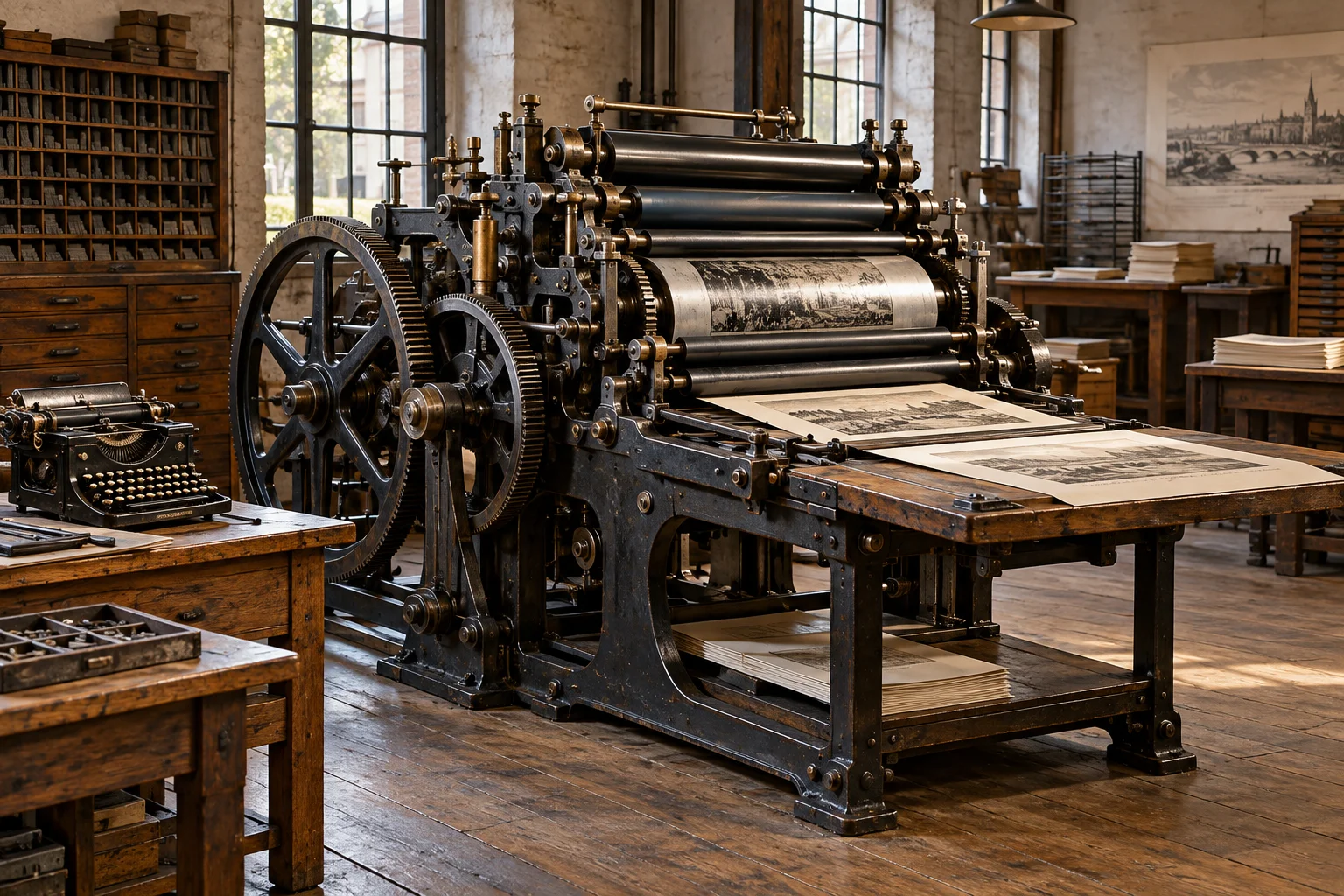
Information becomes historically powerful when people can preserve it, reproduce it, find it, and act upon it. Each of those activities depends on physical arrangements. A carved block holds an image in relief; a sheet carries ink; a typewriter guides a striking element; a punched card stores a pattern in holes. Even electronic information travels through equipment built from materials and moving components. Studying these machines connects intellectual history to workshops, paper mills, offices, distribution networks, and the practical effort required to make a message available to somebody else.
This field includes printing, paper production, writing equipment, calculation, and information storage. Their histories overlap without forming a single ladder of progress. Handwriting survived printing, books survived broadcasting, and paper records coexist with computers. Different methods offer different combinations of permanence, speed, cost, accessibility, and control. A machine that produces thousands of identical impressions answers a different need from a device that records one transaction. The useful historical question is therefore not which invention replaced everything before it, but which kinds of information work became possible, economical, or institutionally important.
Printing begins with separating the preparation of a message from the repeated act of reproducing it. In relief printing, raised surfaces receive ink and transfer it to another surface. A woodblock can combine text and image in one durable object. Movable type allows individual characters to be assembled, printed, and redistributed for another composition. The apparent simplicity hides demanding material problems. Type must have consistent dimensions; the printing surface must be level; ink must adhere and transfer appropriately; and paper must tolerate pressure without losing the intended detail.
A press adds a controlled force to this process. Screws, levers, beds, platens, and later cylinders distribute pressure and coordinate movement. Their geometry affects the size of the impression, the effort of the operator, and the repeatability of the result. Composing a page, correcting it, preparing the press, and handling sheets remain substantial tasks. Printing therefore developed through cooperation among crafts rather than one isolated mechanism. Metalworkers, compositors, papermakers, ink makers, binders, and merchants all influenced what could be produced and how far the finished material could circulate.
Powered presses increased the rate at which impressions could be made, but faster pressure alone could not transform publishing. The Smithsonian's printing collections show the importance of changes in machine construction and inking alongside power. A press running quickly needs a dependable ink supply, reliable sheet or web handling, accurate timing, and equipment capable of withstanding repeated loads. Cylinders and rotary arrangements reorganised the motion of printing. Instead of repeatedly stopping a flat assembly, designers could coordinate continuous or repeating movement around rotating surfaces and feeding systems.
Paper manufacture and finishing had to develop with printing. Continuous paper production, cutting, folding, binding, and distribution affected the cost and availability of newspapers, books, packaging, and forms. Offset printing introduced an indirect transfer between the prepared image surface and the final sheet, with its own material and registration demands. Colour work required several images to align. These developments were not merely improvements in appearance. They changed production planning and investment, encouraged large editions, and linked publishing more closely to transport, advertising, commercial finance, and the routines of mass consumption.
The typewriter mechanised the production of individual documents. Keys, linkages, escapements, ribbons, carriages, and paper guides coordinated a sequence of small movements. The escapement advanced the writing position in controlled steps, while the carriage return prepared a new line. Variations in keyboard arrangement, striking mechanism, and correction method reflected competing priorities. Legibility and speed mattered, but so did training, maintenance, desk organisation, and the ability to produce copies. The typewriter belonged to a larger office system of forms, filing cabinets, correspondence, and administrative authority.
Copying equipment changed the relationship between an original document and its circulation. Different processes relied on pressure, transfer materials, stencils, photographic methods, or electrical effects. Each brought particular restrictions on preparation, copy count, image quality, and storage. Standardised documents could coordinate distant branches of a company or government, but they also encouraged information to fit predetermined categories. Office machines consequently deserve attention as instruments of organisation. They redistributed tasks among workers, altered the pace of administration, and made records easier to multiply without guaranteeing that those records were accurate or fairly used.
Mechanical calculators express numerical operations through the positions and movements of parts. A wheel can represent a digit, while a carry mechanism transfers a completed revolution into the next place value. Addition is therefore not just a mental instruction but a sequence embodied in teeth, stops, shafts, and interlocks. Multiplication and division can be arranged through repeated operations and positional changes. The challenge includes preventing an incomplete movement from producing an ambiguous result. Reliable calculation requires a clear relationship between the user's action, the machine's internal state, and the displayed answer.
Punched cards and tabulating equipment extended mechanisation from arithmetic to the handling of structured records. Holes could represent categories or values, while sensing and sorting arrangements directed cards into useful groups. The information had to be encoded before the machine could process it. This was a powerful capability and a significant limitation: the chosen categories shaped the questions that could be asked. Early computers brought further changes in programmability, storage, and speed, but continued the underlying task of representing a problem in forms that equipment could manipulate consistently.
Information storage is also a history of physical compromise. A printed book offers direct human access, whereas a card deck or magnetic disk needs an interpreting system. Rotating disks require controlled speed, positioning, and careful spacing between components. Greater capacity is valuable only if information can be written, located, read, and preserved dependably. Equipment becomes obsolete; materials deteriorate; formats become difficult to interpret. The survival of an archive therefore depends on maintenance and migration as well as the initial act of recording. Mechanical precision supports intellectual continuity in surprisingly direct ways.
The social effects of these machines are equally complex. Lower reproduction costs could support education and public debate, while also enabling censorship, surveillance, propaganda, and concentrated ownership. Administrative equipment made large organisations manageable but could distance decisions from the people described by their records. This directory follows those connections through particular machines and production systems. A printing press, typewriter, calculator, and disk drive differ greatly, yet each makes information repeatable through engineered constraints. Understanding those constraints reveals how material technology helped shape what societies could remember, communicate, count, and organise.
These links open the existing topic guides, with their current stories, series and collection items.