
Keeping time
- Mechanical clocks
- Watchmaking
- Marine chronometers
How did machines become accurate and self-regulating?
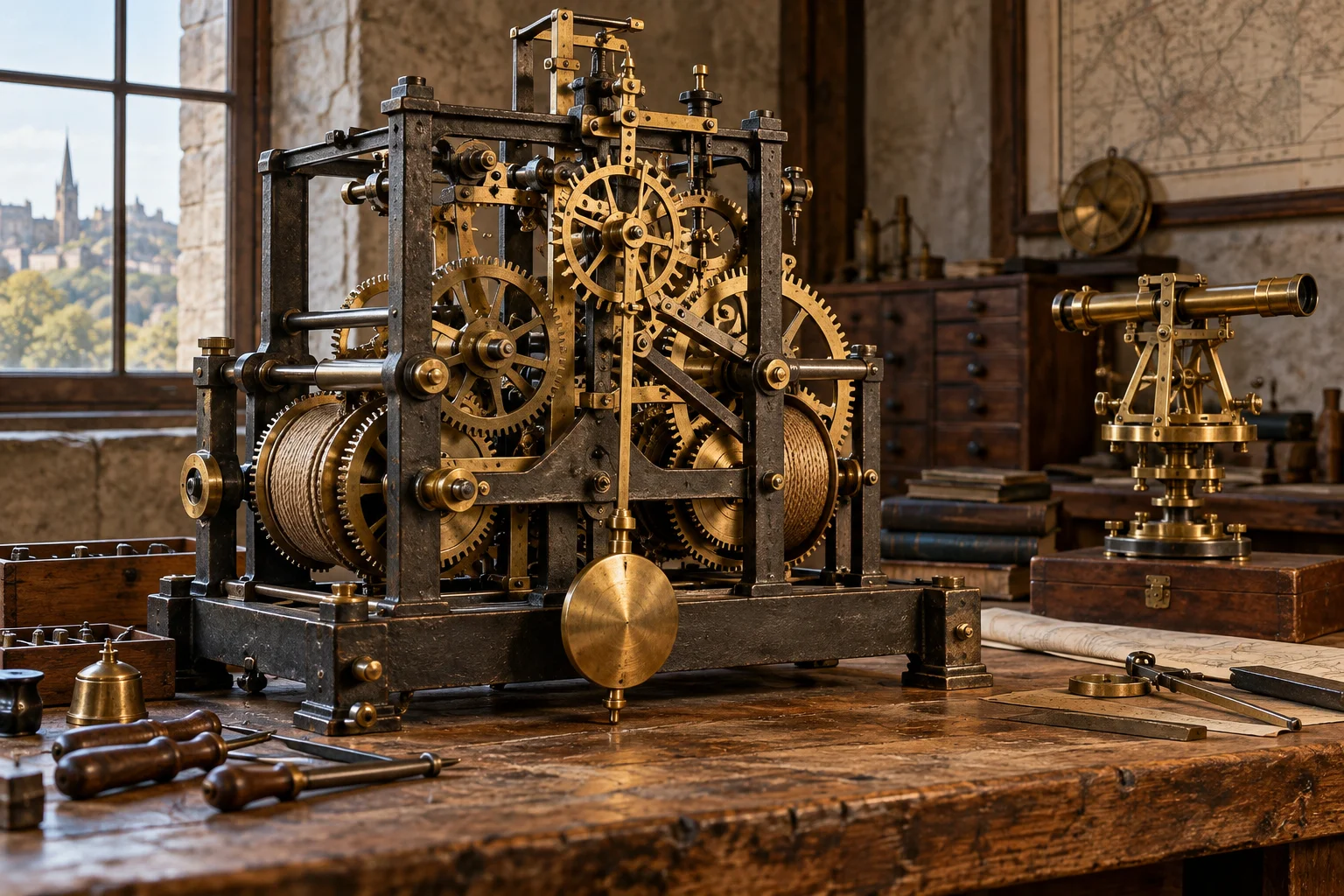
Precision is the ability to make, detect, or reproduce small differences consistently. It is related to accuracy, but the two are not identical: an instrument can give tightly repeated readings while remaining wrongly calibrated. The history of precision therefore includes standards, comparison procedures, skilled judgement, and environmental control as well as finely made objects. A measuring instrument becomes useful when people understand what its reading means and how confidently it can be compared with another reading. This makes precision a social arrangement supported by mechanical construction.
Control concerns a related ambition: making a system behave in an intended way despite disturbances. A governor adjusts power, a clock regulates motion, and a machine tool follows a guided path. Some systems simply repeat a prepared sequence; others measure their own behaviour and correct it. Studying these differences connects clocks and surveying instruments to industrial automation and robotics. It also prevents a misleading division between old craft and modern intelligence. Historical mechanisms already embodied careful reasoning about timing, comparison, error, and the management of uncertain physical conditions.
A mechanical clock needs an energy source, a train that transmits motion, and a regulating arrangement that prevents the stored energy from escaping too quickly. Weights or springs can provide energy, while gears establish relationships between the regulator and the displayed time. The escapement links periodic motion to controlled release. Friction, wear, lubrication, temperature, and changes in driving force all affect performance. A clock is therefore not simply a set of wheels turning at predetermined speeds. It is a continuing negotiation between energy, resistance, and a repeatable physical rhythm.
Pendulums and balance systems offered different solutions to regulation. Their suitability depended on where the timekeeper would operate. A clock in a building and a watch carried by a moving person face different disturbances. Watchmaking encouraged compact construction and careful finishing; public clocks raised questions of visibility, maintenance, and shared schedules. Increasingly reliable timekeeping supported navigation, science, transport coordination, and industrial discipline. These uses did not arise automatically from better mechanisms. Institutions had to agree on time signals, reference standards, and the authority of the clocks around which activity was organised.
Marine timekeeping demonstrates how performance changes when an instrument leaves the workshop. A ship moves, temperatures vary, and moisture threatens materials. A timekeeper intended for navigation must remain sufficiently dependable through those conditions. The Royal Museums Greenwich account of Harrison's work emphasises the demanding development of portable timekeepers and the practical difficulties surrounding their adoption. Their historical significance lies in connecting a mechanical reference to geographical reasoning. Comparing a reference time with observations made locally offered a way to relate the ship's position to a known meridian.
Surveying instruments similarly connect controlled geometry to an irregular world. Levels establish horizontal references; angular instruments measure directions; distance measurement links observations into a network. The instrument's mount, optical alignment, scales, and adjustment procedures matter as much as its theoretical principle. A surveyor must account for the limits of observation rather than simply trust a number. Better instruments supported mapping, property boundaries, roads, railways, and construction, but maps also served political and economic power. Measurement made territory legible to institutions while depending on labour and decisions that the finished drawing often conceals.
Precision manufacturing requires ways to compare a workpiece with an intended dimension or shape. Rules, calipers, micrometers, gauges, reference surfaces, and inspection fixtures serve different purposes. A gauge may answer whether a part falls within an acceptable range without giving a numerical reading. This can be more useful in production than measuring every feature from first principles. Standards and tolerances turn the broad idea of a correct part into an operational agreement. They establish which variations matter, how those variations will be checked, and when a component can be accepted.
The pursuit of interchangeability depended on this infrastructure. Parts made in separate operations must fit together without excessive individual adjustment. That requires suitable machine tools, stable materials, controlled processes, and inspection that detects drift. Better measurement can reveal errors that previous generations could not see, but ever tighter tolerances also increase cost and may provide little benefit for a particular task. Engineering judgement lies in allocating precision where it improves function. The history of metrology is consequently a history of economical reliability rather than an endless contest to make every surface more exact.
A feedback system compares some aspect of actual behaviour with an intended condition and acts on the difference. In a mechanical governor, motion associated with speed can alter the supply of energy to the machine. The arrangement creates a loop: a speed change produces a corrective movement, which changes the driving force and therefore affects speed again. The response cannot be instantaneous or unlimited. Friction, delay, inertia, and the strength of the correction influence whether the system settles smoothly, responds sluggishly, or repeatedly overshoots its intended condition.
Servomechanisms develop this principle by using a relatively small command to control a more powerful motion. Position sensing and amplification allow machinery to move loads that a human operator could not manipulate directly. Different implementations use mechanical, hydraulic, pneumatic, or electrical components, often together. The practical achievement is not merely amplification but predictable response. Designers must consider what happens when a sensor fails, a supply weakens, or a moving part encounters resistance. Automatic control makes certain tasks easier while introducing new responsibilities for diagnosis, testing, and the management of unusual conditions.
Automata demonstrate how a sequence can be stored in physical form. A cam profile, pinned cylinder, or linkage arrangement determines when and how a movement occurs. These devices can produce elaborate performances without observing their surroundings. Programmable industrial systems extend the ability to change a sequence, while sensors and feedback allow motion to respond to actual conditions. The distinction matters: repeated movement, adjustable programming, and adaptive behaviour are separate capabilities. Treating all three as equivalent hides the engineering work required to make automation useful outside a carefully prepared demonstration.
Industrial robots and machine vision combine these older problems at a larger scale. A robot needs repeatable joints, useful coordinates, controlled forces, and an understanding of its working environment. A vision system needs lighting, calibration, and a method of relating an image to a practical decision. Neither removes uncertainty from the world. This directory traces how engineers have represented uncertainty, measured error, and constructed mechanisms that act within acceptable limits. Across clocks, gauges, governors, and robots, precision and control transformed human coordination by making time, dimensions, and motion more dependable and transferable.