
Water & wind
- Waterwheels
- Windmills
- Water turbines
How did we move beyond muscle power?
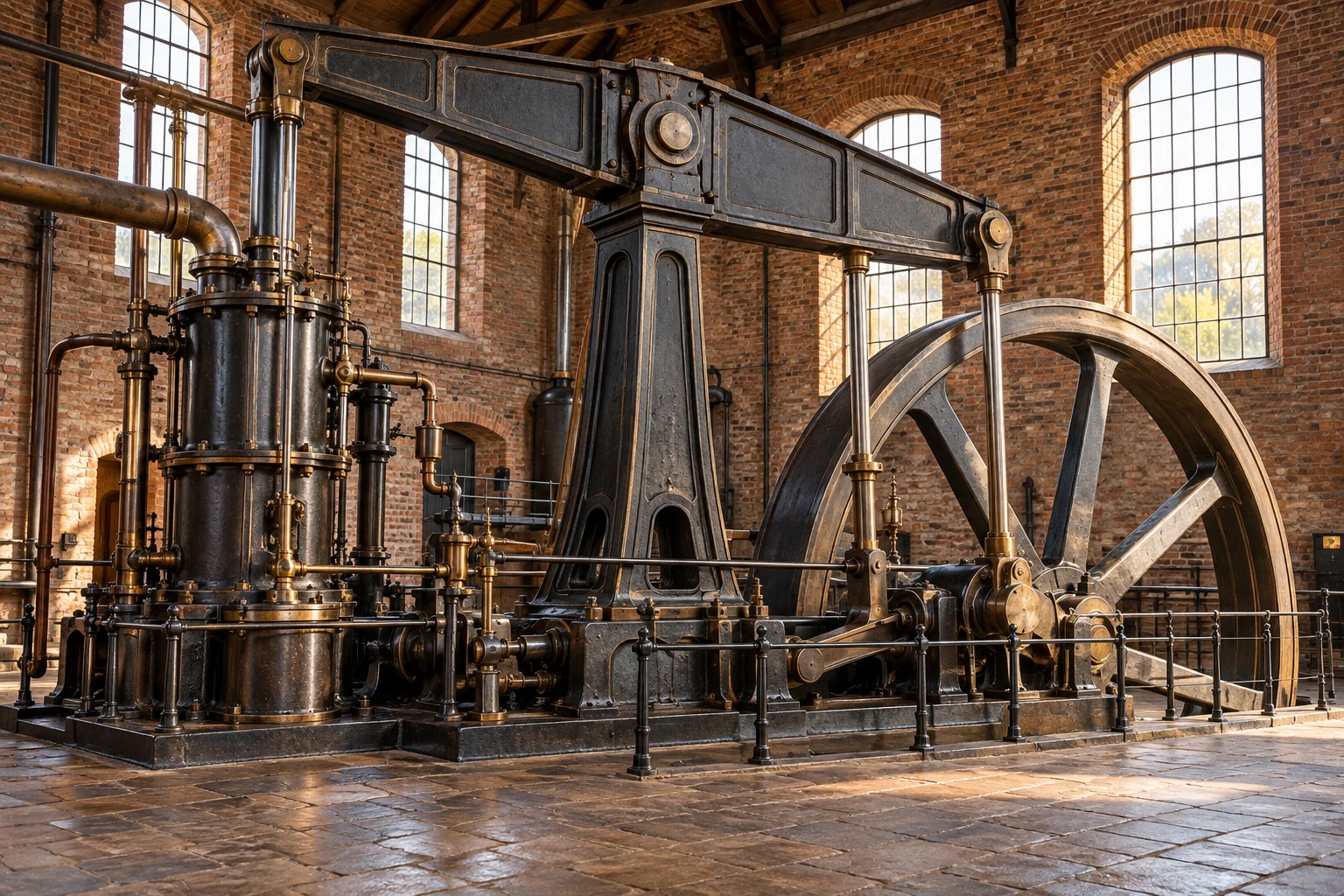
The history of power begins with a practical question: what has to move, and what can supply the force? A person turning a millstone, an animal pulling a plough, and a stream driving a waterwheel all connect an energy source to a useful task. Their differences matter. Muscles tire, animals need feeding, rivers change with the seasons, and wind is intermittent. An ingenious mechanism cannot remove those limits, but it can match available motion to a job more effectively. Power history therefore concerns the arrangement of whole systems, not simply the invention of increasingly impressive engines.
Mechanical advantage was essential long before industrialisation. Levers, pulleys, screws, gears, and capstans allowed people to exchange travel for force or redirect motion into a workable form. None created energy. They made existing energy more useful, particularly when many people or animals had to cooperate. The important historical transformation was often organisational: a reliable lifting arrangement could make a building project possible, while a mill could concentrate work that had previously been distributed among households. Power already shaped settlement, ownership, and labour before the arrival of steam.
Waterwheels converted the movement or weight of water into rotation. Different sites called for different arrangements, including wheels receiving water at different heights. Head, flow, channels, wheel construction, and the resistance of the driven machinery all influenced performance. A mill was consequently an engineered landscape as much as a building. Dams and millraces controlled the supply, gearing adjusted speed, and shafts carried rotation to grinding stones, hammers, or textile equipment. The river supplied energy, but skilled construction and maintenance made that energy dependable enough for production.
Windmills faced a related problem with a different source. Their sails intercepted moving air, while gearing connected the rotor to the machinery inside. Changing wind direction and strength demanded adjustments that a fixed water supply might not. Across both technologies, builders learned to balance strength, friction, and controllability. These machines should not be dismissed as primitive predecessors awaiting replacement. They remained economical in suitable locations and continued to develop. Their histories explain why energy transitions overlap: a new source competes with established equipment, local knowledge, and sunk investment rather than appearing on an empty landscape.
Steam engines widened the range of places where substantial power could be produced. Their earliest industrial importance included pumping, especially where water obstructed mining. National Museums Scotland explains its Newcomen engine through this drainage problem. In an atmospheric engine, condensing steam inside a cylinder reduced its pressure, allowing atmospheric pressure to move the piston. The familiar beam transferred that motion to a pump. This was a useful machine because it addressed a persistent operating need, not because its builders were pursuing a modern abstract definition of an engine.
Later developments improved the management of heat and adapted reciprocating motion to a wider range of work. Condensers, boilers, cylinders, valves, governors, flywheels, and transmission mechanisms formed a connected engineering problem. Fuel consumption mattered, but so did reliability, repairability, and the ability to deliver the required motion. Rotary engines could drive factories; compact, higher-pressure systems supported transport. Their spread required metalworking, skilled operators, fuel supply, and inspection. A steam engine that appears isolated in a museum once belonged to a working network of coal, water, buildings, tools, and people.
Internal combustion placed the heat-producing process inside the working machine. Instead of receiving steam from a separate boiler, an engine used expanding combustion gases to drive a piston or turbine. This offered combinations of compactness, starting behaviour, and power delivery that suited vehicles and smaller installations. Yet there was no single universally superior arrangement. Fuel availability, cooling, lubrication, vibration, and the time spent at part load influenced which engine made sense. A stationary plant, a farm tractor, and an aircraft imposed very different priorities on their designers.
Turbines took a different approach to converting fluid energy into shaft work. Moving fluid passed through carefully shaped stationary and rotating passages rather than repeatedly reversing a piston. Water, steam, and gas turbines share a broad concern with fluid momentum, but their materials and operating environments differ greatly. High rotational speed can suit generators while demanding gearing for other loads. Looking at duties rather than names reveals the continuity between technologies: engineers must still manage losses, heat, bearing loads, and control while matching an energy converter to the work it serves.
Electrical generation and motors separated the location of energy conversion from the location of mechanical work. A factory no longer had to receive all its motion through long belts and a central line shaft. Motors could drive individual machines, allowing production arrangements to change. That flexibility was a major consequence, alongside the growth of electric transport, pumping, and household equipment. Electricity did not abolish machinery; it rearranged the machinery and the infrastructure connecting it. Generators, switchgear, conductors, motors, and controls became parts of a different power system.
The distinction between energy and power helps make sense of these changes. Energy describes an amount available or transferred, while power describes the rate of that transfer. A machine can have ample energy available yet fail to supply a short burst of required power. Storage adds another dimension: a flywheel, battery, reservoir, or fuel tank holds energy in very different forms. Historically, the usefulness of a source depended on when it could deliver, not merely on how much existed. Distribution and storage therefore deserve a place beside engines in this directory.
Power systems transform work and also distribute costs. A more productive machine can reduce the labour needed for a particular task while creating new demands for fuel extraction, maintenance, and infrastructure. Smoke, waste heat, noise, water use, and later atmospheric emissions are physical consequences of the system, not external details to be considered only after celebrating an invention. Access is equally important. The ability to purchase equipment, control a watercourse, obtain electricity, or secure fuel can determine who benefits from mechanical power and whose work becomes dependent on it.
This field connects naturally to transport, manufacturing, mining, and everyday life. Useful comparisons ask the same concrete questions of different machines: where does the energy enter, how is it converted, what motion leaves, how are speed and load controlled, and where are the losses? Historical answers should remain specific to place and period. Waterwheels, steam engines, combustion engines, and motors coexisted because their advantages were conditional. Following those conditions produces a richer account than a parade of replacements and helps explain why the power systems of the present still contain layers of earlier engineering choices.
These links open the existing topic guides, with their current stories, series and collection items.