
Below the surface
- Mine drainage
- Winding engines
- Ventilation equipment
How did we extract resources and move heavy loads?
Mining and material handling are connected by a stubborn fact: useful material rarely begins where people want to use it. Ore may lie underground, coal behind a rock face, grain inside a store, or a container beside a ship. Mechanical systems must extract, support, guide, and transfer these loads through a complete route. This field examines those routes. It includes dramatic cutting and lifting machines, but also the conveyors, pumps, brakes, hoppers, rails, and handling routines that make them productive. The capacity of one machine means little when the next stage cannot accept its output.
The problems differ from moving a passenger. Material may be abrasive, fragile, irregular, dusty, wet, or extremely dense. A bulk solid can bridge across an opening, damage a belt, or behave differently when its moisture changes. A discrete load can have an uncertain centre of gravity or an awkward attachment point. Equipment therefore develops around the properties of what it handles. The history is not a simple increase in lifting strength. It concerns the relationship between load, mechanism, environment, and the organisation of movement from beginning to end.
Underground extraction requires a usable working environment. Water entering a mine can stop work even when the material itself is accessible. Pumps consequently occupy a central place in mining history and in the development of industrial power. They connect an energy source to the repeated movement of fluid through pipes and valves, with performance influenced by the depth and rate of inflow. A pumping system must also be maintained where access may be difficult. The importance of drainage explains why a device that never directly touched ore could transform the practical limits of extraction.
Air presents another system problem. Ventilation must move suitable air through working areas and remove contaminated air, heat, or dust as appropriate to the mine. Shafts, passages, fans, doors, and the arrangement of work influence flow. These needs connect mining with fluid mechanics and with the organisation of an entire underground network. Historical accounts that focus only on a miner's tool miss this supporting engineering. Equipment could increase output while making reliable drainage and ventilation even more important, because larger operations placed additional demands on the systems that sustained them.
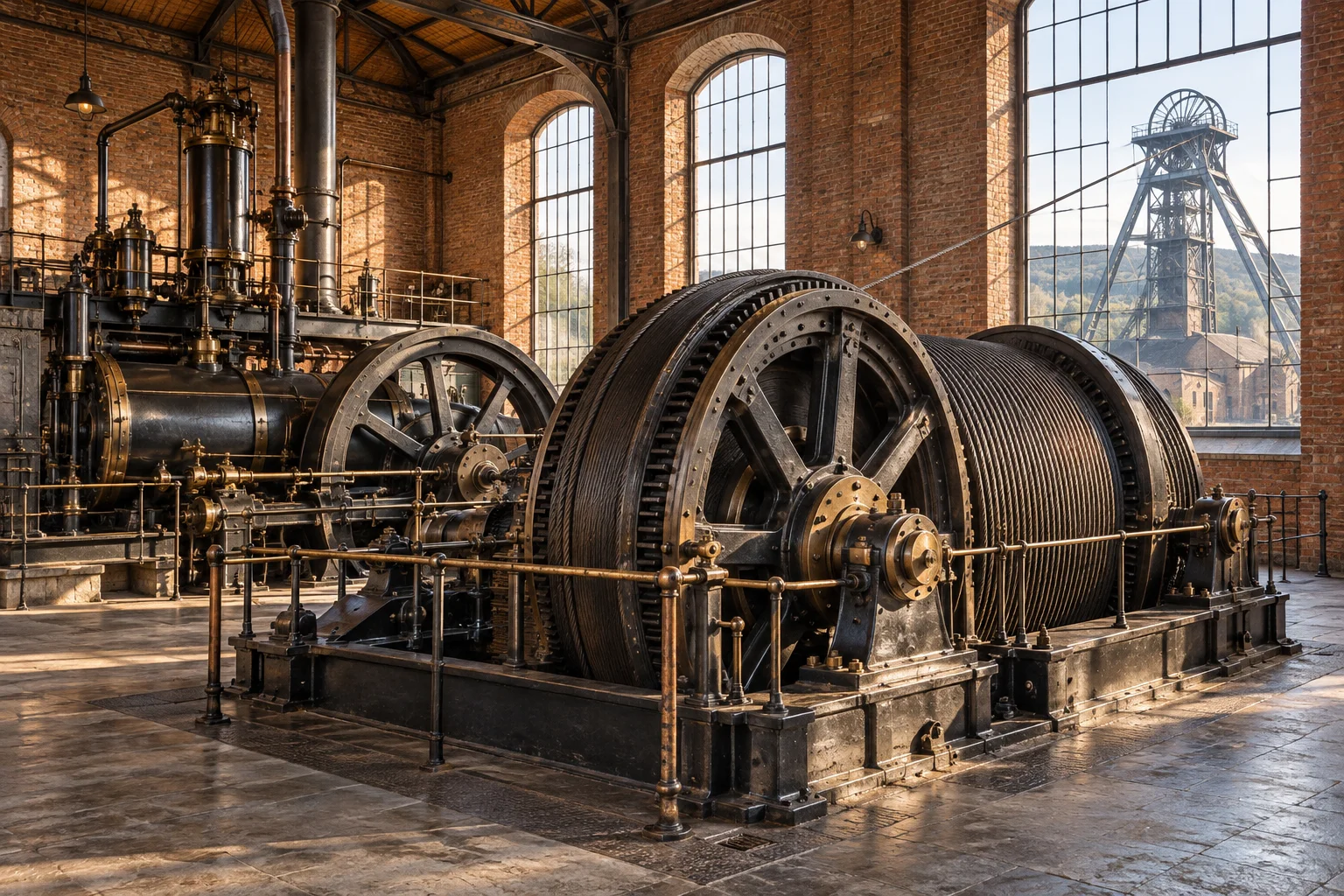
A winding engine controls the movement of a rope supporting a cage, skip, or other load. The engine, drum, ropes, sheaves, guides, brakes, and shaft structure form a connected mechanism. It must accelerate, decelerate, and stop loads rather than merely pull with sufficient force. The varying position and weight of suspended rope complicate the duty. Early human and animal arrangements gave way in many settings to powered systems, while the need for predictable control remained. The history of winding is therefore a history of braking and regulation as well as prime movers.
The National Trust's record of the winding engine house at Ecton illustrates how machinery belonged to a particular landscape and material route. The building, drum platform, shaft, and surrounding mine remains help explain the job that the engine performed. Studying such a site requires more than identifying the engine manufacturer. One must ask where loads were received, how power reached the drum, how the rope was guided, and what happened after a load reached the surface. The arrangement of structures can reveal operational relationships that a surviving engine alone cannot show.
Extraction equipment changes the relationship between tool and material. Drills concentrate force and motion at a cutting interface; cutting machines remove material along a face; excavators collect broken material and place it into transport. Tool wear, reaction forces, vibration, and the character of the deposit affect performance. More power can be useful, but it does not remove the need for suitable geometry and a stable support. The history of these machines includes improvements in tool materials, drive arrangements, and the ability to supply and maintain them where they work.
After extraction, material may require breaking, sorting, or cleaning. Crushers reduce size through compression, impact, or other mechanical action, while screens separate material by its ability to pass through openings. These operations influence later transport and processing. Feeding a crusher unevenly can reduce its usefulness; a screen cannot perform as intended if its openings become blocked. The whole plant must be balanced. This makes preparation equipment a useful bridge between mining and manufacturing: both depend on controlling material flow and making the output consistent enough for the next operation.
Conveyors offer a way to move material repeatedly along a defined route. Belts, rollers, chains, drives, tensioning arrangements, and supporting structures must work together. The system's usefulness depends on how material is introduced and discharged, not just on its speed. Transfers can be locations of spillage, damage, dust, or blockage. Cableways and other suspended systems answer related questions where ground access is difficult. Continuous handling can reduce repeated manual movement, but it creates dependence on a connected route in which a failure at one point may interrupt the whole flow.
Forklifts and cranes address more discrete tasks. They bring a tool or lifting connection to a load, position it, and place it at a destination. A forklift's usefulness includes its ability to work within storage geometry, while a port crane must coordinate reach, load attachment, and the sequence of ship and shore operations. Standardised containers made handling compatibility especially visible: the load's dimensions and connection points became part of the machinery system. The broader lesson applies elsewhere. Standardisation of pallets, bins, or lifting fittings can be as influential as a larger engine.
Mechanised extraction and handling can reduce some forms of heavy manual work and increase the amount moved within a period. They may also concentrate energy and create new exposures to suspended loads, moving machinery, dust, or noise. The historical development of guards, controls, inspections, and working procedures belongs within the technical narrative. These are not merely additions after the interesting invention. They influence the design and practical availability of the machine. A system that moves material rapidly but cannot be maintained or controlled reliably is not equivalent to a dependable production process.
To explore this field, follow a load rather than stopping at the largest machine. Identify where material begins, which stages alter it, how each transfer occurs, and where energy enters. Then ask who owns the equipment, who operates it, and who experiences the consequences of extraction and movement. Such questions connect mining to energy, construction, transport, and environmental history. They also explain the modern warehouse's relationship to much older lifting and hauling problems. Machinery changes, but the need to make material accessible, manageable, and useful remains a central force in human history.