
Instruments & procedures
- Surgical instruments
- Dental equipment
- Surgical robots
How did engineering extend care and human capability?
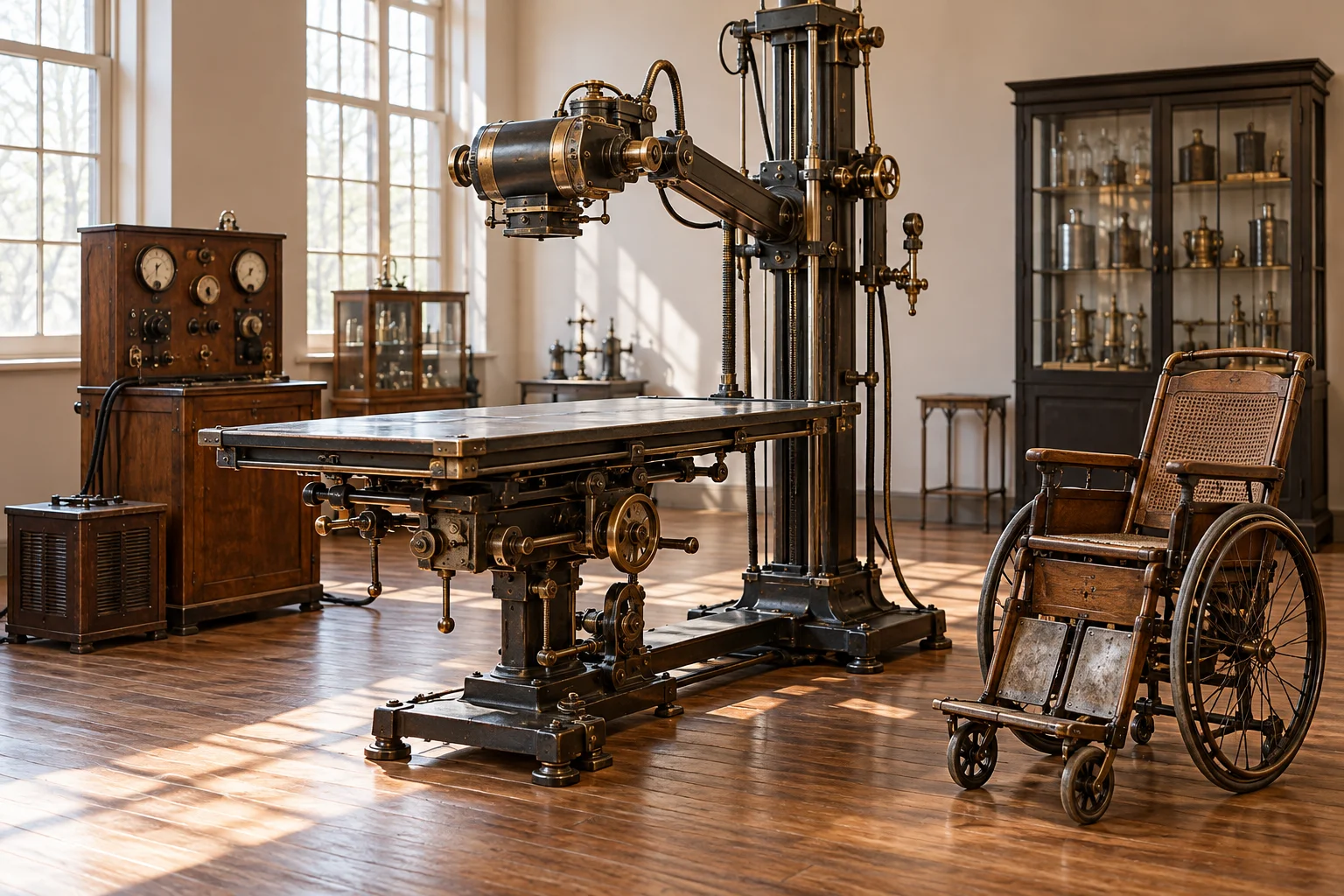
Medical equipment makes the relationship between engineering and human life especially visible. A ventilator moves gas, a dialysis machine manages fluid exchange, an X-ray system produces and records a form of radiation, and a wheelchair supports movement through the built environment. Their purposes differ, but each translates a human need into a physical system with materials, mechanisms, controls, and limitations. This directory studies those systems historically. Its concern is how devices were developed, manufactured, maintained, and integrated into care, rather than the broader history of every disease or medical treatment.
A device's significance cannot be read from its mechanism alone. Reliable operation depends on trained people, suitable facilities, supplies, cleaning, maintenance, and a means of recognising failure. Instruments also influence what practitioners can observe and what patients experience. Some equipment extends an existing procedure; other machines make entirely new forms of support or investigation possible. Historical development usually involves many contributors and repeated redesign. It is more revealing to follow these networks of engineering and practice than to describe every advance as the isolated achievement of a single inventor.
Surgical and dental instruments connect the hand to a precisely shaped working end. Levers, hinges, cutting edges, ratchets, and gripping surfaces organise force and movement. Their dimensions determine access, visibility, and control, while the material must tolerate the intended use and suitable cleaning processes. An instrument that looks simple may embody considerable knowledge about balance and handling. Manufacturing consistency matters because practitioners need predictable behaviour. The history of such tools therefore connects metalworking and materials to specialised skill, professional training, and changing expectations about the environment in which procedures take place.
Powered dental equipment adds transmission, rotation, cooling, and positioning to that relationship. Surgical robots introduce another layer between operator and instrument, using controlled actuators and interfaces to reproduce or modify commanded movement. These systems do not erase the need for skilled judgement. Instead, they change how information and force pass between the person and the working site. Studying them alongside earlier instruments reveals continuity: engineers repeatedly seek better access, steadier motion, more useful feedback, and dependable handling. The machinery becomes more elaborate, but the practical question remains how to perform a constrained physical task reliably.
Ventilation equipment illustrates the difference between supporting a bodily function and replacing the person who provides care. Breathing involves pressure differences that move gas into and out of the lungs. Historical negative-pressure equipment changed pressure around part of the body, while positive-pressure systems delivered gas through an airway connection. Wellcome's history of ventilation describes several generations of approaches rather than one direct progression. Different arrangements brought different problems of access, comfort, portability, staffing, and control. Their practical importance depended on the care setting as well as the principle of operation.
A ventilator requires much more than a source of moving gas. Valves, circuits, sensors, timing arrangements, and alarms coordinate delivery and observation. The equipment must cope with changing conditions and provide useful information to the people supervising it. As controls developed, designers could manage more aspects of a repeating cycle, but complexity introduced new demands for understanding and maintenance. The historical lesson is not that automation makes human attention unnecessary. It is that machines can sustain repetitive physical work while creating a continuing responsibility to interpret their behaviour and respond when the expected conditions change.
Dialysis equipment uses controlled exchange across a membrane to help perform part of the work normally associated with functioning kidneys. The relevant engineering includes fluid pathways, pumps, membranes, pressure relationships, monitoring, and the preparation of suitable solutions. A membrane is valuable because it permits some forms of transport while restricting others. Turning that principle into dependable equipment requires managing the whole circuit. Material compatibility, contamination control, and the behaviour of blood in contact with artificial surfaces all influence design. This is a history of manufacturing and monitoring as much as of pumps.
Heart–lung machines address another demanding combination of circulation and gas exchange during particular procedures. Their circuits manage blood movement and contact with a gas-exchange surface while teams supervise the wider operation. Historical development depended on advances in materials, components, and working practice, not simply the addition of a motor to a pump. These systems show how a machine can become part of a temporary physiological arrangement. They also demonstrate why medical engineering cannot be evaluated by nominal capacity alone: dependable integration, supervision, and the management of interacting conditions are central to its usefulness.
Imaging equipment converts interactions within the body into representations that people can interpret. X-ray systems use a controlled source, positioning arrangements, and a recording or detecting system. The image depends on how different structures affect the radiation reaching the detector. Equipment design must coordinate geometry, exposure, support, and the means of viewing the result. Improvements in detectors and processing changed what could be recorded, but mechanical positioning remained important. A source and detector must have a known relationship to the subject for the resulting representation to be useful.
Computed tomography combines measurements from multiple directions with calculation to construct sectional representations. Rotating assemblies, accurate position sensing, detectors, and data processing work together; it belongs to both mechanical and computational history. Ultrasound uses a different physical interaction, transmitting sound and analysing returning signals. Transducers, coupling, timing, and processing determine what can be represented. These distinctions matter because an image is an engineered result, not a transparent window. Historical study asks how equipment made previously inaccessible structures observable, while also considering interpretation, infrastructure, and the changes it brought to the organisation of medical investigation.
Prostheses and mobility aids make the user's own activity central to engineering. A prosthetic limb must connect an artificial structure to a person, manage loads, and support useful motion. Joints, alignment, suspension, materials, and interfaces matter alongside appearance. A wheelchair combines seating, support, wheels, bearings, propulsion, and manoeuvrability within practical limits of size and weight. The best configuration depends on the user and the places they need to reach. These technologies cannot be judged adequately by a generic performance demonstration conducted away from everyday conditions.
Assistive equipment also exposes the importance of the environment. A capable wheelchair may still meet an inaccessible entrance; a sophisticated prosthesis may be difficult to maintain where specialised service is unavailable. Rehabilitation machines similarly operate within relationships among users, practitioners, goals, and available resources. Historical progress should therefore include changes in participation and control, not just greater mechanical complexity. This directory follows medical and assistive devices as tools made for people whose needs differ. Their history links precise mechanisms to questions of access, dignity, maintainability, and who participates in deciding what useful technology should do.