
Ships & shipbuilding
- Hull construction
- Sailing rigs
- Iron & steel ships
How did machines open the seas and skies?
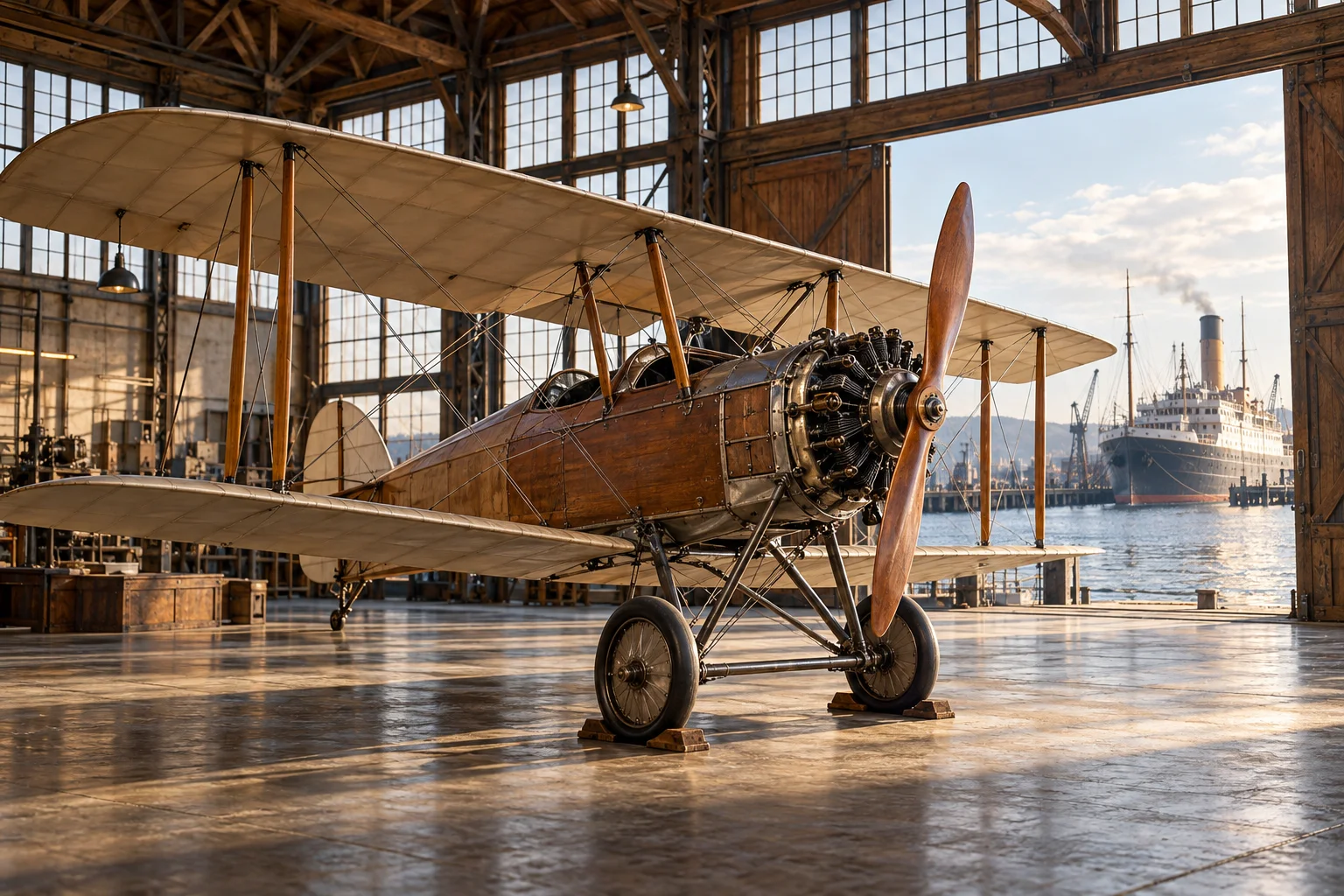
Ships and aircraft operate in different environments, but both must manage movement through a fluid. Their structures carry loads, their surfaces influence the surrounding flow, and their propulsion systems transfer momentum to water or air. The resemblance should not obscure the differences. A ship is supported by buoyancy and may remain afloat without propulsion; an aircraft in normal flight needs the conditions that sustain aerodynamic lift. Understanding those distinct relationships makes this field more useful than a collection of famous journeys. It links hulls, wings, engines, controls, and the environments in which they work.
Long-distance travel also depends on much more than the craft. Ports and airports require handling equipment, workshops, fuel supply, communication, and organised traffic. Navigation and weather knowledge influence the possible route. Crew training and maintenance determine whether an ingenious design becomes reliable transport. Maritime and aviation history therefore connects machines with systems of preparation and support. A vessel or aircraft preserved in isolation can conceal that dependence. Asking what had to happen before departure, during the journey, and after arrival restores the larger setting in which its engineering acquired meaning.
A hull must enclose usable space, resist the loads it encounters, and move with acceptable resistance. Shipbuilders worked with the materials and joining methods available to them, from timber frameworks and planking to iron and steel construction. Changes in material affected attainable dimensions, maintenance, internal arrangement, and the ways loads could be carried. They did not abolish the need for careful shape and structural continuity. The sea supplies changing forces from many directions, making construction quality and the management of water entry fundamental concerns throughout the history of navigation.
Sailing vessels transformed wind into driving force through a system of sails, masts, rigging, and the hull's interaction with water. Sail handling was a demanding combination of mechanism and collective skill. Blocks, tackles, capstans, and steering arrangements enabled crews to manage forces greater than any individual could control directly. Different rigs suited different routes, crew sizes, and cargoes. These were not merely decorative variations before the engine arrived. They were working responses to the relationship among wind, labour, ship structure, and the economic demands of a voyage.
Mechanical propulsion changed the degree to which a ship could follow a schedule independently of suitable wind. Paddle wheels and screw propellers offered different ways of transferring power into water. Either required the engine, shafting, bearings, and hull arrangement to work together. Boilers and fuel occupied valuable space, and machinery needed access for operation and repair. A steamship was consequently not a sailing hull improved by an added engine. It represented a different allocation of weight, volume, labour, and risk, supported by places where fuel and maintenance could be obtained.
Later marine propulsion systems continued to reflect the intended duty. A vessel spending long periods at steady load faced different choices from one required to manoeuvre frequently. Engines, gearing, electric drives, propellers, and auxiliary systems could be combined in different ways. Steering involved the flow around control surfaces as well as the mechanism moving them. At sea, reliability and maintainability often outweighed a small improvement in a theoretical performance measure. Ship machinery illustrates why engineering history must consider the journey and its support network, rather than treating an isolated prime mover as the whole invention.
Flight demanded a workable combination of lift, propulsion, control, and sufficiently light structure. Improving one part without coordinating the others was not enough. The Smithsonian's account of the Wright brothers emphasises systematic experiments and the treatment of the propeller as an aerodynamic device, rather than assuming an engine alone would solve the problem. That is a valuable way to read aviation history more generally. Success emerged from understanding interacting problems and testing their relationships. An airframe with good wings could still be unusable if it could not be controlled or driven effectively.
Early aircraft drew on familiar mechanical practices while imposing unusually severe weight constraints. Cables, linkages, chains, bearings, and lightweight structures had to work without excessive mass or flexibility. Pilots needed effective control in several axes, and the structure had to carry changing loads. Materials and manufacturing mattered as much as shape. The development of dependable aircraft thus involved workshops, test methods, and operating experience alongside aerodynamic ideas. Preserved machines reveal this through bracing, control runs, fittings, and repairs that can be more informative than the external silhouette alone.
A propeller accelerates air by means of rotating blades, turning shaft work into thrust. Its performance is related to blade shape, rotational speed, forward motion, and the power available. Jet propulsion uses a different arrangement of compression, heating, and expansion to produce a high-speed flow. The Smithsonian propulsion collection includes many generations of engines and their supporting components, underscoring that accessories for fuel, lubrication, cooling, and air delivery belong to propulsion history too. The working system includes much that is easy to omit from a simplified engine diagram.
Helicopters and submarines show how different operating requirements reshape the entire craft. A rotor must produce useful aerodynamic forces while handling changing blade loads and control demands. A submarine must manage buoyancy, pressure-resistant structure, propulsion, and an enclosed environment. These systems should be introduced through their governing relationships rather than through dramatic claims about conquering nature. Their histories involve difficult tradeoffs among endurance, space, complexity, and control. An arrangement well suited to one mission can be inefficient or impractical for another, even when it represents impressive technical achievement.
Ships and aircraft altered the practical geography of trade, migration, warfare, science, and ordinary travel. They connected places while depending on inequalities in resources, infrastructure, and political power. Larger capacity or greater range could expand opportunity but also intensify extraction and conflict. Their environmental effects include fuel use, emissions, noise, and the reshaping of coastal or airport landscapes. Mechanical improvement is part of these histories, but it does not determine how a technology will be used. Ownership, regulation, and the organisation of routes influence who receives the benefits and who bears the costs.
A good exploration begins with a concrete operating problem. What supports the craft, what drives it, how is direction controlled, and what keeps its structure intact? Then extend the inquiry to fuel, repair, navigation, and terminals. This approach connects maritime and aviation history with energy, precision instruments, manufacturing, and material handling. It also makes comparisons across periods more meaningful. A sail, propeller, or turbine is not merely a symbol of its age; it is a particular solution within a larger system of forces, materials, skills, and journeys.