
Metals & forming
- Smelting & casting
- Forging hammers
- Rolling mills
How did we learn to make precise, interchangeable parts?
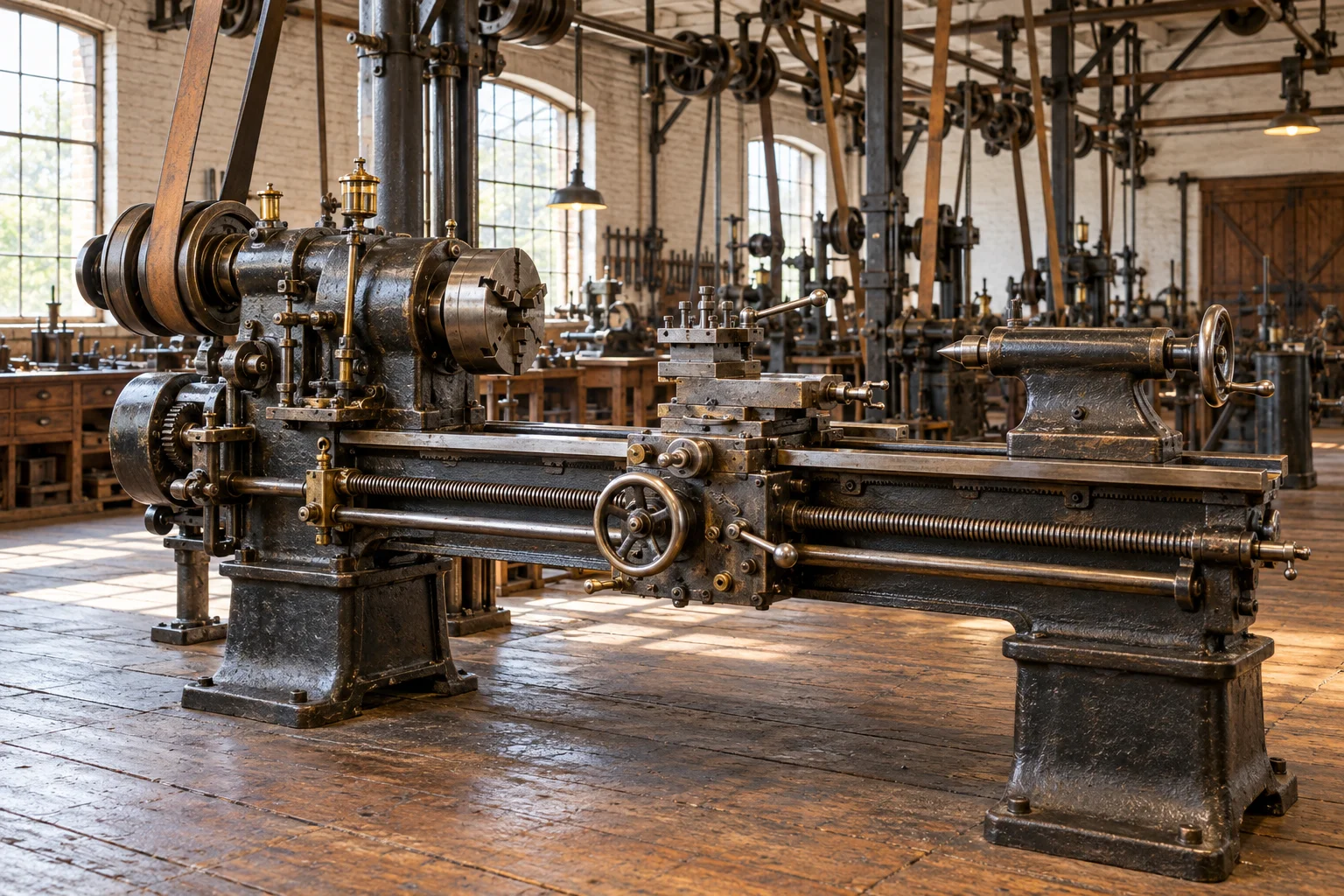
Manufacturing history asks how people learned to turn material into repeatable forms. A finished engine or vehicle attracts attention, but it could not exist without methods for casting, cutting, forming, measuring, joining, and finishing its parts. Tools also need to be made and maintained, so this field contains a powerful feedback loop: better tools enable better machines, which can then produce still better tools. Following that loop helps explain why a manufacturing breakthrough may influence many apparently unrelated industries. The decisive change is sometimes a way of making rather than a new consumer object.
Material is an active part of the story. Wood, cast iron, steel, glass, plastics, and composites differ in strength, stiffness, hardness, temperature response, and the way they fail. A process appropriate for one cannot simply be transferred unchanged to another. Designers must also account for the difference between a promising specimen and dependable material produced in quantity. The history of manufacturing therefore combines craft judgement with experiments, machines, standards, and institutions that make quality consistent enough for parts to work together. Precision has social and organisational foundations as well as mechanical ones.
Casting pours or otherwise introduces liquid material into a mould, allowing shape to be established before final machining. Its usefulness depends on controlling flow, cooling, shrinkage, and the quality of the mould. Forging and rolling instead shape material through deformation, often at elevated temperature. These processes can produce different structures and properties from casting. Their machinery must deliver force while surviving repeated loads, and their furnaces must bring material into a workable condition. Much of industrial history involves coordinating thermal and mechanical operations rather than treating them as separate concerns.
Larger furnaces, powered hammers, and rolling equipment expanded the scale of production, but scale alone did not guarantee reliability. Material defects could make a powerful machine unsafe or uneconomical. Testing, inspection, and improved process control developed alongside greater capacity. The important questions include how material travelled through the works, how heat was supplied and recovered, how finished sections were handled, and how workers identified a successful result. A photograph of a glowing furnace captures drama, while the less dramatic routines of sorting, measuring, and maintaining often explain how production actually became dependable.
Machine tools constrain the relative movement of a cutting edge and a workpiece. In a lathe, rotation of the workpiece is combined with controlled tool movement; in milling, a rotating cutter removes material as the work is fed along a selected path. Slides, bearings, screws, fixtures, and machine frames make that motion stable. The task is not merely to remove unwanted material but to remove it predictably. Deflection, vibration, heat, tool wear, and clearance can all cause the actual surface to differ from the geometry intended by the maker.
Power improved the amount of work a tool could perform, while better guidance and measurement improved its repeatability. A machine's rigidity mattered because cutting forces acted back on its structure. Fixtures mattered because a well-made tool could still produce an incorrect part if the workpiece moved or was located poorly. These relationships explain why machine-tool history is richer than a list of lathes and drills. It is a history of controlling uncertainty through geometry, materials, maintenance, and procedures. The operator's knowledge remained important even as more movements became constrained by the machine.
Interchangeable parts are often described as though they result from a single remarkably accurate machine. In practice, a component must meet agreed dimensions, and those dimensions must be related to the components with which it will assemble. Gauges, drawings, inspection methods, and consistent references are therefore essential. The National Park Service's account of Springfield Armory links the advance of machine production with systems of gauges and specialised manufacturing methods. The lesson is not confined to firearms: producing many parts that fit without individual adjustment requires a coordinated definition of what acceptable means.
This changed the economics of assembly and repair. If a replacement part could be selected by specification rather than hand fitted, products could be supported across greater distances and in larger numbers. Yet interchangeability also requires discipline. Changes in design have to be communicated, tools kept within condition, and stock identified correctly. A supply chain can fail even when each workshop believes its own parts are satisfactory. Manufacturing history thus leads directly to documentation and logistics. Paper drawings, standards, and inspection records deserve attention because they allow mechanical ideas to remain coherent across many different hands.
Production lines coordinate tasks so that material moves through a planned sequence. They can reduce handling and make output more predictable, but they also depend on balancing workloads and preventing one station from blocking the rest. A faster machine does not necessarily improve the line if the next process cannot accept its output. Buffers, transport equipment, schedules, and maintenance can be as influential as cutting speed. The physical flow of work helps explain why industrial plants developed particular layouts, and why modifying an established factory can be difficult even when new equipment is available.
The labour consequences were substantial and varied. Some tasks became narrower and more repetitive; other roles expanded in toolmaking, maintenance, planning, and inspection. Skill did not simply disappear. It moved, changed, and was sometimes embedded in fixtures or procedures that allowed less experienced workers to perform a particular operation. Manufacturing also created disputes over control, pace, working conditions, and the distribution of productivity gains. A complete account should examine the people who operate and support machines, rather than assigning all change to the decisions of inventors or owners alone.
Numerical control and later computer control allowed selected machine movements to be specified through a programme. This increased the practical complexity of shapes and made changing certain tasks less dependent on rebuilding mechanical guides. Additive manufacturing approached form from another direction, depositing or consolidating material rather than removing it from a larger workpiece. Neither development eliminated constraints. Thermal behaviour, material properties, surface quality, accuracy, and inspection still determine whether the resulting part is suitable. A digital description is an instruction to a physical process, not a guarantee of its outcome.
This field can be explored by comparing complete manufacturing routes. Begin with material entering a process and follow its changes in shape, structure, and accuracy. Ask which operations establish critical surfaces, how errors are detected, and what makes an economical quantity. A prototype, a production component, and a repair part can require different choices even when their nominal geometry is identical. The history becomes especially revealing where technologies overlap: a cast body may be machined, measured electronically, and assembled with formed sheet metal. Modern products continue to contain many generations of manufacturing knowledge working together.