
Wheels & roads
- Wheels & axles
- Wagons & carriages
- Bicycles
How did people and goods move farther, faster?
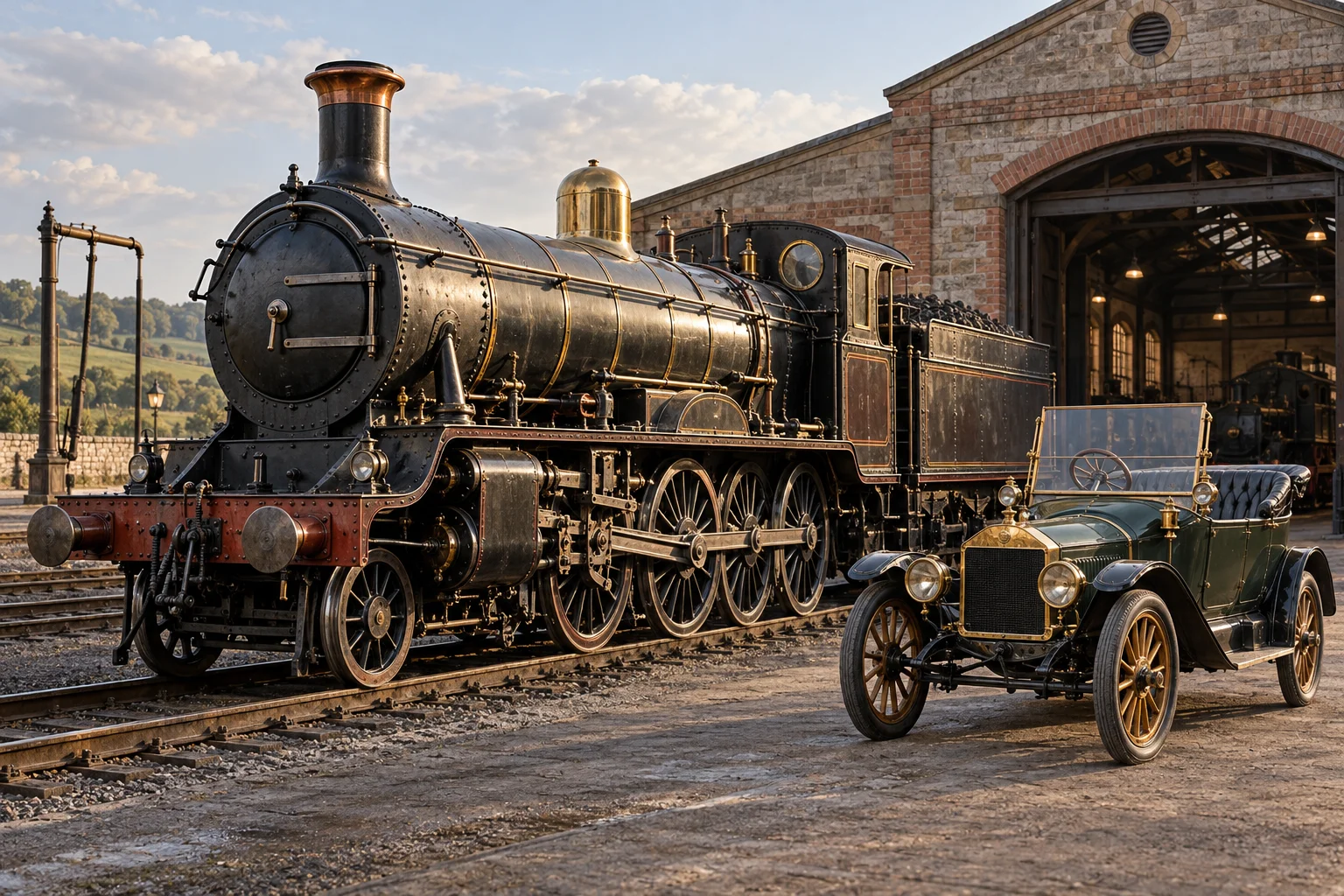
Land transport history begins with resistance. Loads must be supported, guided, accelerated, and stopped, while the route beneath them may be uneven, soft, steep, or crowded. A wheel reduces some forms of resistance but does not make the road disappear from the engineering problem. A powerful engine cannot compensate for every weakness in a vehicle's bearings, brakes, tyres, or track. This field therefore follows vehicles together with the surfaces, structures, and operating systems that make them useful. A road, railway, depot, or timetable can be as important as the machine that attracts the visitor's eye.
Before motor power, carts and carriages already embodied complex choices. Wheel diameter, axle arrangement, body weight, harnessing, and the distribution of a load influenced what animals could move. Suspension affected both comfort and the survival of goods. Roads required investment and maintenance, and their quality varied greatly. The familiar story of faster vehicles is consequently only one part of transport history. Dependability, carrying capacity, repair, and access often mattered more than maximum speed. A modest machine available at the right time could change daily life more than a spectacular one that rarely operated.
A wheel has to carry load while rotating with manageable friction. Its rim, spokes or body, hub, and axle must transfer forces without excessive distortion. Metal tyres, pneumatic tyres, and different wheel structures answered changing requirements for grip, comfort, weight, and durability. The development of bearings likewise made movement easier to control, but bearings depended on accurate manufacture and lubrication. These details are easy to overlook because a wheel looks so elementary. They help explain why dependable mobility developed through material and manufacturing improvements as well as through changes in propulsion.
The bicycle brought these relationships into sharp focus. Its rider supplied limited power, so weight, friction, gearing, and tyre losses became immediately noticeable. Chains and sprockets allowed useful relationships between pedalling cadence and wheel speed; different frame layouts affected stability and accessibility. The bicycle also illustrates the connection between design and the human body. A theoretically efficient transmission was insufficient if mounting, balance, or riding position excluded potential users. Bicycle technology fed knowledge into other industries, while workshops developed experience with tubing, lightweight structures, bearings, and repeatable parts that had significance beyond cycling.
Railways combined a guided vehicle with a prepared path. Steel wheels and rails offered advantages for moving heavy loads, but guidance created obligations: vehicles needed compatible track, suitable curves, stable structures, and controlled access to the route. Locomotives, wagons, signals, stations, and maintenance facilities formed one system. Railway history cannot be understood by comparing locomotive power alone. A line's useful performance depended on gradients, braking, loading limits, traffic management, and the ability to sustain service despite wear and failures. Infrastructure made repeated movement possible, while also constraining the vehicles that could use it.
Steam locomotion connected this system with boilers, fuel, water, valve gear, and running maintenance. The National Railway Museum's research on Locomotion emphasises the machine's industrial background and the importance of investigating its material history rather than relying only on later celebratory narratives. The same caution applies across this field. Preserved locomotives may have been modified repeatedly during working lives. They are evidence of adaptation, not frozen illustrations of a single invention date. Their repair marks, replacement parts, and changing duties help reveal how railways developed through sustained operation.
Road vehicles carried their power with them and could travel beyond a fixed rail network, although roads still shaped where and how they worked. Combustion engines required fuel systems, cooling, ignition or injection, lubrication, and a transmission capable of matching engine behaviour to road conditions. Clutches, gearboxes, differentials, and final drives answered different parts of that problem. An automobile was therefore a coordination of subsystems rather than an engine with wheels attached. Starting, stopping, turning, and carrying a useful load reliably were all necessary for practical mobility.
Cars, buses, and trucks evolved under different pressures. A passenger car might emphasise comfort and convenience; a truck needed to protect a load and deliver dependable work over long service. Public transport depended on boarding arrangements, operating costs, and passenger flow as well as vehicle design. Manufacturing methods, spare parts, repair businesses, and fuel distribution supported adoption. The resulting networks changed land use and expectations about distance. Such effects were uneven: the same mobility system could increase access for some people while creating traffic, barriers, pollution, or displacement for others.
The ability to move quickly only becomes useful when a vehicle can also be controlled. Brakes convert kinetic energy into other forms, usually heat, and must do so repeatedly without losing the required performance. The mechanism transmitting the driver's command is separate from the friction surfaces that slow the wheel or drivetrain. Steering likewise has both a command path and a force path, while suspension keeps the wheels and body related despite irregular surfaces. These systems reveal why the development of transport was always a history of control alongside propulsion.
Vehicle stability depends on more than the presence of four wheels. Load distribution, geometry, tyres, road conditions, suspension behaviour, and driver inputs interact. Historically, improving roads or introducing new vehicle duties could expose weaknesses that previous conditions had concealed. Testing and regulation grew around these interactions. Modern electronic assistance adds another layer, yet still acts through physical tyres, brakes, steering mechanisms, and structures. Reading the components beneath the body makes continuity visible between older vehicles with exposed linkages and contemporary ones whose mechanical systems are hidden behind panels and software interfaces.
Electric road and rail vehicles reorganise the path from stored or supplied energy to motion. Motors can provide controllable torque without reproducing the operating characteristics of a combustion engine, but storage, charging or current collection, cooling, and vehicle mass introduce their own constraints. Electric traction is not merely a recent ending to a combustion-centred story. It has occupied different roles across transport history, especially where infrastructure could supply energy predictably. The useful comparison concerns a particular duty and energy system rather than a claim that one propulsion type is best in every circumstance.
This directory connects vehicles to the societies that build routes and organise movement. Useful questions include what a vehicle carries, which distances and surfaces it serves, how often it stops, and who maintains it. The answers explain why transport technologies coexist and why changing a fleet is harder than replacing a single machine. Walking, cycling, rail, and road transport can complement rather than simply supersede one another. By tracing the whole journey from energy supply to arrival, mechanical history reveals mobility as an achievement of materials, control, infrastructure, and collective decisions, not speed alone.