
Water & sanitation
- Domestic pumps
- Water supply equipment
- Sanitation machinery
How did engineering change ordinary daily life?
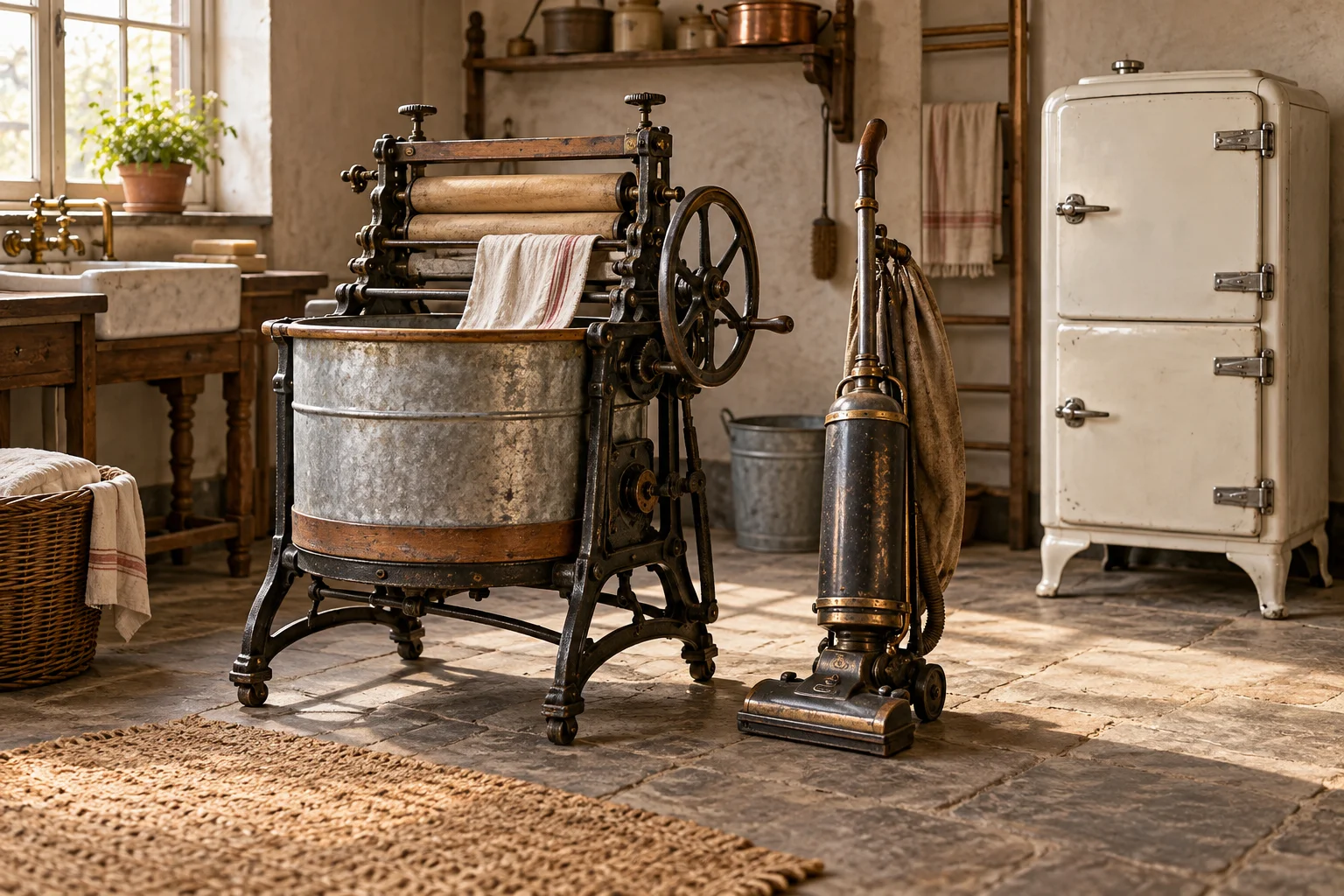
Domestic machines belong to the history of work as much as the history of comfort. Washing clothes, preparing food, carrying water, heating rooms, and preserving provisions require energy, materials, time, and judgement. For much of history those requirements were met through muscular effort and specialised knowledge within households and communities. Mechanisation changed the equipment available for these tasks, but it did not simply make domestic labour disappear. It often altered expectations about cleanliness, meal preparation, convenience, and the amount of work considered necessary for an acceptable home.
The household also depends on infrastructure beyond its walls. An appliance may be sold as an independent object, yet it needs water, drainage, electricity, fuel, replacement parts, and repair services. The ability to purchase equipment does not guarantee the ability to operate it affordably. Housing design and the distribution of public services shape adoption. This field therefore follows both mechanisms and their surroundings. A refrigerator, pump, washing machine, and vending machine reveal how industrial systems entered everyday life and reorganised relationships among users, paid workers, manufacturers, landlords, and public authorities.
Moving water is one of the most consequential forms of domestic engineering. Hand pumps turn an operator's repeated movement into the displacement of water through valves and chambers. Mechanical advantage can reduce the force required, although the total work still depends on the quantity raised and the height involved. Powered pumping allows larger supplies and more continuous delivery. Storage tanks, pipes, valves, and pressure regulation then determine how water reaches individual points of use. A tap is the visible endpoint of a much larger mechanical and administrative arrangement.
Drainage and sanitation require equal attention. Waste must move away without contaminating the clean supply or creating unacceptable conditions nearby. Pipe gradients, traps, flushing arrangements, access for maintenance, and suitable connections to wider networks all matter. The domestic bathroom should consequently be understood as a system rather than a collection of polished fittings. Its historical development involved building standards, municipal investment, and decisions about who would receive service. Improved machinery could support better living conditions, while unequal access meant that its benefits arrived at different times for different communities.
Washing combines several operations: wetting material, loosening and removing dirt, rinsing, extracting water, and drying. Early mechanical arrangements addressed parts of that sequence through cranks, paddles, rotating drums, or squeezing rollers. A powered washing machine adds controlled agitation and coordinates water with movement. Later automatic equipment integrates filling, washing, draining, rinsing, and spinning. The machine must move fabric vigorously enough to clean it while avoiding excessive damage, imbalance, or leakage. Bearings, seals, suspension, transmission, and controls make a mundane household task a substantial engineering problem.
Vacuum cleaners organise another combination of air movement, separation, and handling. A fan establishes a pressure difference that moves air and entrained particles through an inlet. Filters or other separating arrangements retain debris while allowing air to continue. Cleaning performance depends on the whole path, including the head, hose, seals, and collection system. Dishwashers similarly rely on coordinated circulation, heat, detergent, and drainage. None of these appliances acts independently of user effort. Loading, preparation, maintenance, and the organisation of a home affect how much labour the equipment actually saves.
Refrigeration moves heat from a cooler region to a warmer surrounding environment by supplying external work. In a common compression cycle, a working fluid changes pressure and exchanges heat in different parts of the circuit. The compressor, heat exchangers, expansion arrangement, insulation, and seals function together. The important result for the household is controlled preservation rather than the mere production of a cold surface. A useful refrigerator must maintain suitable conditions despite door openings, changing loads, ambient temperature, and the heat generated by its own operation.
Air conditioning shares aspects of this thermal history but addresses occupied spaces and their changing conditions. Heating equipment likewise connects energy conversion to distribution through air, water, or radiating surfaces. Controls coordinate operation with the desired indoor environment. These technologies changed architecture, food distribution, patterns of shopping, and expectations of comfort. Their adoption also increased dependence on energy systems and specialised maintenance. Domestic thermal machinery illustrates an important historical tension: equipment can improve daily life while making households more sensitive to fuel prices, power interruptions, and the environmental consequences of supplying that comfort.
Kitchen machines translate repeated hand actions into powered movement. Mixers combine rotating tools with a vessel; grinders force material through cutting or crushing arrangements; food processors coordinate blades, drives, and interlocks in compact packages. Their value depends on the task, the amount being prepared, and the effort of cleaning afterwards. The widespread availability of small electric motors made many such arrangements practical, but motor power alone did not determine success. Designers also had to consider storage, noise, handling, durability, and the habits of the people expected to use them.
Vending machines move everyday automation into public settings. They must recognise an acceptable transaction, select an item, deliver it, and prevent unintended access to the remaining stock. Historical systems used combinations of coin mechanisms, levers, rotating carriers, gravity feeds, and later electrical controls. The goods themselves impose constraints: a newspaper, bottle, ticket, and hot drink require different handling. Maintenance and replenishment remain human work even when the sale is automatic. These machines demonstrate how convenience often results from moving labour behind the scenes rather than removing it from the overall system.
The Library of Congress presents household technology as a history involving stoves, irons, and washing equipment alongside changing domestic routines. Museum interpretations also show why advertising claims need careful reading. A device advertised as saving labour might have been intended for a household employing servants, or its saved time might be absorbed by more demanding standards of cleanliness. Decisions about purchasing and operating equipment were connected to gender, income, domestic service, and family organisation. There was no single experience of the mechanised home shared equally by all its occupants.
Studying domestic equipment therefore requires attention to use rather than appearance alone. Who lifts the load into the machine? Who cleans its filter, pays for electricity, or repairs a failed part? Can a user understand the controls and reach the working surfaces? These questions connect historical design to accessibility and maintenance without reducing the subject to a list of inventions. This directory treats everyday machines as serious engineering: compact systems that manage fluids, heat, motion, and human effort while quietly shaping how people spend their time and what society expects a household to accomplish.