
Building upward
- Lifting tackles
- Construction cranes
- Pile drivers
How did machinery reshape the built world?
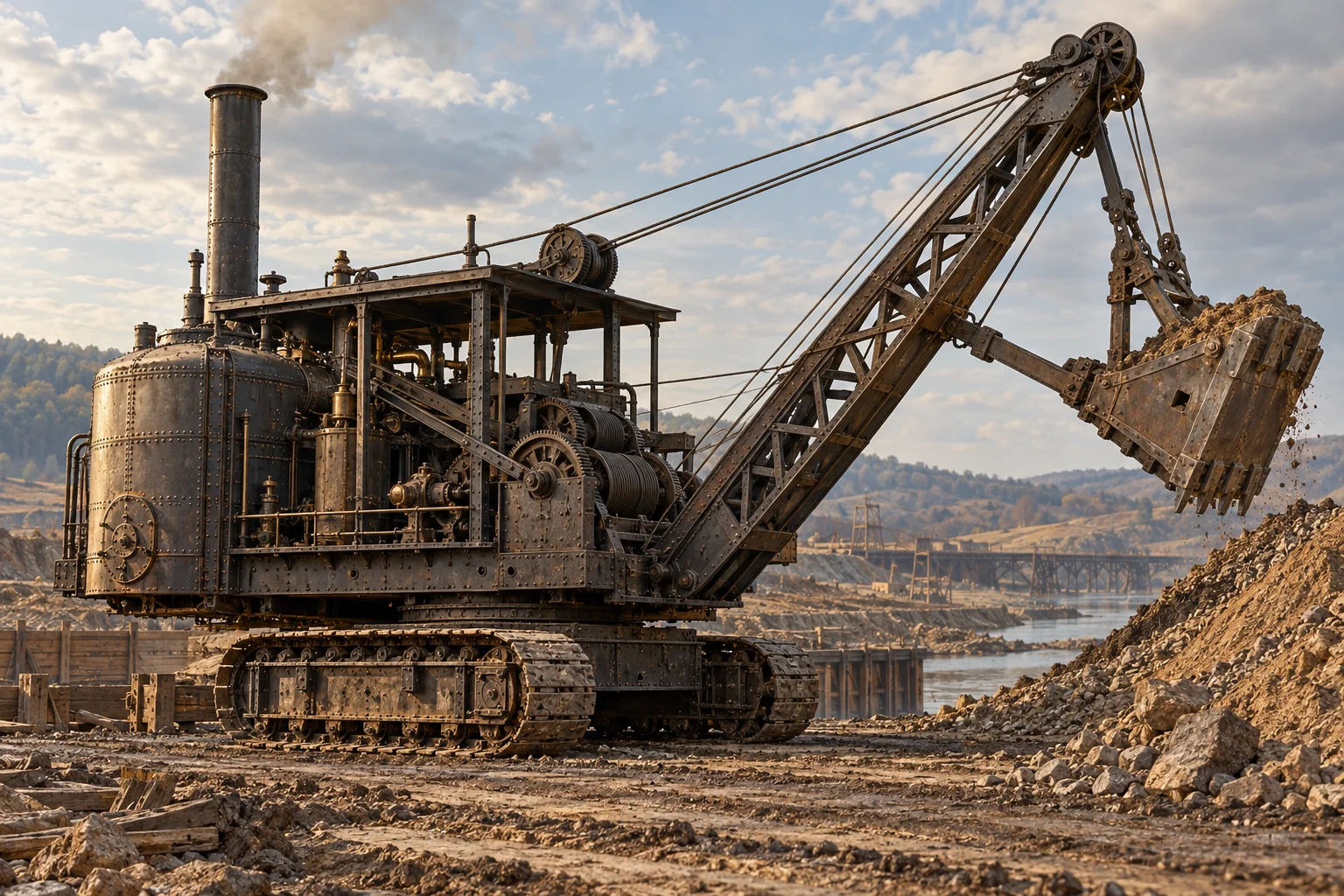
Buildings, roads, bridges, tunnels, and waterworks are often remembered as completed structures. Their construction required temporary systems that may have disappeared entirely: lifting rigs, earthmoving machines, access tracks, pumps, workshops, and carefully sequenced operations. This field restores those systems to the story. It asks how large quantities of material were moved and positioned, how difficult ground was managed, and how people organised work across changing sites. Construction machinery matters because it helped make possible the places in which other technologies could operate, from railway cuttings to factories and tall urban buildings.
Unlike a production line, a construction site rarely remains stable. Its working surface changes as the job progresses; deliveries compete for space; weather affects access; and the machine may have to move before it can repeat its task. The history of construction equipment is therefore a history of adaptability. Capacity matters, but so do reach, mobility, setup time, and the ability to work within a constrained area. A useful machine must not merely exert force. It must bring that force to a particular place in the sequence of a project.
A crane makes the path of forces visible. The load is connected through hooks, ropes or chains, pulleys, drums, structural members, bearings, and a supporting base. Mechanical advantage can reduce the force required at one point by increasing movement elsewhere, but the structure still has to carry the resulting loads. Early lifting arrangements used human or animal effort through capstans, treadwheels, or other mechanisms. Powered hoists increased the available rate of work while introducing requirements for braking, control, and the dependable transmission of motion from an engine or motor.
Reach changes the problem. A load close to its support is not equivalent to the same load farther away, and the machine's stability depends on the whole arrangement. Different crane forms suit fixed workshops, building sites, ports, and mobile work. Historical improvement involved stronger materials and better power sources, but also better understanding of load paths, inspection, and operating limits. The successful lift depended on coordination among people who prepared the load, controlled the machine, and directed its placement. The operator was one part of a larger lifting system.
Excavation means separating material from the ground, collecting it, transporting it, and placing it somewhere else. A shovel, loader, scraper, and bulldozer do not perform identical versions of one task. Their geometry and movement suit different stages of the material path. Steam-powered shovels and cable excavators concentrated substantial mechanical effort in digging and loading. Later hydraulic systems allowed another relationship between engine, actuators, and working members. Their flexibility supported precise control of several motions, although hydraulic machinery still depended on structural strength, stable support, and a suitable tool for the material.
The consequences extended beyond the amount one bucket could hold. More rapid excavation could make different road alignments or site preparations practical, but loading and haulage had to keep up. A machine waiting for a vehicle was not performing useful production. Historical construction accounts therefore reward attention to temporary railways, wagons, trucks, spoil tips, and access routes. The National Park Service's account of Going-to-the-Sun Road places equipment within a demanding landscape and a prolonged construction process. It is a reminder that geography and planning shape what mechanical capability can achieve.
A structure begins transferring load to the ground before its visible form is complete. Pile-driving equipment delivers repeated impacts or other forms of controlled force to establish foundations. The mechanism must guide the working element and manage the energy applied to it, while the ground responds in ways that differ between sites. Compaction machinery similarly changes soil or aggregate through pressure and sometimes vibration. Its historical importance lies in preparing support that can sustain later traffic or construction. Much essential engineering remains hidden beneath the finished surface.
Tunnel work adds restricted access, ventilation, water, and the continuous problem of removing excavated material. A tunnel boring machine should be understood as a system for cutting, supporting, handling, and advancing, not simply a rotating face. Older methods relied on different combinations of drilling, breaking, labour, and temporary support. No single machine is appropriate for every geology. The history is therefore shaped by adaptation to ground conditions and by the ability to maintain equipment in difficult spaces. Tunnels connect construction directly with mining, fluid machinery, surveying, and logistics.
Lifts and escalators changed the practical use of buildings after construction was complete. A lift installation includes a car, guides, supporting structure, drive, braking, doors, controls, and arrangements for managing motion. Its value depends on reliable repeated service and on how people enter and leave it. Escalators provide a different form of continuous movement, coordinating a chain of steps with handrails and the transitions at each end. Both connect mechanical systems with architecture and passenger flow. The building must accommodate the machine, rather than treating it as an accessory added without consequences.
Other service machinery is less conspicuous but equally influential. Pumps move water through tall buildings, fans provide ventilation, and heating or cooling equipment changes the conditions of occupancy. These systems helped support new densities and patterns of use, while creating dependence on energy, maintenance, and skilled servicing. A building's history is not contained entirely in its facade. Shafts, plant rooms, ducts, and service access reveal a continuing relationship between architecture and machines. The infrastructure needed to sustain comfort and movement remains active long after the original building work ends.
Construction mechanisation can shorten some operations and increase the range of projects considered feasible. It also consumes materials and energy, changes landscapes, and redistributes risk. Communities may gain transport, water, housing, or protection, while others experience displacement or environmental damage. Such consequences cannot be derived from machine capacity alone. The selection of a project, its funding, and its location are social decisions. Historical interpretation should connect the capability of equipment with the purposes to which it was put and the conditions under which people worked.
The most revealing question is often how the project sequence was organised. Which task limited progress? How did material reach the site, move within it, and leave as waste? Where did power come from, and what happened when equipment failed? These questions link the grand finished structure to less visible machines and labour. They also connect ancient lifting devices with contemporary earthmoving and building services. Across those changes, construction engineering continues to negotiate gravity, ground, access, and time. Its history is the story of making a temporary working system capable of leaving a durable result.