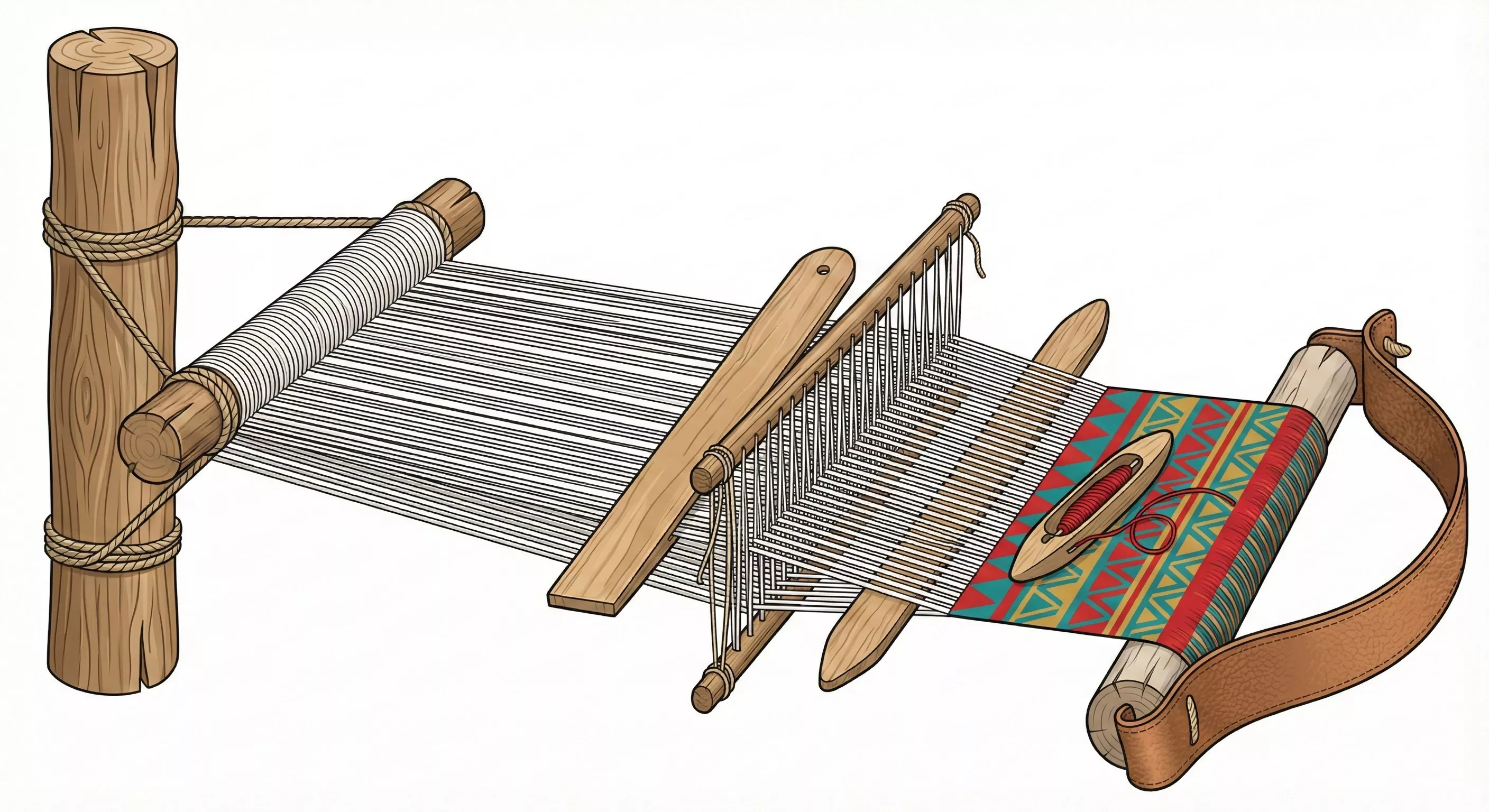
The backstrap loom is one of the oldest and most direct body-based weaving technologies in human history. It has no fixed frame and does not rely on gravity or complex structures. Instead, it connects textile tension directly to the weaver’s body. When weaving on a backstrap loom, the human body itself becomes part of the machine.
A backstrap loom is a portable loom with an extremely simple core structure:
• One end is anchored to a tree, post, or wall
• The other end is tied to the weaver’s waist with a belt or strap
• The warp threads are stretched between the two points
• Tension is adjusted by leaning the body forward or backward
👉 In other words:
The tension of the fabric is not stored in the machine,
but in the human body.
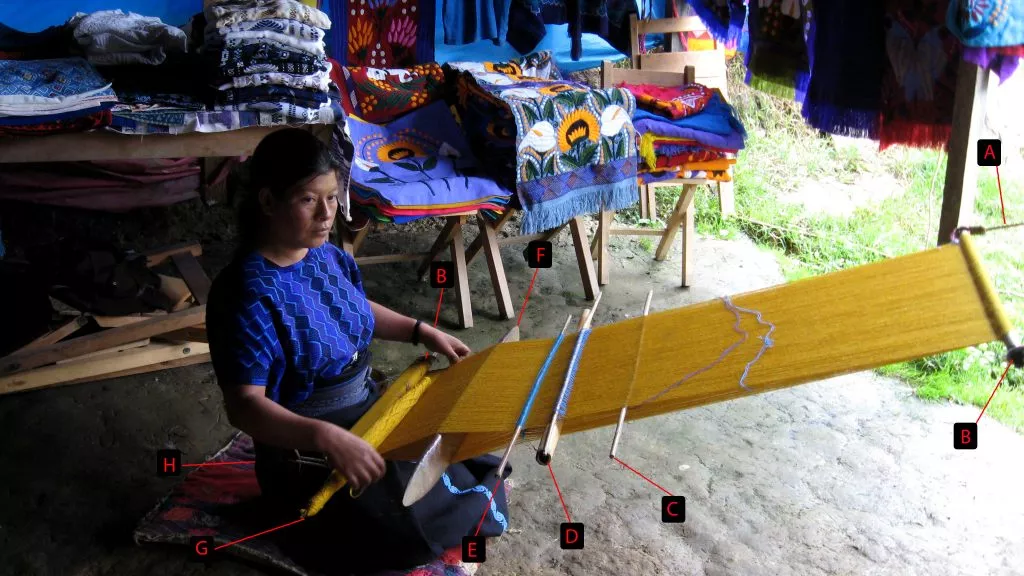
II. How does it work?
The basic weaving process is as follows:
1. One end of the warp is fixed to a stationary object
2. The other end is attached to the weaver’s waist
3. The weaver sits or squats and leans backward
4. Leaning back → the warp tightens
5. A shuttle is passed to insert the weft and the fabric is beaten
6. To adjust tension:
• Lean forward → loosen
• Lean backward → tighten
The weaving process forms a tightly coupled system of body, yarn, and rhythm.
⸻
III. What can it produce?
Despite its minimalist structure, the backstrap loom is capable of remarkable work:
• High-density, finely woven textiles
• Complex geometric patterns
• Stripes and patterned weaves
• Narrow but extremely long fabrics
Common products include:
• Belts
• Shawls
• Garment fabrics
• Ritual or ceremonial textiles
👉 The limitation is not precision, but width, which is constrained by what the human body can physically control.
⸻
IV. Historical and cultural distribution
The backstrap loom is almost a global technology, found across many regions:
• Mesoamerica: Maya, Aztec
• Andean region: Inca civilization
• Southeast Asia: Thailand, Laos, Indonesia
• Southwest China: ethnic groups such as the Buyi and Li
• Parts of Africa
In many cultures:
• Weaving is a bodily skill traditionally associated with women
• Techniques are transmitted across generations through observation and imitation
• Patterns themselves carry cultural identity and narrative meaning
⸻
Dimension | Backstrap Loom | Warp-weighted Loom | Horizontal Treadle Loom |
Frame | None | Yes | Yes |
Source of tension | Human body | Gravity | Mechanical |
Portability | Extremely high | Moderate | Very low |
Fabric width | Narrow | Medium | Wide |
Human–machine relation | Human is the machine | Human operates the machine | Human controls the machine |
👉 The backstrap loom represents:
“body-embedded technology” rather than “external mechanical systems.”
⸻
VI. Significance in the history of technology (crucial)
The importance of the backstrap loom lies not in efficiency, but in conceptual meaning:
1. It demonstrates that:
• highly complex patterns
• do not necessarily require complex machines
2. It represents:
• the most fully embodied stage of textile technology
3. Nearly all subsequent loom developments focus on one task:
• extracting tension, rhythm, and repetition from the human body
From this perspective:
The backstrap loom is one of the final forms in which
the human body itself functions as the machine.

COMMENTS (0)
Please Login to join the discussion.