 MECHANICA PLANET
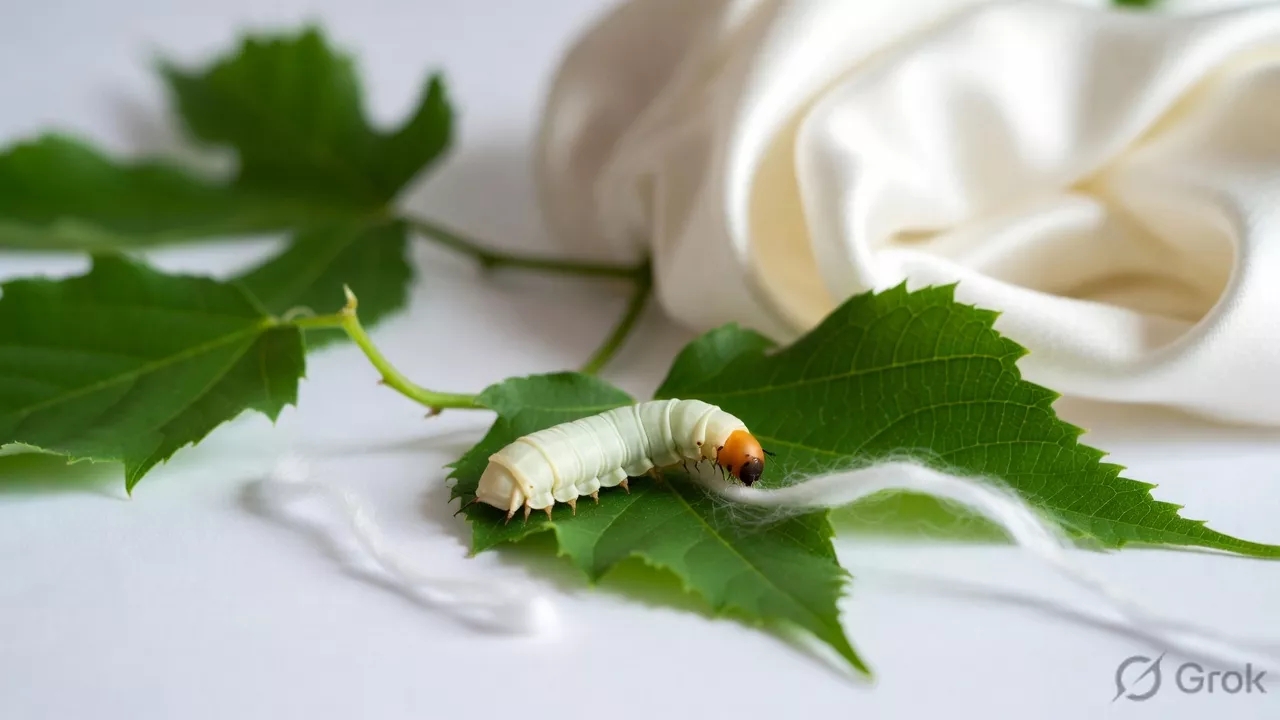
In addition to those animal fibers that “grow out,” there is also another kind of animal fiber that is “spun out” or “secreted”—one of enormous importance and of very high value: silk. Silk is a distinctive animal fiber that originated in China. In the first article of this series, we already saw the crucial role that the silk-processing industry played in the Industrial Revolution.
Archaeological evidence indicates that by around 6500 BCE, people in China had already begun to use wild silk. In legend, the discovery of silk is credited to Leizu, the wife of the Yellow Emperor. It is said that while Leizu was drinking tea beneath a mulberry tree, a silkworm cocoon fell into the hot water, and the silk filament from the cocoon began to unwind. In this way, she discovered the method of extracting silk. This beautiful legend roughly coincides in time with the archaeological record, and probably does have a substantial historical basis.
Around 5000–4100 BCE, the wild silkworm began to be domesticated in central and eastern China. At the same time, textile techniques such as silk reeling, spinning, and brocade weaving also developed. After thousands of years of effort, the wild silkworm (Bombyx mandarina) was domesticated into the domesticated silkworm (Bombyx mori). The domesticated silkworm is an extraordinarily remarkable creature. It is the most thoroughly domesticated species in the entire animal kingdom, bar none. To what extent? To the extent that it is almost entirely a product of human intention.
Born for Textiles
Compared with the wild silkworm, the domesticated silkworm is much larger, and its cocoon is also larger and whiter. It grows extremely fast and digests with very high efficiency. It has lost its pigmentation and is pure white all over, while also showing extremely strong tolerance for crowding and contact with humans. In just 7–10 days, a domesticated silkworm can eat its way from a tiny black larva the size of a ballpoint pen tip into a plump white creature 7 or 8 centimeters long. During this period, it must molt four times. It then spins silk and forms a cocoon. After that, it spends another 10–14 days pupating and turning into a moth. It then emerges from the cocoon, mates and lays eggs within 5–10 days, and finally dies. The entire cycle takes only about fifty days. It is precisely this highly compressed growth cycle that enables sericulturists to raise as many as seven or eight batches in a single year, multiplying silk output dramatically.
Wild silkworms can fly. Domesticated silkworms cannot. The wings of the domesticated silkmoth are severely degenerated; it cannot fly and can only crawl on the ground. This makes it extremely suitable for breeding. There is no need at all to worry about silkmoths flying all over the silkworm house. One can arrange their mating and egg-laying as one pleases, without worrying that they will escape.
The domesticated silkworm cannot reproduce independently. A male moth cannot find a female on its own without human assistance, so people must pair them manually. The eggs also require artificial incubation. But the conditions for hatching are very clear, and sericulturists can cause the silkworm eggs to hatch by adjusting the temperature. In this way, silkworms can be bred indoors under controlled conditions and at very high cycle density.
The domesticated silkworm cannot forage in the wild. It feeds only on specific mulberry leaves (it is said that Britain’s attempt to introduce sericulture once failed because the wrong species of mulberry tree was planted). Once removed from the silkworm house, it will basically die from heat or cold. It is completely incapable of avoiding predators—it quite obviously has no idea what a “predator” even is. The domesticated silkworm no longer has any wild population. It is entirely extinct in the wild, or perhaps it was never able to become feral in the first place.
In short, the domesticated silkworm has wasted hardly even the slightest bit of its genetic endowment on anything other than silk production and reproduction.
The quality of silk is far superior to that of all bast fibers and animal hairs. It is almost the only natural continuous filament fiber. A single filament can reach 800 to 3,000 meters in length. For that reason, processing silk into thread is much simpler: one only needs to draw the silk out from the cocoon and reel it onto a spool or frame. A single silk filament is not really “single.” Its core consists of two parallel fibroin filaments, wrapped on the outside by two or more layers of sericin. The fibroin filaments are made of silk protein. The structure of this silk protein is very interesting: it is neither crystalline nor amorphous, but rather consists of “nanoscale beta-crystalline regions embedded in an amorphous matrix.” The beta-crystalline regions are hard, while the amorphous matrix is soft. The result is a chain-like structure with alternating hard and soft segments, and the strength and toughness of silk come from precisely this arrangement.
Silk reeling is in fact somewhat cruel. Before the adult moth has emerged and while it is still alive inside the cocoon, the cocoon must be placed into hot water at around 90 degrees Celsius. The outer sericin layer on the silk softens when heated (and will dissolve in alkaline hot water), and the whole cocoon begins to come apart. Workers lightly brush the surface of the cocoon with a brush or a small bamboo broom. After brushing away the outer tangle of floss, the true filament end is exposed. They pick up the filament ends, combine several of them together, pull them up, and reel them onto a silk reeling frame.
What is obtained through reeling is raw silk. Raw silk cannot be used directly for weaving. It must first be washed to remove impurities, and then combined and twisted. This process is called throwing—that is, winding and twisting silk. After throwing, one obtains boiled-off silk, which can then be woven.
Diffusion
Soft, lustrous, and suggestive of nobility, silk in the pre-Qin period was reserved exclusively for royal houses and aristocrats. The ruling authorities treated sericulture as a state secret and enforced secrecy with extreme strictness; violators could even face the death penalty. In the early Western Han period, silk was used in trade with various tribal groups. By 114 BCE, when the Silk Road was opened, large quantities of silk goods were being exported westward. Even at this point, however, sericulture itself was still kept secret.
But no secret can remain completely airtight. It was simply too difficult to keep sericulture hidden across so vast a territory. The technology first spread to China’s East Asian neighbors, which enjoyed the advantage of proximity. Around 200 BCE, through migration and trade, sericulture first spread to the Three Han states—Baekje, Silla, and Goguryeo—where small-scale production was established. Korea’s silk industry developed rapidly and then spread further to Japan.
According to tradition, Empress Jingū of Japan (169–269 CE) led troops in an invasion of the Korean Peninsula, captured craftsmen and techniques related to sericulture in the course of the campaign, and brought them back to Japan. Thus sericulture also spread to Japan. This, however, is only legend. Whether Empress Jingū even existed remains disputed today. It is more likely that sericulture reached Japan through migration and trade. Even so, the Stele of King Gwanggaeto excavated in Jilin, China, records a Japanese campaign in Korea in the year xinmao, and the timing does correspond roughly to this supposed conflict. So the possibility that sericulture spread to Japan through warfare cannot be ruled out. In addition, according to the Nihon Shoki, around 300 CE the Japanese court sent envoys or students to China to study, including weaving techniques, and recruited four young Chinese women to Japan to teach textile production. In this way, a complete silk-production industry was established there.
Next comes another legend, again involving a princess. During the reign of Emperor Wu of Han, Zhang Qian made his second mission to the Western Regions and formed an alliance with Wusun. The king of Wusun, Liejiaomi, then sent envoys to Han to request a princess in marriage. Emperor Wu granted the title of princess to Liu Xijun and married her off to Wusun. Liu Xijun was the daughter of Liu Jian, the Prince of Jiangdu. Her father committed suicide after being implicated in a suspected rebellion, and she was adopted in childhood by Liu Xu, the Prince of Guangling. Among the common people she was known as the “Princess of Jiangdu.” According to legend, Liu Xijun loved embroidery, and when she was married off she brought with her a great quantity of silk fabrics. But these were limited in supply, and she feared she would not be able to continue in Wusun. Encouraged by the envoys who came to escort her, she hid silkworm eggs and mulberry seeds in her coiffure and carried them with her into the Western Regions. In this way, sericulture spread westward. Although Liu Xijun is indeed the first marriage-alliance princess recorded in the standard histories, the story that she secretly smuggled silkworm eggs is essentially only a legend.
There is yet another legend, also about a princess. Around 440 CE, she was married off to Khotan in the Western Regions, in what is now the Hotan area. She too supposedly hid silkworm eggs in her hat and secretly carried them out of the country. This story appears in Xuanzang’s Great Tang Records on the Western Regions. In the early twentieth century, a Tang-dynasty wooden panel painting titled Silkworm Seeds Come from the East was unearthed in the Hotan region and is now preserved in the British Museum; it also depicts this story. The official histories contain no record of a princess from the Han heartland being married off to Khotan, so this too is probably only a legend. Modern scholars believe that the “princess from the eastern land” in the story may not have been a princess from the Chinese heartland at all, but more likely a princess from one of the smaller states east of Khotan, such as Shanshan, Loulan, or Kucha. If that is indeed the case, it would mean that sericultural technology had already spread to the Western Regions via the Silk Road, and that the Central Plains’ policy of technological secrecy had ultimately failed all the same.
The actual course of events is unclear. Sericulture may have spread to the Western Regions through marriage alliances, but it is even more likely to have spread through migration and commerce. In any case, by the fourth century CE the Western Regions had already acquired sericultural technology. From there, sericulture spread further west and south. To the west, it continued along the Silk Road through the Tarim Basin, reaching Ferghana (in present-day eastern Uzbekistan) and Samarkand (in present-day Uzbekistan). The local climate there was “suitable for silkworms,” and sericulture developed in those places. By the seventh century, Khotan, Ferghana, and Samarkand had become silk centers of Central Asia. The technology did not stop there, but continued westward through Margilan (in present-day Uzbekistan) and Bukhara to Merv (in present-day Turkmenistan). By the ninth century, Merv was already a major oasis center of silk production. From Merv it spread farther west to Nishapur (in present-day eastern Iran). After entering Persia, sericulture continued to develop through Nishapur, Jurjan and Mazandaran along the southern coast of the Caspian Sea, and into the Caucasus. The Armenian town of Bardaa later became a silk center of the Middle East. Finally, sericulture spread to Syria. Then came the story discussed in the first article of this series: the two monks who stole silkworm eggs, and later the technology’s arrival in Italy, leading eventually to the story of Lombe’s Mill.
Its southward spread led into the Tibetan Plateau. Tibet, at elevations of over 4,000 meters, was completely unsuitable for mulberry silkworms, and no corresponding industry developed there. But through migration and merchant caravans, the technology spread to the southern foothills of the Himalayas and from there entered the Indian subcontinent. India itself had already developed some indigenous silk industries using native wild silkworm species. After Chinese mulberry silkworm sericulture arrived, it combined with these local silk traditions and gave rise to a diverse range of varieties, such as Tasar silk and Eri silk.
Through the Islamic conquests of the seventh and eighth centuries, sericulture also expanded further into North Africa. Sericulture was established there as well, but Chinese domesticated silkworms were not used; local wild silkworms were used instead. The overall scale remained limited, mainly because the climatic conditions were still not well suited to mulberry silkworm cultivation.
As for the Americas, since even the spindle had been invented there independently, one could hardly expect sericulture to have crossed the oceans and arrived there on its own. Silkworm eggs and mulberry seeds were brought to the Americas by colonists. After a series of attempts, tropical climates and pests and diseases defeated the silkworm. In the end, only silk processing remained, dependent on imported silk.
Beyond Textiles
In China, silk was used not only for clothing or for displaying status; it was also frequently used as a gift and as a diplomatic instrument. Such a high-end material was naturally also employed in ritual and religious contexts. Scholars wrote on silk, and maps were often drawn on silk as well, because it was portable and durable. It was also used in other applications that required strong cordage, such as fishing lines and bowstrings. Chinese musical instruments are referred to as “silk and bamboo,” because stringed instruments used silk strings.
In modern medicine, silk is used in many fields. Because silk has excellent biocompatibility, it is often used to make various scaffolds for repairing bone, cartilage, skin, nerve, and liver tissues, promoting cell growth and healing. The structure of silk also allows controlled drug release, making it useful in cancer treatment, enzyme immobilization, and wound dressings. Other applications include reducing blood sugar, ophthalmology (such as artificial lenses), dentistry (such as artificial teeth), and neural repair (such as artificial nerves), among others.
Yet none of these can compare with the financial function of silk.
As early as the Han dynasty, silk was used to pay military salaries, to grant rewards, and to settle trade accounts. By the Tang dynasty, taxes could be paid in silk. In the Ming dynasty, silk could be directly exchanged for silver. The Tang writer Li Zhao recorded in his Supplement to the National History of the Tang the story known as “Liu Po Pays for the Jars”:
On the road through Mianchi, there was a cart loaded with earthenware jars, blocking a narrow pass. It was bitterly cold, with ice and snow making the slope steep and slippery, and the cart could neither advance nor retreat. As evening approached, official and private travelers, in groups numbering in the thousands, were crowded up behind it, with no way forward. A traveler named Liu Po came riding up, raised his whip, and asked, “How much are the jars in the cart worth?” The answer was, “Seven or eight thousand.” Liu Po then immediately opened his pouch, took out fine silk, paid for them on the spot, and ordered his servants to climb onto the cart, cut the ropes, and push all the jars off the cliff below. In a moment, the cart was light enough to move on, and the crowd surged forward.
The general meaning is that a cart carrying earthenware jars had blocked the road, and in freezing conditions thousands of travelers and vehicles could not pass. One traveler asked the price, took out fine silk, and bought the whole cartload of jars. He then ordered his servants to push the jars over the cliff, lightening the cart so it could move forward and clear the road. This story vividly illustrates the financial status of silk: by the Tang dynasty, it could already circulate quite freely as a form of currency.
More Expensive, More Luxurious
To say that silk is “almost” the only natural continuous filament fiber is because there is another natural continuous filament that can just barely be counted as a textile fiber: spider silk. In terms of quality, spider silk surpasses every other fiber. Whether in strength, luster, or fineness, no other fiber can compare. Only silk can barely contend with it. Yet even today, with all our technological development, humanity still cannot raise spiders in large numbers. The domesticated silkworm is vegetarian: as long as it is given enough mulberry leaves, it will keep eating and keep growing. It does not matter if a mulberry leaf is covered with silkworm larvae; they do not interfere with one another, but simply keep their heads down and eat voraciously. Spiders are different. Unlike silkworm larvae, they are carnivorous. So if you keep a group of spiders together, after a few days you may be left with only one or two of them, quite apart from the problem of where to find enough food to feed them all. For this reason, spider silk is extraordinarily rare and expensive, let alone garments made from it. The Victoria and Albert Museum holds a spider-silk cape, entirely golden in color and magnificently splendid, made from 1.2 million golden orb-weaver spiders, at a cost of more than 500,000 US dollars. Raw natural spider silk generally costs between 500 and 5,000 US dollars per gram, far exceeding the price of gold.

With the support of modern technology, artificial spider silk has also made major advances. Through bioengineering, it is now possible to produce so-called recombinant spider silk. One method is to insert spider genes into bacteria, allowing the bacteria to produce spider-silk proteins, which are then artificially spun into man-made fibers. Another method is to insert spider genes into silkworms, enabling the silkworms to synthesize spider-silk proteins and then spin spider silk. The quality of these artificial products is still inferior to that of natural spider silk, but they are much cheaper, at roughly 100 US dollars per kilogram, about twice the price of silk. Some manufacturers are working to scale up production and bring the price down to around 40 US dollars per kilogram. Spider silk has enormous development potential in medicine, body armor, and fashion.
At this point, we have already gone through the major natural textile fibers...
Wait a moment! There is still one important natural fiber missing here!!!
Yes, cotton has not yet been introduced here. But it is not merely one of the major natural textile fibers; it is the most important natural textile fiber, without question. That is why I am saving cotton for the next article, so that I can discuss it in full detail.
COMMENTS (0)
Please Login to join the discussion.