 MECHANICA PLANET
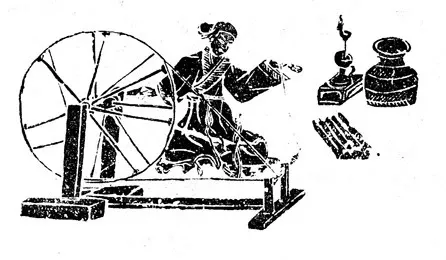
Spinning is the primary skill that enables humans to make use of fibers. The craft of spinning began to develop not long after humans first started making complex stone tools. After all, ropes were needed to bind stone axes and spearheads, or to construct traps.
The earliest yarn appeared in the Late Paleolithic period. At present, the earliest archaeological discovery comes from the Abri du Maras rock shelter in southern France, dating to roughly 41,000–52,000 years ago. Archaeologists found a piece of three-ply cord made of plant fibers, about 6.2 mm long and 0.5 mm wide. The fibers had been twisted into strands and then reverse-twisted together, clearly demonstrating a spinning technique.
However, this was actually the achievement of Neanderthals. Our own ancestors, modern Homo sapiens, appear somewhat later—around 30,000–34,000 years ago. Archaeologists working at Dzudzuana Cave in Georgia discovered twisted flax fibers, some of which had even been dyed.
These are only the archaeological records discovered so far. It is quite possible that even earlier evidence lies quietly buried at some yet-unknown prehistoric site.
Early yarn was used primarily for making rope. The use of yarn to produce textiles—such as cloth or fishing nets—appeared somewhat later. Organic fibers used by prehistoric humans are difficult to preserve, so the earliest evidence for textiles is indirect. At Dolní Věstonice in the present-day Czech Republic, dating to about 26,000–28,000 years ago, archaeologists found clear impressions of textiles on fired clay fragments, including both plain weave and twill structures.
The earliest surviving fragments of actual cloth were discovered at Çatalhöyük in present-day Turkey, dating to approximately 8700–8500 years ago in the Neolithic period. The site preserves fragments of plain-weave fabric made mainly from plant fibers, possibly oak bast or some other bast fiber. The oldest surviving complete garment is a linen dress excavated from the Tarkhan cemetery in Egypt, dating to roughly 3482–3102 BCE.
The principle of spinning is not complicated. People in the Paleolithic period produced yarn simply by rolling fibers between their hands—literally hand-rolling. This can easily be tried. Take a dry cotton ball from a first-aid kit. Gently pull out a small tuft of cotton fiber, then twist it between your fingers in one direction. The tuft will immediately become a thin thread. Pull out a little more fiber and twist again—this is the fundamental method of spinning.
To transform short fibers such as wool or cotton into yarn, the process relies on entanglement. Individual fibers, a few centimeters to over ten centimeters long, overlap and twist together. The fibers wrap around and press against each other, and friction holds them together, consolidating them into a single strand of yarn.

Our ancestors typically spun yarn either with both hands, or by working their hands against the surface of the thigh. However, spinning purely by hand is slow, uneven, and produces yarn of relatively low strength. To achieve higher productivity and better yarn quality, tools were necessary. Thus the first technological leap appeared. At some point in the distant past, one—or perhaps several, or many generations—of ingenious ancestors developed the drop spindle (hand spindle), the simplest spinning tool.
The earliest spindle so far discovered comes from the Nahal Ein-Gev II site in present-day Israel. Archaeologists uncovered more than one hundred doughnut-shaped pebbles with biconical holes in the center. These artifacts date to roughly 12,000 years ago, in the Neolithic period. These “doughnut” pebbles are believed to be spindle whorls. When a wooden rod (the spindle shaft) is inserted through the central hole of the whorl and fixed in place, the result is a functioning spindle.
This does not mean that the spindle was invented in the Middle East and then spread across the entire world. First of all, the spindle in the Americas can be shown to have developed independently. Indigenous peoples began migrating from Asia into North America across the Bering land bridge around 23,000–21,000 years ago, gradually spreading across the continents of the Americas. By roughly 13,000–11,000 years ago, the last glacial period ended; polar ice sheets melted, sea levels rose, and the Bering land bridge was submerged, cutting off the land connection between Eurasia and the Americas. As a result, the spindle had no opportunity to spread to the Americas. Moreover, the earliest archaeological evidence of spindles in the Americas appears in the Andean region, only around 5000–3000 BCE, which does not match the timeline expected if the technology had diffused along a Middle East–East Asia–North America route.
East Asia—particularly China—also developed the spindle independently. The earliest Chinese spindles appeared in the early to middle Neolithic period, around 8000–6000 years ago, in the Yellow River basin. Although there was no geographical barrier between East Asia and the Middle East, no evidence has been found indicating that the spindle spread eastward from the Middle East. On the contrary, the archaeological evidence from East Asia and China suggests an independent developmental trajectory.
In other regions, such as South Asia or the Indian subcontinent, the earliest spindles appear around 7000–5000 BCE. These may also represent independent development, although the evidence there is less conclusive.
What can be stated with confidence is that before the late Neolithic period (before roughly 7000 BCE), technological limitations prevented humans from transporting objects over distances greater than about 1,000 kilometers. Under such conditions, it would have been extremely difficult for spindles to spread through trade networks beyond their regional contexts—for example between South Asia and East Asia. Existing archaeological DNA evidence also does not support population migrations consistent with the spread of spindle technology. Overall, the most plausible interpretation is that the spindle developed independently in multiple regions.
The spindle is an extremely simple tool, yet it has had a remarkably long lifespan. Only with the full mechanization of spinning did it finally withdraw from the sphere of production. Even today, enthusiasts around the world continue to spin yarn with drop spindles, using fibers from a wide variety of plants and animals—including, in some cases, the fur of their own pets.
Spinning with a spindle is straightforward and closely resembles hand-twisting. Two actions are required: first, drafting a small amount of fiber—such as cotton—and attaching it to the spindle; second, setting the spindle whorl into rotation. On the spindle, the twisting action is produced by the rotation itself. After a certain length of yarn has been spun, another step is necessary: the yarn must be wound onto the wooden shaft beneath the whorl. As more yarn accumulates, the shaft effectively becomes a spool, or in other words a primitive bobbin—a cylindrical core used for winding yarn.

This is the most basic method of spinning with a spindle. All later spinning devices—whether operated by hand or fully automated machines—have followed the same underlying process. It necessarily contains three steps:
- Drafting: pulling out a small bundle of fibers and drawing it out so that the fiber bundle becomes thinner and reaches the desired thickness.
- Twisting: twisting the drafted bundle of fibers in one direction so that it forms a compact and slender yarn.
- Winding: winding the finished yarn onto a rod or tube.
In order to obtain higher-quality yarn and produce finer threads, the fibers must be prepared before spinning begins. First, the fibers are cleaned to remove dust and impurities. After clean fibers are obtained, they must undergo carding, a process similar to combing hair, which aligns the previously tangled fibers into a more parallel and orderly arrangement. Carded fibers are easier to spin and less likely to break during the spinning process. Sometimes, after carding, the fibers are further combed (combing), which produces smoother and stronger yarn. For this reason, the earlier stage of carding is sometimes called rough carding. The fine worsted wool used in making suits, for example, is spun from fibers that have undergone combing.
The spindle, being such a minimalist spinning tool, is obviously not associated with high productivity. To achieve greater output, machines are required.
Prehistoric societies used the spindle continuously, and early dynasties and states still relied on it as well. After a long period of waiting, spinning technology eventually experienced its second major leap—the appearance of machines. A hand-driven machine already represents a major improvement. In Chinese it is called a 纺车, while in English it is known as the spinning wheel. In appearance, they are generally quite similar.

The history of the spinning wheel’s evolution can be described as a genuine historical puzzle.
Who invented the spinning wheel? No one knows.
Which region first invented it? No one knows.
Was it invented independently in several places, as with the spindle, or invented in one place and then spread across the world? No one knows.
Even the definition of the spinning wheel itself is somewhat confused.
Let us break the issue down step by step.
If we consult simple reference materials—or ask AI—we often receive rather confusing answers. Generally, three different claims appear:
The Indian origin theory: the spinning wheel originated in India and appeared sometime between 500 and 1000 CE.
The Middle Eastern origin theory: the spinning wheel was invented in the Middle East around the 11th century and then spread to India and China.
The Chinese origin theory: this is the most striking claim. Stone carvings from the Chinese Han dynasty (2nd century BCE) depict spinning wheels, which implies that spinning wheels must have existed even earlier than the date of those carvings. Moreover, paintings from the Eastern Jin dynasty already show a three-spindle treadle spinning wheel, a level of development far more advanced than the others.
When I first encountered these claims, I was completely perplexed. The logic seems inconsistent. If there is solid evidence that spinning wheels existed in China before the Han dynasty, why do some people still insist that the spinning wheel was invented in the Middle East and later spread to China? And if Chinese spinning wheels predate those in India by nearly a thousand years, why is it never suggested that the Indian spinning wheel spread from China?
Generally speaking, such intense disagreement usually arises from confusion in the historical evidence. Specifically, the claim that spinning wheels appeared in India between 500 and 1000 CE relies on descriptions found in certain literary works. However, critics argue that some of the terminology used in those texts actually refers to spindles, not spinning wheels. As a result, their reliability is limited. The earliest truly reliable evidence comes from 1350, in the historical and poetic work Futuh-us-Salatin by Abdul Malik Isami, which describes the charkha, the well-known Indian spinning wheel. This means that in India the spinning wheel certainly existed no later than 1350.
The Middle Eastern origin theory proposes that spinning wheels were already present in the Middle East around 1030. This conclusion is based on interpretations of early 11th-century Islamic textile texts, but critics consider the descriptions ambiguous and unreliable. A more secure piece of evidence is an illustration created in 1237 by Yahya ibn Mahmud al-Wasiti for the manuscript of Maqamat al-Hariri (The Assemblies of al-Hariri). This visual depiction provides clear confirmation.
Together with the previously mentioned Chinese evidence, each of the three theories possesses its own documentation and associated dates. But can these pieces of evidence determine who invented the spinning wheel first, or where it spread from? Unfortunately, no. These sources only demonstrate that spinning wheels existed at certain places by certain dates; they do not prove that the invention itself occurred at that moment. It is entirely possible that the technology had been invented centuries earlier without leaving surviving evidence. On that basis alone, no firm conclusion can be drawn.
But wait—Chinese evidence for spinning wheels appears almost a thousand years earlier than the uncertain dates suggested for the Middle East and India. During such a long period, did the spinning wheel really fail to spread westward? Especially given the Silk Road, through which China exported silk and linen textiles to the Middle East and South Asia, it would seem highly likely that spinning wheels would have spread along the same routes. The probability that they did not spread seems extremely small.
The root of this confusion lies in the definition of the spinning wheel.
A “spinning wheel” must refer to a machine used for spinning yarn. Today the term generally refers to hand-operated spinning machines. Since it is a machine, it is naturally more complex than the minimalist spindle. Therefore, the spindle must first be excluded from consideration. However, spinning machines themselves can be divided into broad and narrow categories.
This is because spinning itself falls into two major types. One involves long fibers, such as silk (a single filament of silk can extend hundreds or even thousands of meters). Spinning long fibers is relatively simple: the fiber is drawn out and wound onto a reel or frame—a process known as reeling. A small amount of twist is then added to bind the filaments together more securely; this is called throwing.
The other category involves short fibers, such as wool, cotton, and flax. Spinning short fibers is far more complex. The spindle spinning described earlier belongs to this category. It requires sophisticated drafting and twisting operations and considerable skill.
Thus, in a broad sense, all manual machines used for reeling, throwing, and spinning short fibers can be called spinning wheels. In a narrow sense, however, the spinning wheel refers specifically to machines used for spinning short fibers. These two categories must be clearly distinguished; otherwise discussions quickly descend into confusion.
If we ask who first invented the spinning wheel in the broad sense, the answer is unquestionably China. The reason is simple: China had domesticated silkworms—and for a long time only China did. From very early times, Chinese artisans used simple hand-operated machines for reeling and throwing silk. Solid evidence appears in Han dynasty stone reliefs, which depict scenes of silk processing. These images represent the earliest confirmed spinning machines in the broad sense. Later, paintings by artists such as Gu Kaizhi of the Eastern Jin dynasty also depict silk spinning, even showing three-spindle devices.
However, if we are trying to understand the global evolution of the spinning wheel, including silk-reeling machines only creates confusion. Silk-spinning machines are much simpler than short-fiber spinning wheels and therefore appeared earlier. Since sericulture existed only in China before its later spread abroad, it is natural that such machines appeared earlier there. If silk-spinning devices are conflated with short-fiber spinning wheels, it becomes easy to raise the question: “Why did the Chinese spinning wheel not spread westward?”
In reality, China’s earliest spinning machines—those used for silk—did spread westward. This occurred alongside the historical diffusion of sericulture toward Europe, briefly mentioned in the previous article. What spread was not merely the practice of raising silkworms but the entire set of silk-processing techniques and tools. Europeans later developed water-powered throwing mills based on these Chinese technologies.
Now the situation becomes clearer. What we are actually discussing is the invention and diffusion of the spinning wheel in the narrow sense—the machine used for spinning short fibers. To clarify the terminology, the historian Kuhn referred to China’s early non–short-fiber spinning devices collectively as “spindle wheels,” distinguishing them from the “spinning wheel” used for short-fiber spinning. Therefore, whenever someone claims that “China invented the spinning wheel very early,” the first question should be: Do you mean a spindle wheel or a spinning wheel? For convenience, we will also adopt Kuhn’s terminology and strictly distinguish between the two.
Even after standardizing the terminology, however, the problem remains unresolved: who actually invented the spinning wheel first? Was it developed independently in several regions, or invented in one place and then transmitted elsewhere?
At present, it is impossible to say with certainty.
We have already seen the archaeological evidence for spinning wheels in the Middle East and India. The two regions are not far apart geographically, and the dates of their evidence are relatively close. Without more precise archaeological discoveries, it is impossible to determine definitively who preceded whom, or whether one region transmitted the technology to the other. At most, one might say that an origin in the Middle East with subsequent transmission to India is slightly more plausible—perhaps giving some credit to the slightly earlier evidence in Maqamat al-Hariri.
An even greater difficulty arises with China. When does the earliest reliable evidence for the short-fiber spinning wheel appear in China? The earliest known example today is the famous “Spinning Wheel Painting” attributed to Wang Juzheng of the Northern Song dynasty (now held in the Palace Museum). The precise date is uncertain but is generally placed around the 11th century. The painting bears no seal or inscription indicating its date, and the attribution to Wang Juzheng relies on stylistic analysis and the record of its transmission. Unfortunately, Wang Juzheng’s own birth and death dates are also unknown. The only firm information is that during the Dazhong Xiangfu era of the Northern Song (1008–1016), he was recruited to Kaifeng to participate in the construction of imperial palace buildings. On that basis, historians can at least estimate a rough time frame.

However, this painting cannot yet be considered conclusive evidence. Why? Such an obvious upright hand-cranked spinning wheel, looking almost identical to those of later periods—does that still not count as proof? Not so fast. Let us first examine the entire painting.

See the old woman on the left? What is she doing?

She is not spinning yarn. If she is spinning, she would not be standing so far away, and she should be holding a bundle of flax fibers in her hand. Instead, the old woman is holding two bundles of already-spun yarn, one in each hand. This clearly indicates that she is plying—that is, combining or twisting several already-spun strands of yarn together into a single strand.
This painting therefore does not depict the process of spinning yarn from loose fibers. Of course, plying can also be done on a spinning wheel. But plying is not simply a matter of joining several threads and winding them onto a spool. Plying also requires twisting, and only a proper spinning wheel can provide the twisting needed for that operation. Thus, although this painting is somewhat weak as direct evidence for spinning wheels, it can still be regarded as reasonably credible proof.
After the Spinning Wheel Painting, spinning wheels began to appear more frequently in painted scenes. Typical examples include the illustrations in the Newly Compiled Biographies of Exemplary Women of Antiquity (Xinbian Gu Lienü Zhuan), compiled by Cai Ji in the mid-to-late Southern Song dynasty (late 12th century), which depict a three-spindle treadle spinning wheel. Another example is the painting “July in the Bin Feng” (Bin Feng Qiyue Tu), dating to the late Southern Song or early Yuan period and traditionally attributed to Ma Hezhi, which shows a five-spindle spinning wheel.
Finally, the most comprehensive account appears in the Nongshu (Book of Agriculture) by Wang Zhen of the Yuan dynasty. In this work he both illustrates and describes in detail several types of spinning machines, including the single-spindle hand-cranked spinning wheel, the cotton spinning wheel, the five-spindle treadle spinning wheel, and even large water-powered spinning wheels.
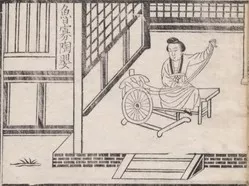
Illustration from Newly Compiled Biographies of Exemplary Women of Antiquity (Xinbian Gu Lienü Zhuan)
whvfw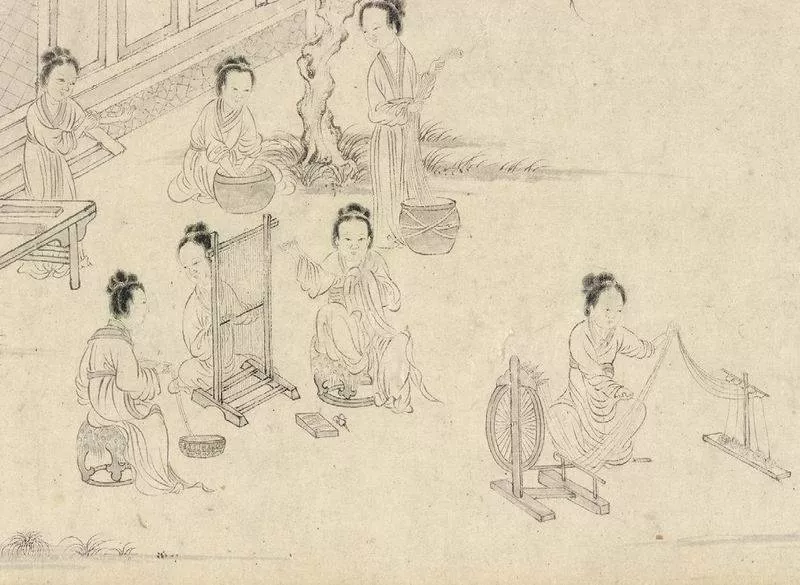
Spinning scene from July in the Bin Feng (Bin Feng Qiyue Tu)
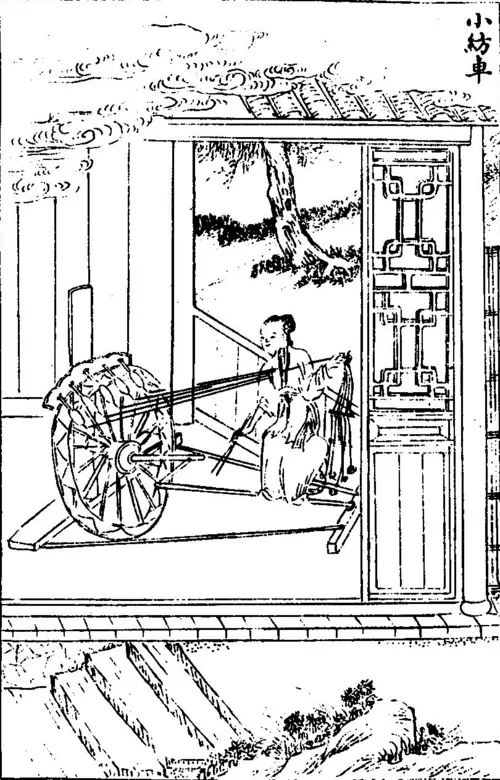
Wang Zhen’s Nongshu: Small Spinning Wheel
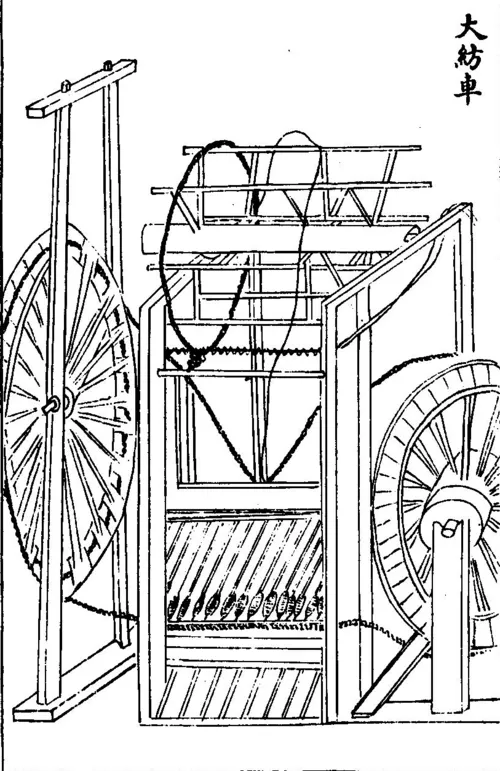
Wang Zhen’s Nongshu: Water-Powered Large Spinning Wheel
If one searches online for paintings related to spinning wheels, many more examples appear—for instance the anonymous Southern Song painting “Illustrations of the Classic of Filial Piety for Women” (Nü Xiaojing Tu) in the Palace Museum, and another “Illustrations of the Classic of Filial Piety for Women,” attributed to Ma Hezhi and now in the National Palace Museum in Taipei. Scenes in these paintings are usually interpreted as depicting plying rather than spinning. The device shown is therefore considered a spindle wheel, not a spinning wheel for producing yarn from loose fibers.
So what do these pictorial sources actually demonstrate? First, they help establish the approximate time when spinning wheels appeared. Wang Juzheng’s Spinning Wheel Painting indicates that spinning wheels already existed in China by the 11th century. Later paintings further confirm the presence of different types of spinning wheels. Second, the types of machines shown in these images allow us to estimate the rate at which spinning-wheel complexity evolved. Working backward from that progression, we can roughly infer a time range for the original appearance of the spinning wheel.
From the Spinning Wheel Painting, it is clear that the machine was already being used in a highly mature manner: in an ordinary rural household, an elderly person and a woman with a child operate it skillfully. This suggests that by the mid–Northern Song period, spinning wheels were probably already fairly widespread. Within the following two centuries, paintings begin to depict three-spindle, five-spindle, and even water-powered spinning wheels, indicating that spinning technology developed rapidly during the middle and late Song dynasty. If we extrapolate backward—allowing ourselves a little imagination—it is reasonable to suppose that spinning wheels had already appeared during the Tang dynasty, spreading gradually during the late Tang and the Five Dynasties period. It is quite possible that a primitive form of the spinning wheel existed already in the early or middle Tang period. On that basis, the invention of the Chinese spinning wheel can tentatively be placed around the 10th century. This timeframe is roughly comparable to (or even slightly earlier than) the estimated date for the invention of the spinning wheel in the Middle East. Such a comparison significantly increases the likelihood that the Chinese spinning wheel developed independently.
If the Chinese spinning wheel appeared earlier than those in the Middle East and India, does that mean the technology spread from China westward? The answer is still uncertain. At present there is no definitive evidence supporting such a transmission. Given that the approximate dates of appearance in the different regions are fairly close, the hypothesis that the technology spread from China to the West cannot be considered particularly strong.
In that case, should the claim that spinning wheels spread from India to China be rejected altogether? Not entirely. In a certain sense, Indian spinning wheels did indeed spread to China—but this again relates to the different categories of spinning wheels.
During the medieval period, India rapidly developed a large cotton textile industry, achieving highly advanced skills in cotton spinning. After adopting the spinning wheel, Indian artisans quickly modified it to suit cotton processing. In other words, India developed highly specialized cotton spinning wheels. During this period, India was the principal exporter of cotton textiles across Eurasia, while China gradually became one of the largest consumers of cotton cloth. Along with the trade in cotton textiles, India’s advanced cotton-spinning techniques—including cotton spinning wheels—spread into China.
In other words, the spinning wheel mentioned in some sources as spreading from India to China refers specifically to the cotton spinning wheel. One theory holds that Indian spinning technology—including cotton cultivation and spinning techniques—did not travel to China along the Silk Road. Instead, it first spread through Southeast Asia into southern China (sometimes called the “Cotton Road”) and then gradually moved northward into the Central Plains. The well-known story of Huang Daopo bringing cotton-spinning techniques back from Hainan Island reflects this transmission process.
This narrative has a certain dramatic quality, but its basic outline is largely correct. Cotton cultivation and cotton-spinning technology did indeed enter China from the south via Southeast Asia, rather than through the northern Silk Road. However, it seems more likely that both routes transmitted the technology. The spread of techniques is usually unconscious—like ants exploring multiple paths. Both routes may have carried cotton knowledge, but the northern route eventually failed because the local environment was unsuitable for cotton cultivation. Without cotton agriculture, cotton-spinning techniques could not take root there. Southern China, by contrast, was well suited to cotton cultivation, so once cotton arrived it developed into an agricultural system that preserved and expanded cotton-spinning technology. This interpretation remains speculative, but it is plausible. In any case, the transmission of cotton through Southeast Asia into southern China is well established. Whether Huang Daopo specifically brought back Indian spinning technology is uncertain, but the precise detail is not particularly important.
Structurally, Indian spinning wheels were actually quite similar to traditional Chinese wheels (which were primarily used for spinning flax). The main difference lay in the gear ratio: Indian spinning wheels had a much higher transmission ratio in order to increase the twist of cotton yarn. Cotton fibers are short and require more rapid twisting. The hardware differences were relatively small; the more important innovations lay in spinning technique. Cotton fibers are short while flax fibers are long, so cotton spinning requires more delicate control of drafting force and wheel speed. The Indian long-draw technique also influenced Chinese cotton-spinning methods to some degree. Indian spinning wheels helped Chinese spinners master the techniques required for spinning short-staple cotton. Beginning in the Ming dynasty, China rapidly became the second major center of cotton textile production and consumption.
After absorbing and adapting Indian spinning techniques, China developed distinctive indigenous spinning wheels. A notable example is the three-spindle treadle spinning wheel still preserved in Wunijing (Shanghai), which displays strong Chinese characteristics. The following video demonstrates how the traditional Chinese three-spindle spinning wheel is operated:
Interestingly, although five-spindle wheels appear in Southern Song paintings, after several centuries of development the wheels actually used in practice rarely exceeded three spindles. In my view this does not represent technological regression but rather practical optimization. At first glance it might seem that once a treadle drives the wheel, both hands are free to hold fiber, so more than three spindles should be possible. However, watching the demonstration clarifies the situation. The spinner holds three cotton slivers between the index, middle, ring, and little fingers of one hand—four fingers perfectly accommodating three strands—allowing three yarns to be spun simultaneously. The other hand holds a small stick used to press down the yarn, adjust the angle between the yarn and the spindle, and guide the winding onto the spindle. This explains why three spindles are practical: one hand with four fingers can manage three slivers.
One might ask: if the second hand did not hold the stick, could it not spin three more threads? In reality, it is not so simple. The second hand has another crucial function. Once the wheel is turning, the hand holding the fiber controls the amount and speed of fiber feed through finger pressure. But as can be seen in the video, the spinner occasionally uses the other hand to pull and adjust the cotton fibers, removing clumps and irregularities. Without this assistance the yarn would become uneven in thickness. Thus the second hand also contributes to maintaining uniform drafting (a motion that, as later developments will show, became extremely important in the invention of spinning machinery). For this reason, the three-spindle wheel is likely the optimal arrangement.
After hand spinning reached a mature stage, treadle spinning wheels appeared in many parts of the world. Only India continued to rely almost exclusively on the single-spindle hand-cranked wheel, which eventually became a national cultural symbol. The reason lies in the nature of Indian textile production. Indian cotton spinning emphasized extremely fine, high-quality yarns. The high-count cotton yarn produced there was famous throughout the world and served as the primary supply of fine cotton yarn before the British Industrial Revolution. The resulting cotton cloth—muslin—was so delicate that it was often described as “transparent,” representing the highest grade of cotton textile. Producing such yarn required precise coordination between drafting force, fiber feed, and spindle speed. A hand-cranked wheel allowed better two-handed coordination for achieving this control. A treadle mechanism was less responsive. Moreover, after drafting and twisting but before winding, the spindle often had to be briefly reversed to adjust the position of the yarn on the bobbin—something easier to accomplish with a hand-cranked wheel than with a treadle drive.
The spread of spinning wheels across the Western world was essentially isotropic, spreading in all directions. The technology moved through the Middle East, East Africa, and West Africa, eventually reaching Europe. Around the 13th century, the spinning wheel crossed the Alps into southern Germany, where it was mainly used for spinning wool and flax. This northward transmission brought about a fundamental transformation in spinning technology—although the consequences of that transformation would not become fully apparent until several centuries later.
Around the 1530s, a new type of spinning wheel appeared in Saxony in Germany. It became known as the Saxony wheel and spread widely after the 16th century. It was quite distinctive and looked roughly like this:
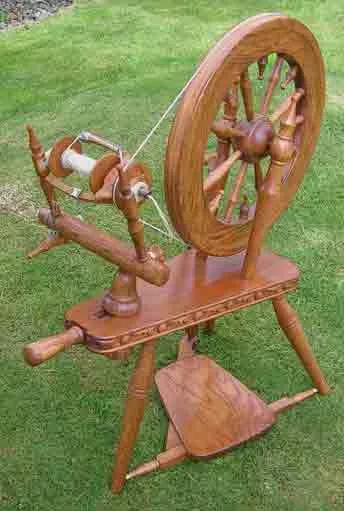
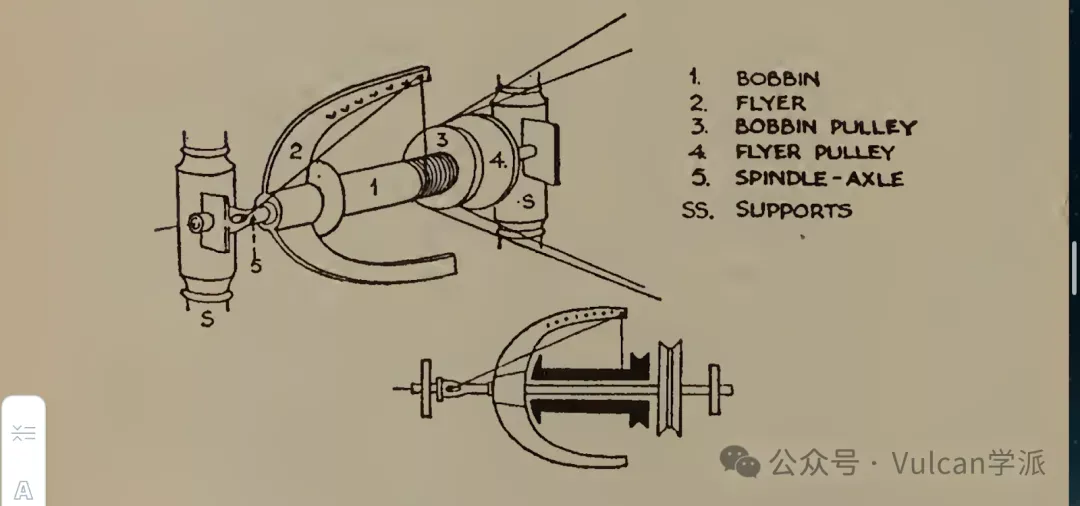
This is a treadle-driven spinning wheel; that aspect itself is not particularly unusual. The remarkable feature lies in its spindle assembly. Outside the spindle there is a U-shaped fork with holes or loops through which the yarn passes. This fork is called the flyer, while the spindle inside it is called the bobbin. The whole mechanism is known as the flyer-and-bobbin system.
The flyer and the bobbin share the same axis. The flyer rotates on the outside, while the bobbin rotates inside it. Two belts run from the drive wheel, one connected to the flyer shaft and the other to the bobbin shaft. When the drive wheel turns, it causes both the flyer and the bobbin to rotate simultaneously.
During spinning, the bundle of fiber is still held in the hand. The yarn passes through the holes or hooks on the flyer and is wound onto the bobbin. Once the large wheel begins turning, the spinner only needs to hold the roving and draw it out gently. As the flyer and bobbin rotate, the yarn is twisted while at the same time being wound onto the bobbin. The operations of twisting and winding, which previously had to be carried out as separate steps, are now combined. Continuous spinning becomes possible.
The key lies in the rotation of the flyer and the bobbin. Their rotational speeds are different. Typically, the speed ratio between the flyer and the bobbin is set at 8:6 (for reasons unknown to me, many sources do not simplify this ratio to 4:3). Because of this difference in rotational speed, the yarn twists around itself—this is how the twist is produced. Modern spinning machinery still relies on this same principle of twist generation.
The design of the Saxony wheel was a major innovation. It was not merely a new spinning tool; it effectively introduced an entirely new spinning process—continuous spinning technology. In doing so, it laid the foundation for modern spinning technology.
The flyer-and-bobbin system is a brilliant design—simple, ingenious, convenient, and practical. But where did it come from? Who invented it?
It was once believed that this design first appeared in Leonardo da Vinci’s manuscripts from around 1490. However, the prevailing view today is that Leonardo was not the original inventor. Rather, he improved an already existing flyer-and-bobbin mechanism by adding a feature for automatic and more uniform winding of the yarn—an idea that was clearly later adopted in spinning machinery.
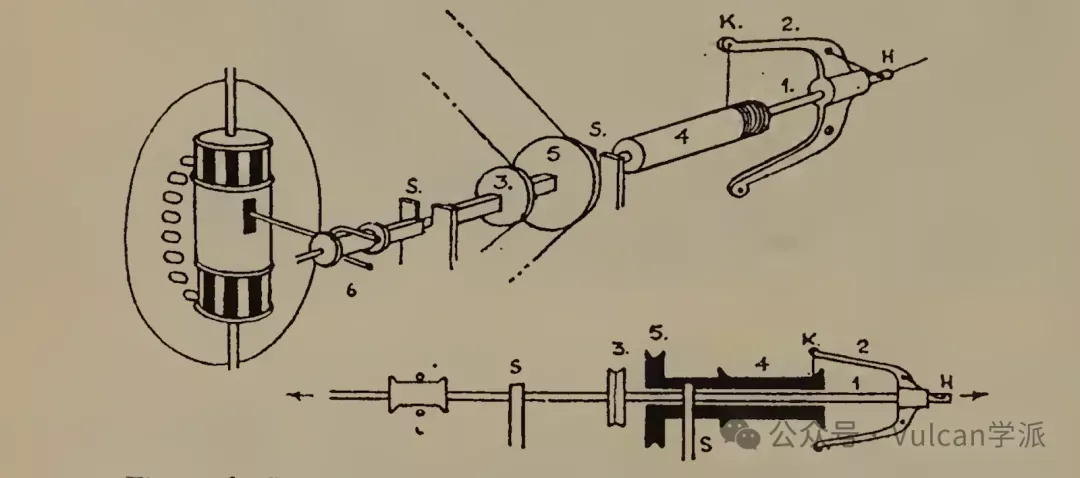
However, a manuscript known as Hausbuch von Schloss Wolfegg, produced in Germany in the 1470s–1480s, contains the earliest drawing of this design, depicted as part of a complete flax spinning wheel.
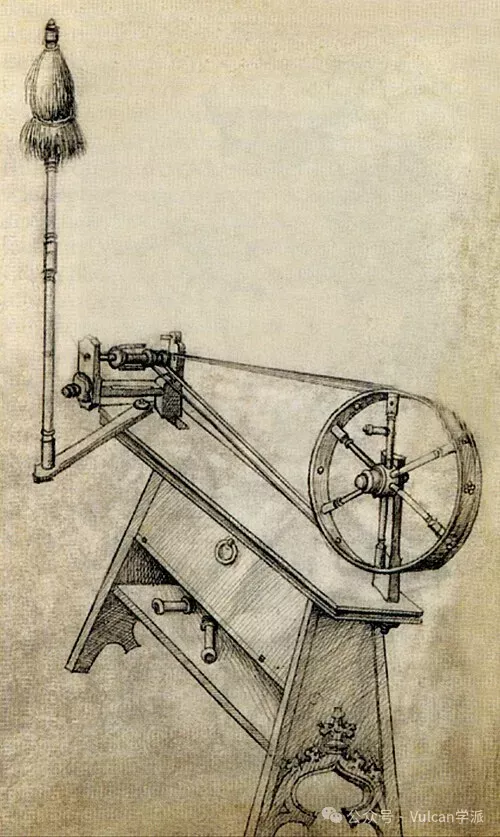
However, this only shows that the flyer-and-bobbin mechanism already existed before that period and had been used in practical spinning. Exactly who invented it remains unknown. In any case, it was a milestone invention. For the first time in history, the flyer-and-bobbin system made continuous spinning possible. Combined with treadle drive, it was easier to operate and offered higher productivity. Even today, many traditional textile enthusiasts in Western countries commonly use the Saxony wheel to spin yarn at home. Online videos showing spinning with a Saxony wheel are far more numerous than those featuring the large wheel, which is enough to demonstrate its advantages.
By this stage, all the principal types of hand-operated spinning machines had already appeared. After that, and until the Lombe brothers carried out their famous act of industrial espionage, hand spinning technology made no particularly notable advances. It is true that some people sensed the growing yarn shortage beginning in the late seventeenth century and devoted effort to improving spinning equipment. However, these attempts largely remained within the existing technological framework, amounting mostly to small modifications and incremental adjustments. As the seventeenth century progressed, deeper pressures began to accumulate within the spinning industry. Forces of change gradually gathered and rose to the surface. The once calm waters of spinning technology began to show bubbling currents beneath the surface.
COMMENTS (0)
Please Login to join the discussion.